Why pines near houses make people nervous
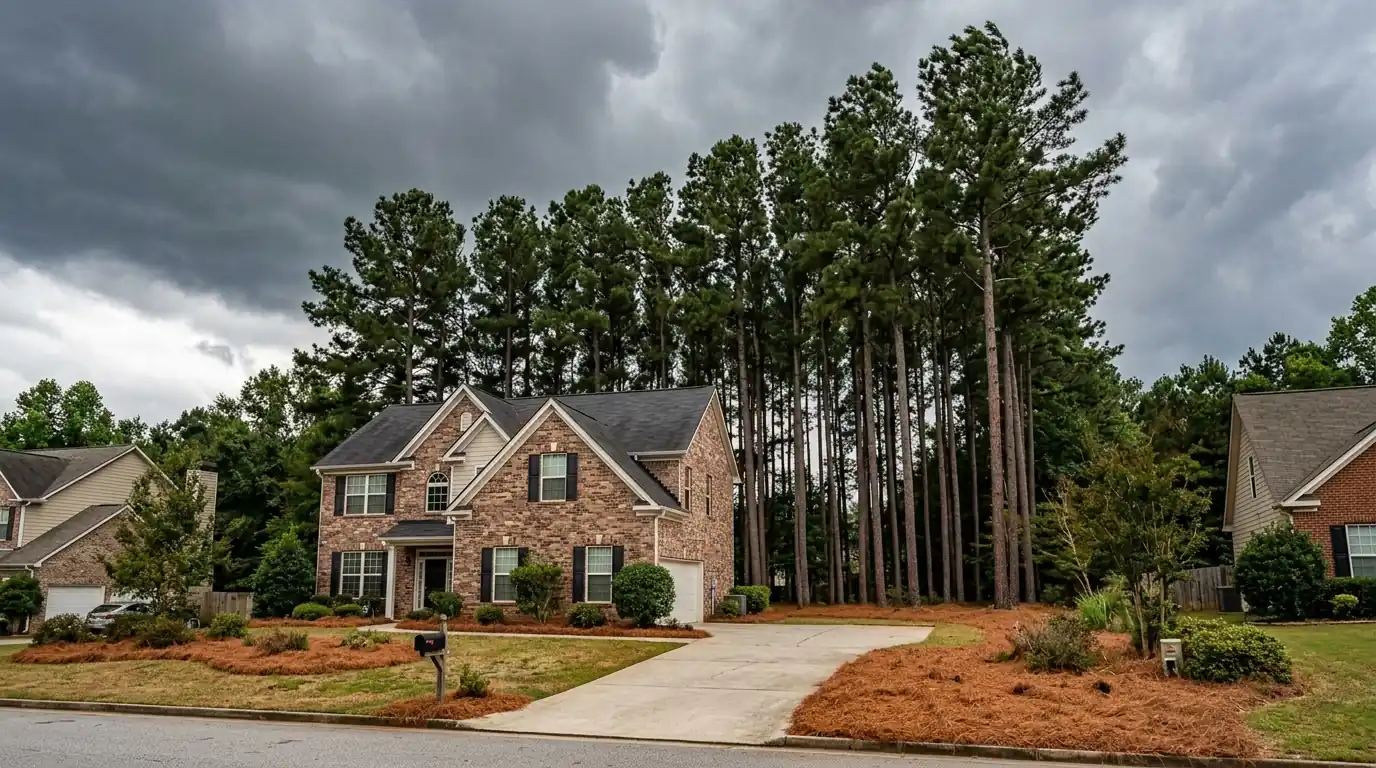
A mature loblolly can stand 80 to 100 feet tall with almost all of its foliage in a small crown at the very top. That shape catches wind high above the roofline, on a trunk that has few lower limbs to slow it down. When a pine sits 30 feet from a house, the house is well within its reach.
That doesn't make every tall pine dangerous. Pines that grew up together in a stand often lean on each other for wind protection, and many stand for decades near homes without trouble. The problem tends to start when something changes: neighboring trees are cleared, the soil gets saturated, the tree is stressed by drought, or beetles move in.
The three ways pines usually fail
Knowing how a pine is likely to fail tells you what to watch for. Most failures we clean up fall into one of three patterns.
Uprooting in saturated clay
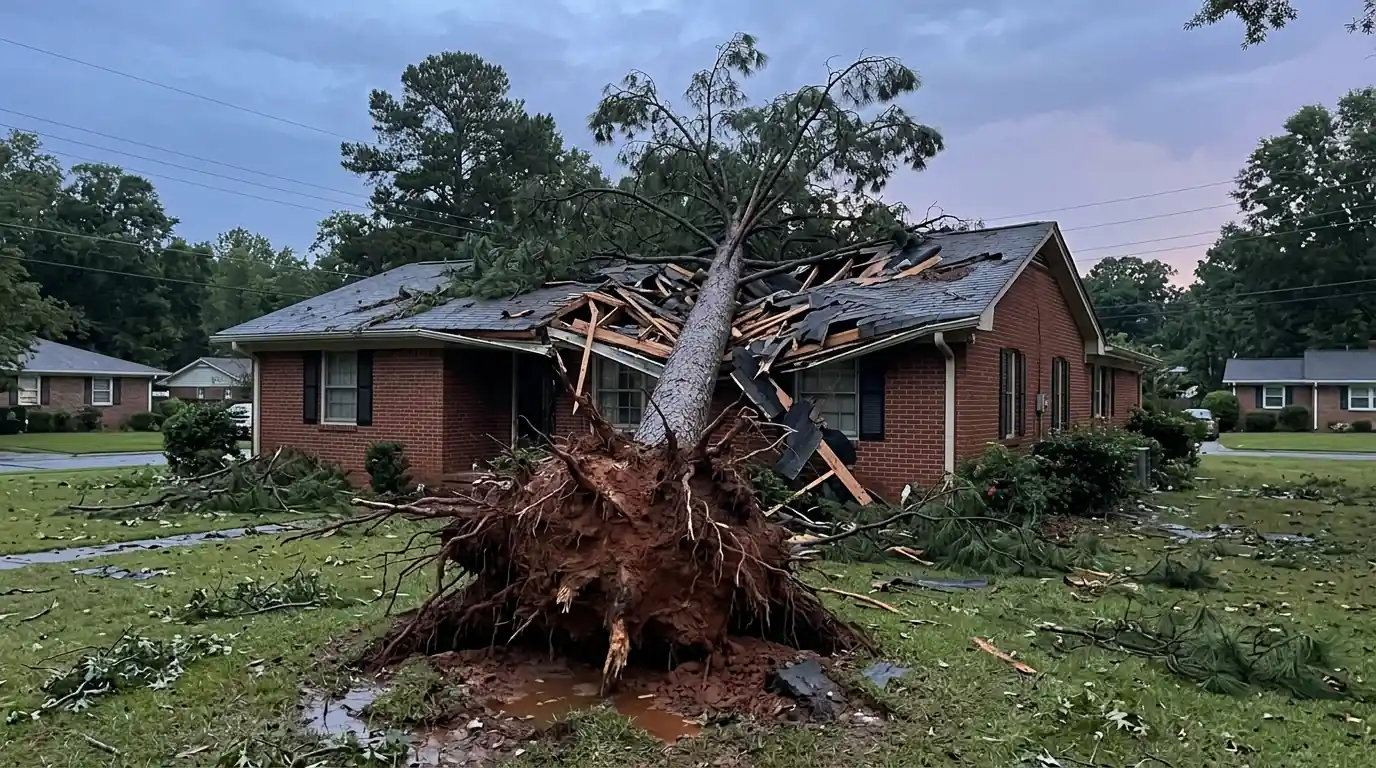
Georgia red clay holds water after long rains, and roots growing in it stay fairly shallow. When the soil is soaked, it loses its grip, and a strong gust can lever the whole root plate out of the ground. This is what happened across metro Atlanta on September 27, 2024, when Tropical Storm Helene soaked the ground and uprooted trees onto homes. A pine that topples this way often has a perfectly sound trunk.
Snapping in wind
Pines that have lost their neighbors to clearing are suddenly exposed to wind they never had to handle. A trunk with a hidden defect, an old lightning wound or decay at a branch stub can snap partway up. Snapped tops are especially common in pines with a heavy crown on a thin, tall stem.
Beetle kill
Southern pine beetles and Ips engraver beetles attack stressed pines, especially after drought. Watch for small resin globs called pitch tubes on the bark, fine reddish dust in bark crevices and at the base, and a crown that fades from green to yellow and then rust. A beetle-killed pine dries out and becomes brittle quickly, so it can drop its top or break apart within months.
What a healthy pine looks like
A healthy loblolly is fairly easy to read from the ground once you know what to look for. Compare your tree with these points, and pay most attention to anything that has changed since last year.
- A dense, dark green crown with needles holding through the growing season.
- Steady new growth at the branch tips each spring.
- A straight trunk, or a lean that has been the same for as long as you can remember.
- Firm bark with no pitch tubes, holes or fine dust in the crevices.
- Soil around the base that is flat and firm, with no cracking or mounding on one side.
- No fungal growth at the base and no soft or hollow-sounding wood when tapped.
Trimming pines: what it can and can't do
People often ask us to trim a tall pine so it will be safer in storms. In most cases trimming adds little. A loblolly sheds its own lower limbs as it grows, so the only live branches are in the crown at the top. Removing some of those does not change how the root plate behaves in soaked clay, and taking too much can stress the tree and invite beetles.
There are times when pine trimming makes sense. Dead limbs in the crown can fall and are worth removing, and so are broken branches hanging after a storm. A pine limb rubbing the roof or reaching over a skylight can be cut back. Cleaning dead wood out of a pine is real, useful work.
What we won't do is top a pine or strip it into a tall pole with a tuft of needles at the end. Topping a pine leaves it weaker and more likely to decay. Over-thinning the crown concentrates wind load on the few branches left. If the reason you want a pine trimmed is that you are afraid it will fall on the house, trimming is usually the wrong tool for that worry.
When removal is the better call
Removal makes sense when a pine is dead or dying, when beetles are active in it, when the lean has changed or the soil is heaving, or when a large defect such as a lightning scar or trunk crack is visible. It also makes sense when the targets are high: a bedroom, a deck where kids play, a carport or a neighbor's house.
Sometimes a healthy pine still makes sense to remove. Pines that were left standing alone after a lot was cleared, or the last tall tree after its neighbors came down, are more exposed than they were built to be. If you can't sleep during thunderstorms because of one tree, that's worth a conversation. We'll give you our honest read of the risk, and we'll say so if we think the tree is fine.
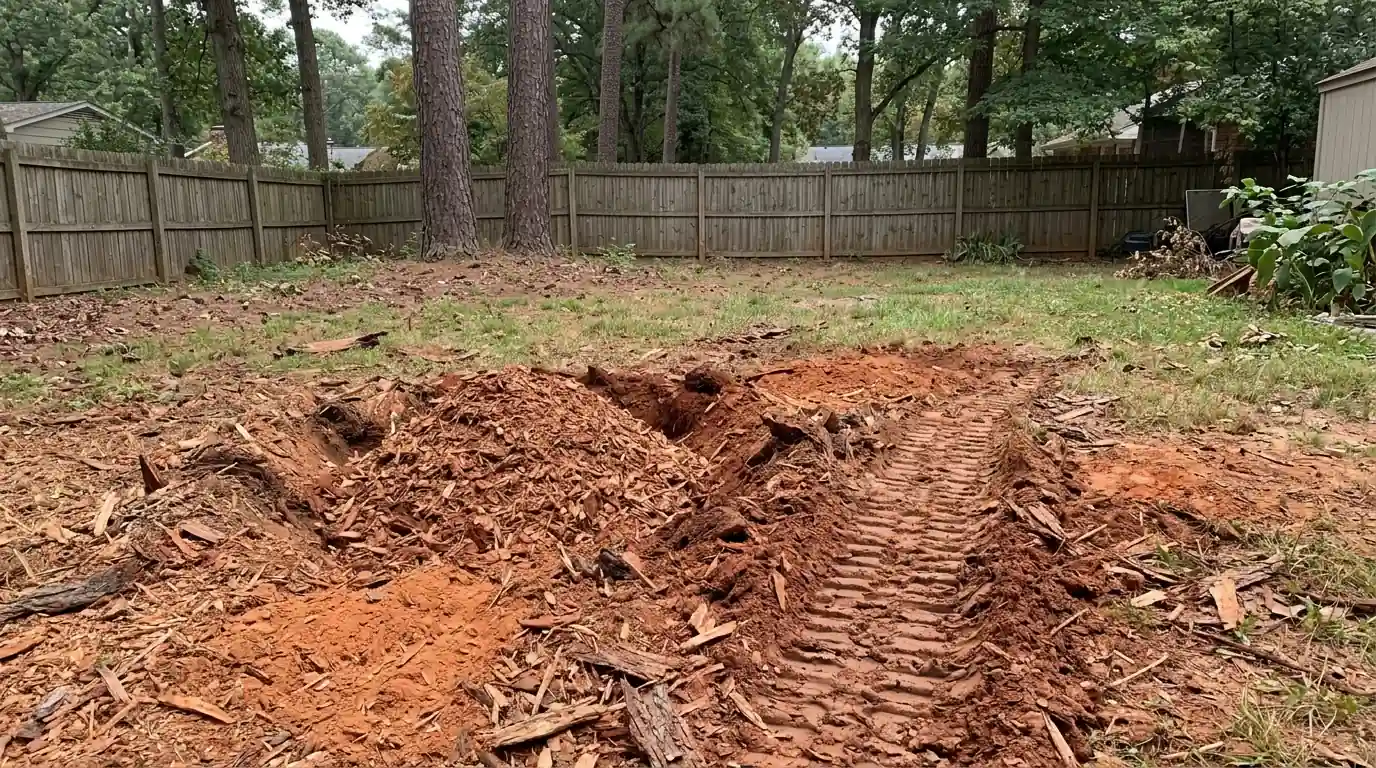
Taking down a tall pine near a house is usually a climb-and-lower job. Our climbers remove the crown in pieces, then bring the trunk down in rounds, since few intown or suburban lots have a clear lane longer than the tree. When the pine leans over the roof or the wood is too far gone to climb, a crane lift is often the safer route. Our pine removal service covers how that work is done.
Permits and the 12 inch pine rule
Inside Atlanta city limits, pines get a higher permit threshold than other trees. Removing a private-property pine needs a permit once the trunk reaches 12 inches in diameter at 4.5 feet above grade, compared with 6 inches for most other species. A dead, dying or hazardous pine still needs a permit, though the city charges no application fee and no replacement charge once it confirms the condition.
Outside the city, the rules vary. In unincorporated DeKalb, a pine of 30 inches or more counts as a specimen tree and needs a Notice of Tree Removal. Most homeowner removals on a developed lot in unincorporated Gwinnett need no permit, with exceptions for buffers and protected areas. Cities set their own rules. Our permit guide lays out each jurisdiction.
How we make the call on your pine
When we look at a pine near a house, we check the crown color and density, the bark for beetle signs, the trunk for wounds and decay, the root zone for heaving or rot, and the soil and drainage around it. We look at what the tree would hit, how exposed it is, and whether its neighbors are gone. Then we give you one of three answers: leave it alone, clean out the dead wood, or plan the removal.
If you're unsure about a pine, a tree risk check gets you that answer without pressure to remove anything. If a pine has already come down or is hung up against the house, our guide to the first hour walks you through what to do.
Key takeaways
- Tall pines usually fail by uprooting in soaked clay, snapping in wind or dying after beetle attacks.
- A healthy pine has a dense green crown, steady new growth, clean bark and firm soil at the base.
- Trimming a pine does little to reduce storm risk, though removing dead and broken limbs is worthwhile.
- Removal makes sense for dead, beetle-infested or newly leaning pines, and for exposed pines over high targets.
- Inside Atlanta, the pine permit threshold is 12 inches in diameter at 4.5 feet.