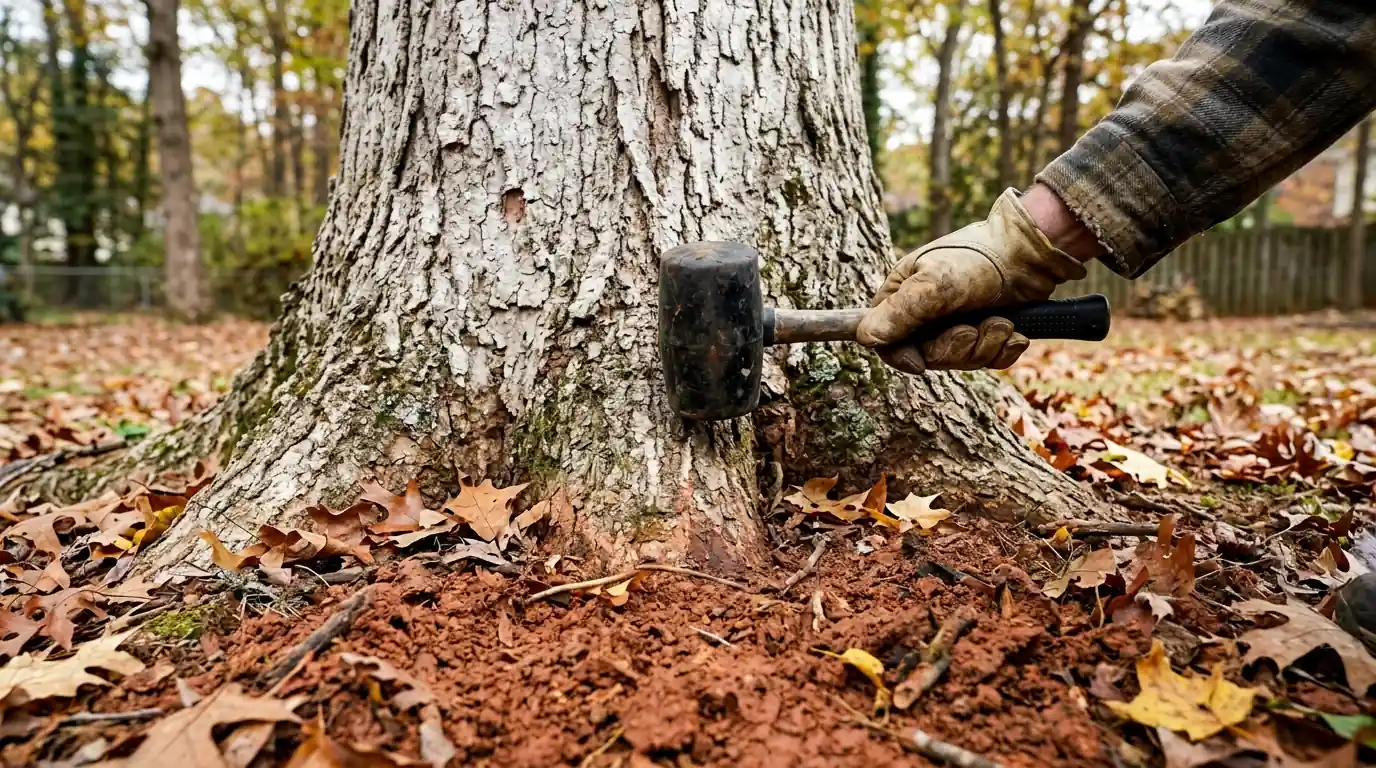
A tree risk assessment is an on-site inspection that weighs how likely a tree or limb is to fail against what it would hit if it did. We check the root flare, trunk, unions and crown, sound the wood with a mallet and probe soft spots, then write a short summary for each tree. Atlanta homeowners book one before buying a house, after a storm, before construction, or when a city needs a tree's condition documented.
What a tree risk assessment looks at, starting with what's underneath
Every assessment starts with what sits under the tree. A dead limb over a back fence line is a different problem from the same limb over a bedroom, a carport, a play set or the sidewalk where kids wait for the bus. We walk the property first and note each target, how often people are near it, and how far a falling trunk or limb could reach. That tells us which trees deserve the closest look and which ones can wait.
Then we work each tree from the ground up. At the base we look for a buried root flare, girdling roots, mushrooms, cracked or heaving soil and roots cut by old trenching. On the trunk we tap with a mallet, listening for the dull, hollow note of decayed wood, and push a steel probe into cavities and soft bark. Higher up we study the unions where stems split, the lean, and the crown for dead tops, hangers and thin foliage.
None of this is guesswork dressed up in jargon. The point is to separate a tree that looks rough but is sound from one that looks fine and isn't. Water oaks are the classic example in Atlanta: a full green crown can sit on a trunk that's hollow for the first ten feet, as our piece on why water oaks are failing explains. We'd rather find that on a calm afternoon than after a thunderstorm.
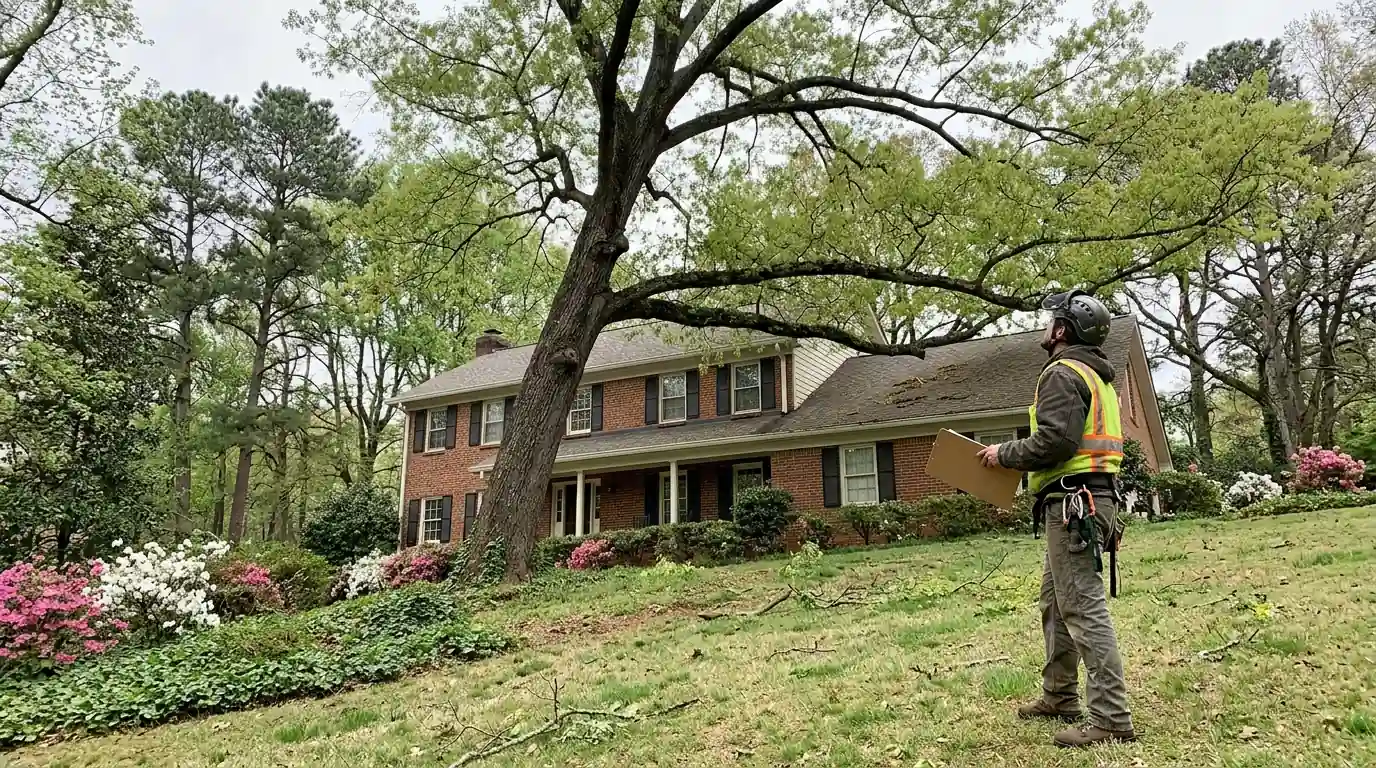
What we check on every tree we assess
These are the defects that most often separate a tree that can stay from one that needs work or removal.
Root flare and root plate
We look for a flare buried under mulch or fill, girdling roots, and soil that cracks or lifts on one side when the tree moves in wind.
Conks and mushrooms
Shelf fungi on the trunk or clusters of mushrooms at the base are the fruiting bodies of decay already working inside the wood.
Cavities and hollow sound
The mallet tells us where the wood rings solid and where it thuds, and the probe shows how deep an open cavity runs.
Cracks, seams and bulges
Vertical cracks, bark seams and swollen areas on the trunk mark wood that has split or is trying to close over an old wound.
Weak unions
Codominant stems with bark pinched between them, common on Bradford pears, maples and some oaks, are a frequent splitting point.
Lean and movement
We separate an old, stable lean from a new one by checking the far side for heaved soil, torn roots and fresh cracks.
Dead tops and hangers
Dead tops on oaks and pines, and broken limbs caught in the crown, are the pieces most likely to come down first.
When an assessment is worth booking
These are the moments when people most often ask us to come take a look.
- Before closing on a house with big oaks or pines over the roof, while you can still negotiate.
- After a thunderstorm, tropical storm or ice event, when limbs crack but don't fall.
- Before an addition, pool, driveway or sewer replacement cuts through the root zone.
- When a tree that has always leaned seems to lean a little more.
- When mushrooms, conks or sawdust show up at the base of a trunk.
- When a neighbor raises a concern about a tree near the property line.
- When a city wants a tree's condition documented before it will allow a removal.
How a risk assessment visit runs, start to finish
A visit follows the same order, whether we're looking at one tree or forty.
- 1
Tell us the worry
You show us the tree that keeps you up during storms, and we ask about recent changes, construction, drainage and anything that has already fallen.
- 2
Map the targets
We walk the lot and note the house, driveway, outbuildings, fences, play areas, the neighbor's roof and the street, and how often each is occupied.
- 3
Inspect from the ground up
Root flare, trunk, unions and crown get checked in that order, with mallet sounding and probing wherever the wood looks or sounds suspect.
- 4
Weigh likelihood against target
Each defect is judged by how likely it is to fail and what it would hit, which sets how urgent the fix really is.
- 5
Write the summary
You get a short written summary listing each tree, what we found, and whether it should stay, be pruned, be watched or come down.
- 6
Talk through the options
If work is needed, we explain the choices, from cutting out dead limbs to cabling a weak union to removal, and which jobs can wait.
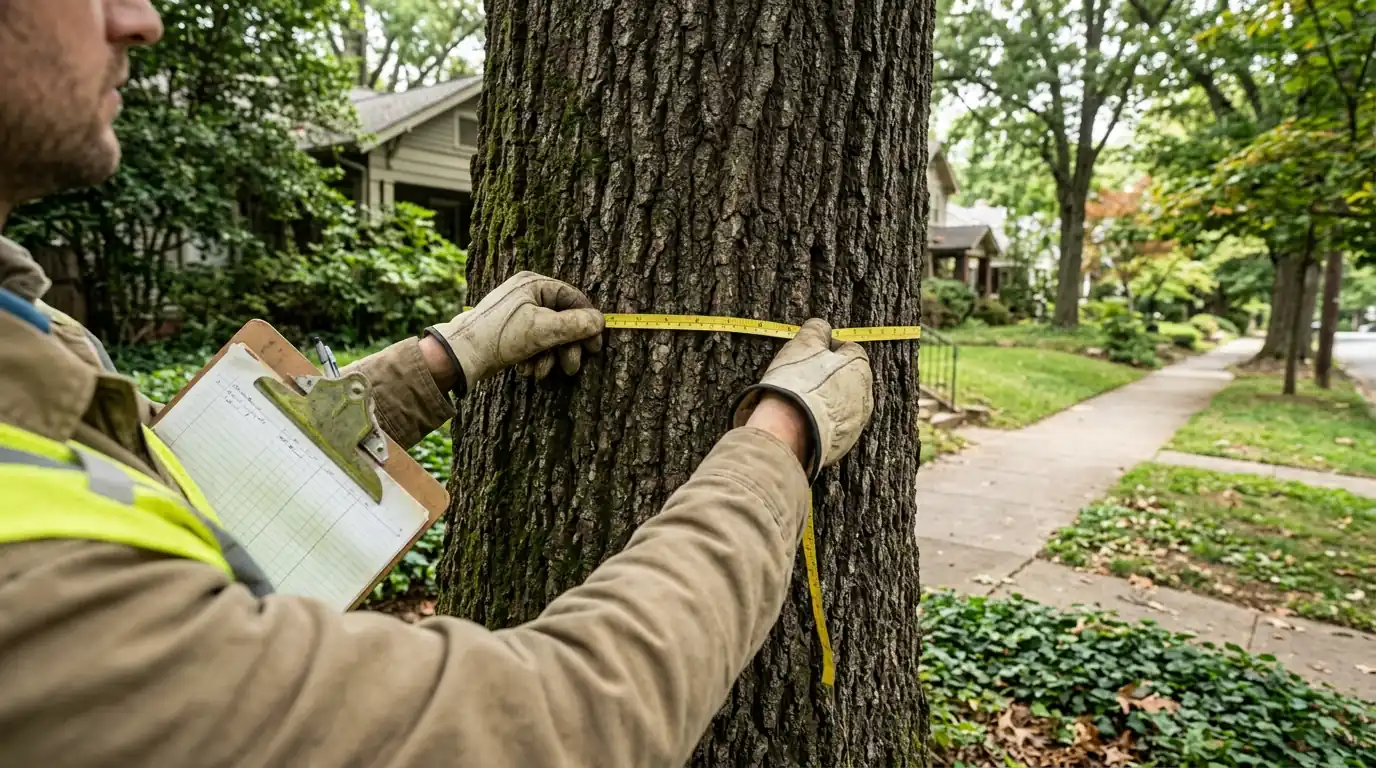
Atlanta trees and rules that make an assessment worth having
The trees we assess most around Atlanta are aging water oaks, tall loblolly pines and big southern red oaks planted or left standing when neighborhoods were built in the 1950s and 1960s. Water oaks often look full while heart rot hollows the trunk. Loblolly pines on Georgia red clay keep shallow roots, and after a long wet spell the whole root plate can tip. Since Tropical Storm Helene uprooted trees onto homes across the metro in September 2024, more people ask us to check the trees that rode it out.
Local rules shape what happens next. Inside Atlanta city limits, a dead, dying or hazardous tree still needs a permit from the Arborist Division, but there's no application fee and the city inspects to verify the condition. In Decatur, a hazard tree needs a permit when a certified arborist's risk report places it at moderate risk or higher, and that report goes in with the application. That's the city's own requirement. In Brookhaven, even a dead or hazardous tree 4 inches or larger needs the city arborist's approval. We hear these questions constantly in Druid Hills, where old canopy trees stand over almost every house.
Keep, prune, support or remove: how the findings sort out
Most trees on a lot land in one of three outcomes once the inspection is done.
| Keep and watch | Prune or support | Remove | |
|---|---|---|---|
| What we found | Minor defects, sound wood, a low-use target | A weak union, dead limbs or a heavy end over a target | Extensive decay, root plate movement or a dying crown |
| Typical next step | Look again in a year or after a big storm | Pruning, crown reduction or a cable | Removal, with permit work where the city requires it |
| Urgency | Low | Months, not years | Soon, sometimes right away |
What moves the price of a tree risk assessment
| Job | Typical range | Priced |
|---|---|---|
| On-site risk assessment | $165 to $385 | per visit |
The number of trees and the size of the lot drive most of the cost. A single oak in a small intown backyard is a short visit. A wooded acre with forty pines and hardwoods takes much longer to walk, inspect and write up, especially when several of those trees stand over the house. Steep ground, thick understory and trees spread across a long property line slow the walk too.
The visit and the written summary are priced together. Any pruning, cabling or hazard tree removal the summary recommends is quoted separately, and you're free to take the summary, get other opinions and decide later. Typical ranges for that follow-up work, tree by tree, are on our price guide.
Where we do tree risk assessment around Atlanta
Crews work from our Atlanta office near the 30340 ZIP and our Duluth office. These are the places we cover most, with their main ZIP codes. See all 56 areas.
- Buckhead 30305
- Virginia-Highland 30306
- Druid Hills 30307
- Morningside 30324
- Grant Park 30312
- Kirkwood 30317
- Cascade Heights 30311
- Sandy Springs 30328
- Dunwoody 30338
- Brookhaven 30319
- Decatur 30030
- Duluth 30096
- Lawrenceville 30046
- Marietta 30060
- Smyrna 30080
- Roswell 30075
- Alpharetta 30009
- Johns Creek 30097