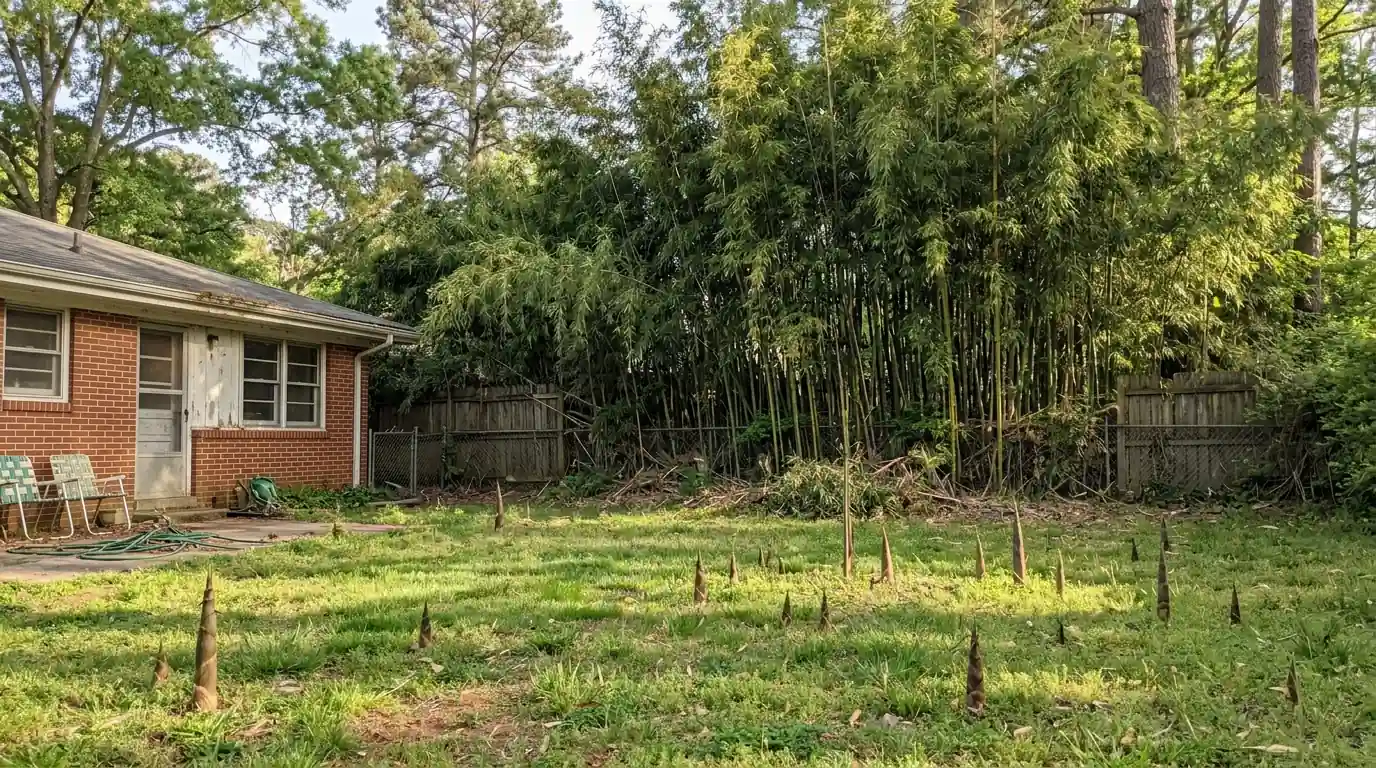
Bamboo removal means cutting down a bamboo stand, then grinding or digging out the underground rhizome mat that feeds it, and often setting a root barrier along a property line. You need it when running bamboo spreads into lawns, beds, foundations or a neighbor's yard. It's common in older Atlanta neighborhoods where groves were planted decades ago, and lasting removal almost always takes follow-up visits.
Running bamboo versus clumping bamboo
Bamboo comes in two broad habits, and knowing which one you have changes the whole plan. Running bamboo spreads by long underground stems called rhizomes that travel sideways several feet in a season, then send up new canes far from the original grove. That is the kind that crosses fence lines and pops up in the middle of a lawn.
Clumping bamboo grows in a tight, slowly widening clump, with new canes rising close to the old ones. It can get big and dense, but it doesn't wander across the yard, and it is usually managed by thinning out old canes and trimming back the edge of the clump rather than by full removal of the plant.
Most of the bamboo we remove in metro Atlanta is running bamboo. It was planted as a quick screen or a curiosity decades ago, often by a previous owner, and has been spreading quietly ever since. By the time the call comes, the rhizome mat under a grove can be dense enough to lift a shovel.
Why mowing and spraying alone rarely win
Running bamboo stores most of its energy in the rhizome mat, not in the canes. Cut the canes, mow the shoots or spray the leaves, and the rhizomes simply send up more. It can work in time, but only with persistent, repeated effort across several seasons, and most people run out of patience long before the bamboo runs out of energy.
Spraying a large grove is also hard to do well. The canes are tall, the leaves are thick, and drift onto lawns, shrubs and a neighbor's garden is a real risk. Herbicides that reach the rhizomes need to be applied carefully and repeatedly to regrowth, and they still leave the root mass in the ground.
Removing the rhizomes is what changes the outcome. Once the mat is out, what's left is scattered pieces that can be handled with regular follow-up, rather than a living network feeding the whole grove. That is why our bamboo work spends far more time below the soil line than above it, and why the grinder or excavator matters more than the saw.
Root barriers and a neighbor's bamboo
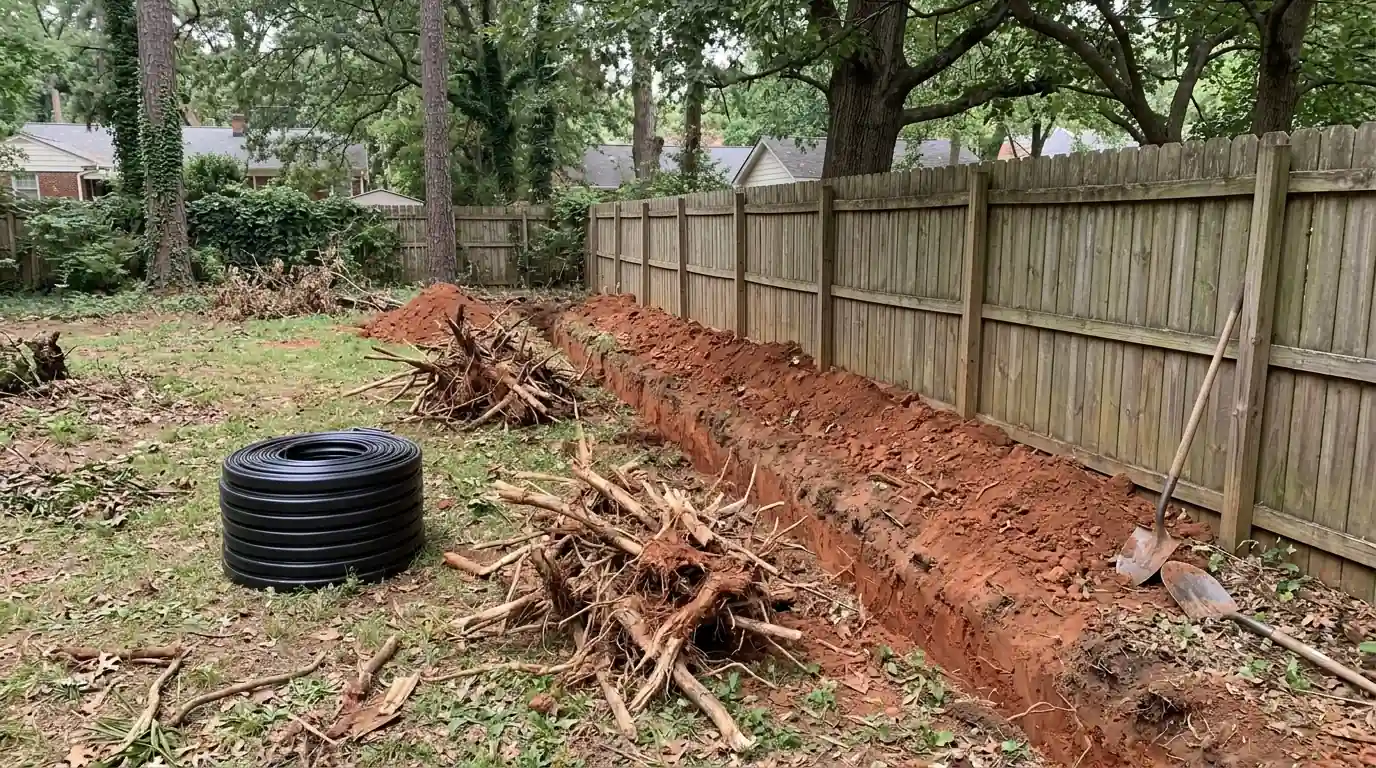
When the grove is on the other side of the fence, you can't remove the source, but you can stop it at the line. A root barrier is a thick plastic sheet set vertically in a trench, deep enough that the rhizomes turn instead of diving under it. The top edge stays slightly above the soil so rhizomes can't cross over the top, and the seams are sealed.
Barriers work well when they go in right after the rhizomes on your side are cleared. They need checking every year or two, since a rhizome that finds a gap or rides over the top will spread again. Talking with your neighbor first often helps, and sometimes leads to removing the grove on both sides at once.
Bamboo problems we see most
Running bamboo rarely stays where it was planted, and most calls come once it reaches something people care about.
Shoots in the lawn
New canes come up through grass several feet from the grove each spring, and mowing them only hides the rhizomes underneath.
Crossing a property line
A neighbor's grove sends rhizomes under the fence, or yours is heading into theirs, which is often what starts the conversation.
Against the house
Rhizomes push along foundations, under walks and into crawlspace vents, and canes rub siding and gutters.
Taking over beds
Garden beds and shrub borders disappear under bamboo that spread from a corner planting.
Choking out trees
Dense groves crowd and shade young trees and make it hard to reach or care for the larger ones.
Old, dying groves
Neglected groves fill with dead canes and debris, becoming a fire, pest and eyesore problem as well as a spreading one.
How we remove a running bamboo stand
Removal happens in stages, starting above ground and ending with follow-up visits.
- 1
Find the edges
We trace how far the rhizomes have run, which is usually well past the visible grove, and file a Georgia 811 locate.
- 2
Cut the canes
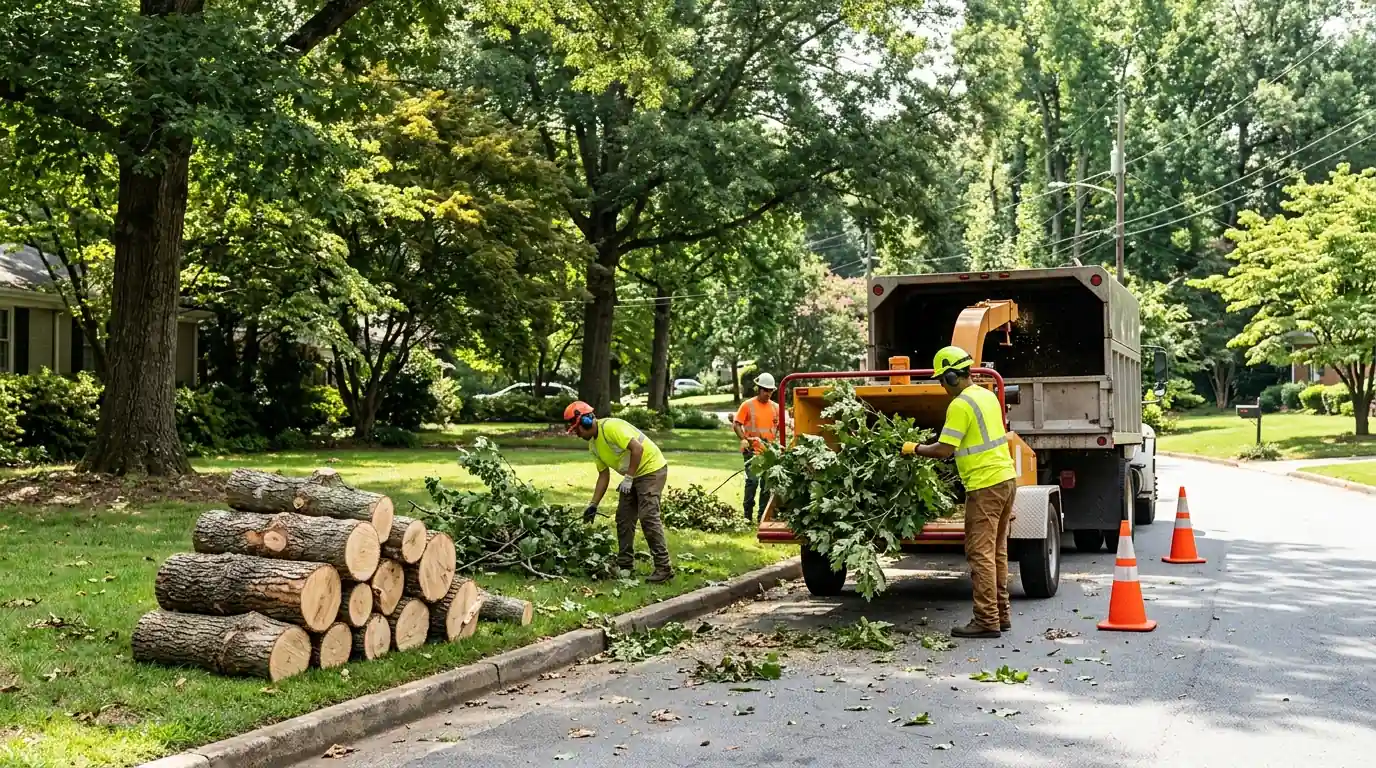
Every cane is cut at the base, then chipped or hauled, which clears the ground for the real work.
- 3
Grind or dig the mat
The rhizome mat is ground out with a stump grinder or dug with a mini excavator, depending on access and nearby lines.
- 4
Rake out the pieces
Loose rhizome pieces are raked and sifted from the soil, since any piece with a node can sprout.
- 5
Set a barrier
Where bamboo is coming from a neighbor or must stay on one side, a root barrier goes in along the line.
- 6
Follow up on shoots
We come back in the next growing season to dig or cut new shoots before they establish.
Keeping bamboo from returning after removal
The first year after removal decides whether the bamboo comes back, so these habits matter.
- Walk the cleared area every week or two in spring, when new shoots come up fastest.
- Dig out new shoots with a bit of rhizome attached, rather than snapping them off at the soil.
- Mow over shoots in lawn areas regularly, which starves small rhizome pieces left behind.
- Check the top edge of any root barrier each year for rhizomes riding over it.
- Keep mulch and soil from piling against the barrier, where they give rhizomes a bridge.
- Don't replant bamboo pieces or compost rhizomes, since a single node can start a new grove.
- Book the follow-up visit in the plan, especially for large or long-established groves.
What moves the price of bamboo removal
| Job | Typical range | Priced |
|---|---|---|
| Running bamboo stand | $1,240 to $6,800 | per stand |
The size of the stand and the density of the rhizome mat drive most of the price, along with how far the rhizomes have spread beyond the canes. Access matters too: a grove next to a foundation, a fence or a buried line needs more hand digging than one in open lawn, and wet red clay slows both digging and grinding.
Barriers are priced by length and depth, and follow-up visits are usually scheduled as part of the plan, since a stand that's cut and ground but never checked again tends to come back. Hauling canes and rhizomes is included. Our price guide has typical ranges, and many bamboo jobs also include grinding nearby stumps at the same visit.
Running bamboo in older Atlanta neighborhoods
Running bamboo is one of the invasive plants found across metro Atlanta yards, along with English ivy, kudzu, Chinese wisteria and Chinese privet. It turns up most in older neighborhoods where groves were planted as screens decades ago, on lots with shared back fence lines and long, narrow backyards. In Grant Park and Morningside it often runs along back fences behind older homes.
In Chamblee and Smyrna, it's often found in the backyards of mid-century ranches, sometimes spread across several lots. Georgia red clay holds rhizomes close to the surface, which helps when grinding but makes digging slow when the clay is wet. For overgrowth beyond the bamboo, our clearing crews can open up the rest of the yard.
Where we do bamboo removal around Atlanta
Crews work from our Atlanta office near the 30340 ZIP and our Duluth office. These are the places we cover most, with their main ZIP codes. See all 56 areas.
- Buckhead 30305
- Virginia-Highland 30306
- Druid Hills 30307
- Morningside 30324
- Grant Park 30312
- Kirkwood 30317
- Cascade Heights 30311
- Sandy Springs 30328
- Dunwoody 30338
- Brookhaven 30319
- Decatur 30030
- Duluth 30096
- Lawrenceville 30046
- Marietta 30060
- Smyrna 30080
- Roswell 30075
- Alpharetta 30009
- Johns Creek 30097