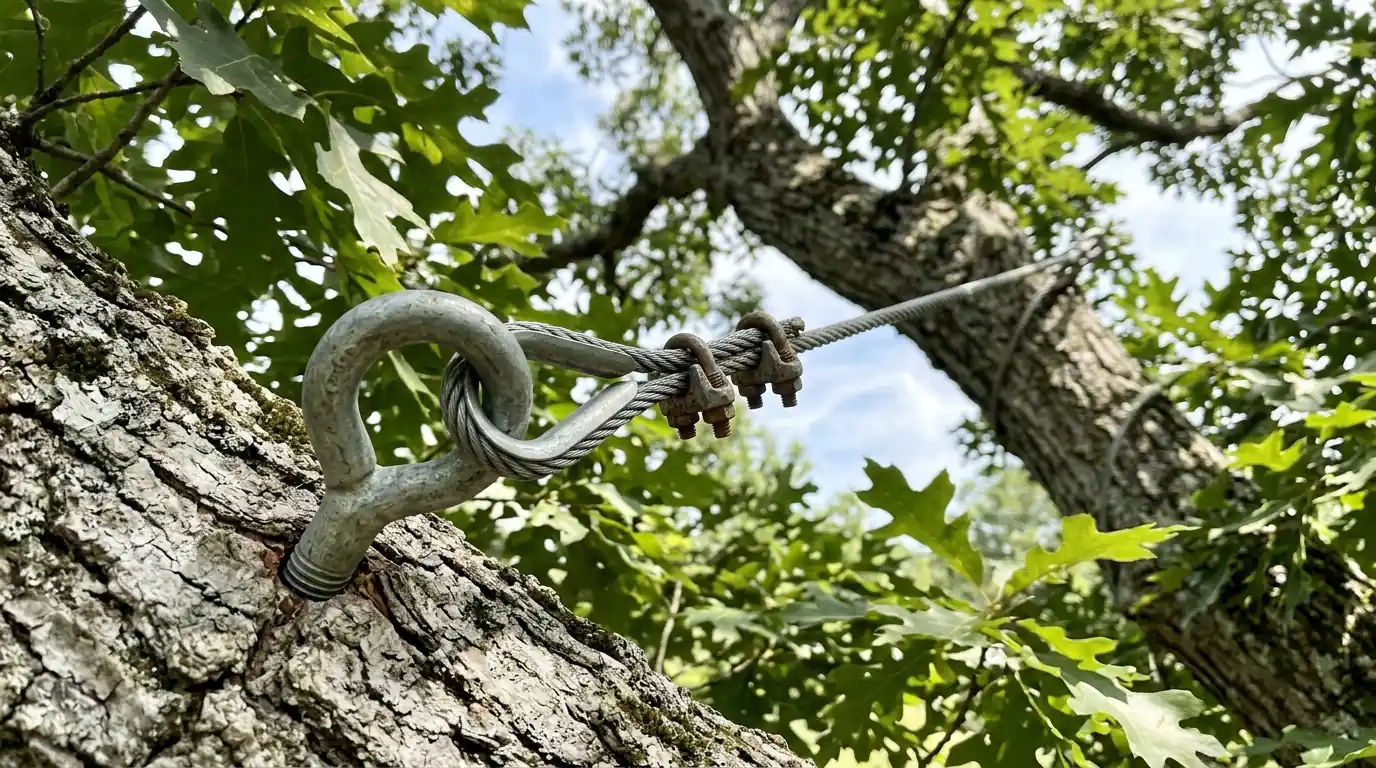
Tree cabling and bracing means installing steel or synthetic cables high in the crown between leaders, and threaded rods through split or weak unions lower down, to limit how far those parts can move. It suits valuable trees with codominant stems, included bark or an early crack. It doesn't fix decay or a dying tree, and every system needs a look every year or two. In Atlanta it's most often used on big oaks over houses.
What cabling and bracing actually do for a tree
A tree's weakest point is often a union, the spot where the trunk splits into two or more stems of similar size. When two stems grow up tight together, bark gets trapped between them instead of wood, and that included bark acts like a wedge. Each storm flexes the stems a little further apart. Eventually the union cracks, and one half of the tree lands on whatever sits below it.
Cabling limits that movement. We install a cable high in the crown, usually about two thirds of the way from the union to the tops of the leaders, so a gust can't spread the stems far enough to tear the union. Steel cable is anchored through the wood with hardware sized to the limbs. Synthetic systems wrap around the stems without drilling and allow a little more give.
Bracing works lower. A threaded steel rod goes through a split or weak union and is tightened with washers and nuts, holding the two sides together the way a bolt holds a split beam. Rods and cables often go in together: the rod keeps the union from spreading, and the cable above takes the load off it.
Support, not a cure, and why inspections matter
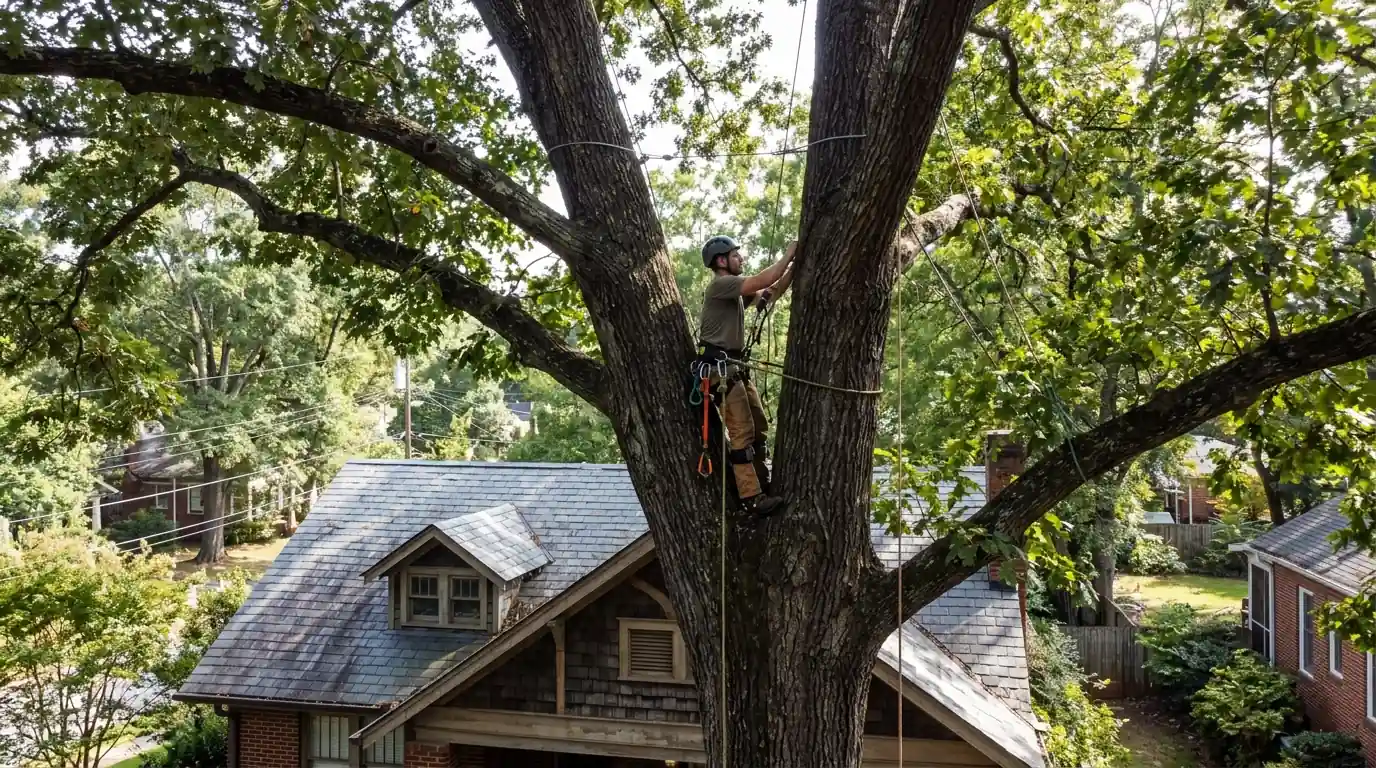
A cable doesn't heal a weak union or make a cracked tree whole again. It lowers the odds that the weak spot fails in wind, and it buys the tree time to keep adding wood around the union. Trees with good systems can stand safely for many years, but only if someone keeps an eye on them.
Hardware wears and trees grow. Bark can start to swallow an anchor, a cable can go slack as the leaders thicken, and a storm can stretch or fray a line. We check the tension, the hardware, the wood around each anchor and the union itself every year or two, and after any major storm. Folding those checks into a care plan keeps them from slipping. If a later inspection shows decay spreading, we'll tell you it's time to rethink the tree.
When cabling and bracing can save a tree
These are the situations where support usually makes sense on a tree that's otherwise healthy.
Codominant stems
Two leaders of equal size rising from one fork, a pattern common on red maples, tulip poplars and many oaks.
Included bark
A tight V-shaped union with bark pinched in the seam, which holds far less load than a wide, wood-filled U-shaped one.
A crack caught early
A fresh split in a union that hasn't opened wide or started to decay can often be bolted and supported.
A heavy leader over a target
A long, heavy stem reaching over the roof, a deck or the driveway can be tied back to the rest of the crown.
Storm damage on a sound tree
A healthy oak that lost one stem in a storm may need support for the stems left carrying an uneven load.
A specimen tree you can't replace
An old white oak or a heritage pecan that shades the whole lot is often worth supporting rather than losing.
How a cabling and bracing job runs
Every system is planned around the tree in front of us, but the steps stay the same.
- 1
Inspect the union
We look closely at the fork, the crack if there is one, and the trunk and roots below, using the same checks as a risk assessment.
- 2
Decide if support fits
If decay or root problems make the tree a poor candidate, we say so and talk about other options instead.
- 3
Lighten the load
Most cabled trees also get end-weight reduction on the leaders, so the cable isn't the only thing holding them.
- 4
Set the hardware
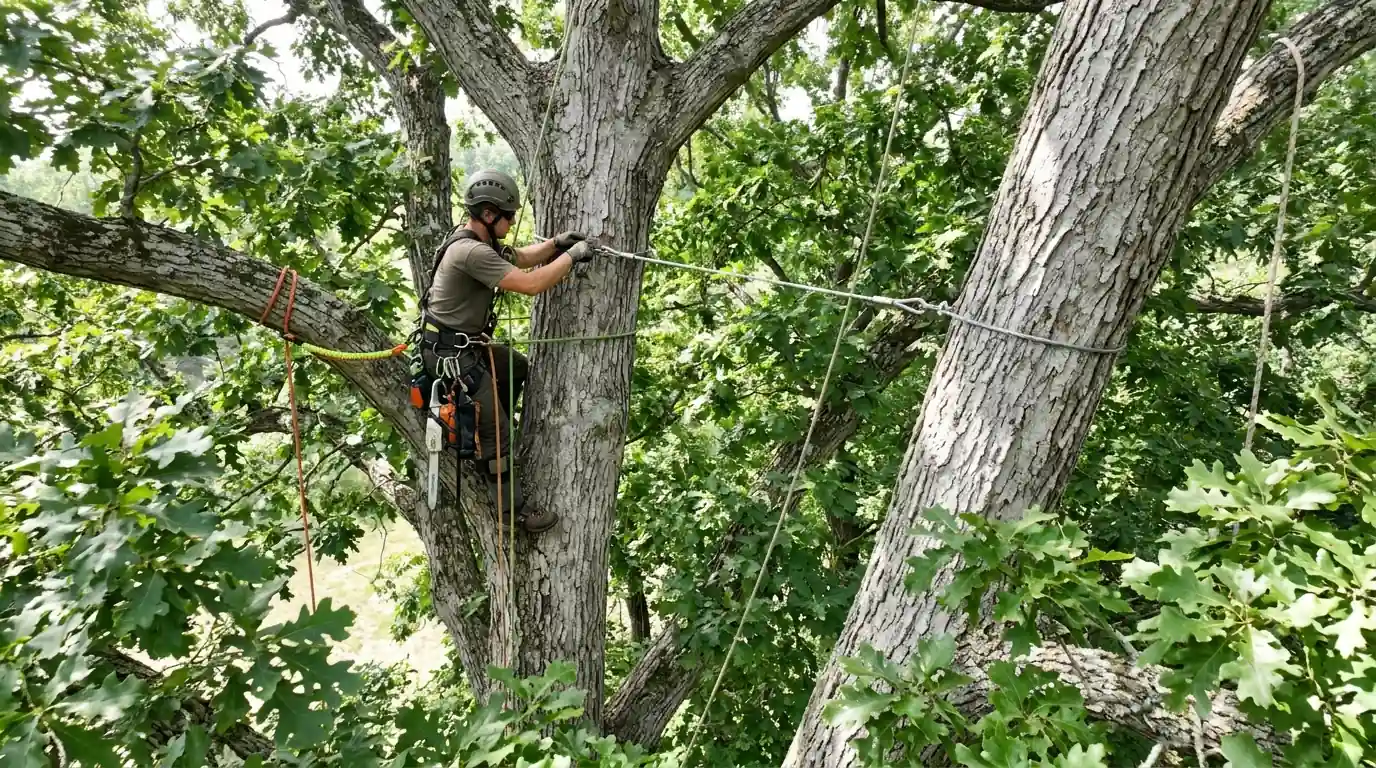
A climber installs cables high in the crown and rods through the union, sized to the diameter of the stems they support.
- 5
Tension it right
Cables are snugged so they take up slack without pulling the leaders together, which lets the tree keep moving and building wood.
- 6
Schedule the next look
We note the date and hardware, and plan an inspection every year or two to check tension, wear and the wood around the anchors.
Atlanta trees that most often need cabling and bracing
The trees we cable most around Atlanta are big oaks with two or three main stems rising from one fork, often planted close to the house when neighborhoods were young. In Ansley Park and Tuxedo Park, where century-old oaks shade grand homes and replacing that canopy would take a lifetime, owners often choose support over removal for a codominant oak with sound wood. Tulip poplars, red maples and pecans also grow tight forks that respond well to cabling caught early.
Bradford and Callery pears are the exception. Their weak V-crotches split so often that cabling rarely pays off, and they're usually better replaced. Water oaks with heart rot in the trunk aren't good candidates either, because anchors need sound wood. Inside Atlanta city limits, pruning on private property needs no permit, but the city's pruning standards still apply, so the end-weight cuts that go with a cable are made to those standards.
When cabling helps and when it doesn't
Support is a good tool on the right tree and a waste of money on the wrong one.
| Cabling makes sense | Cabling won't help | |
|---|---|---|
| Wood condition | Sound wood at the union and anchor points | Decay, cavities or conks at the union or in the trunk |
| Crack | Small, recent, not yet decayed | Wide open, old, or running down into the trunk |
| Tree health | Full crown, good growth | Dying crown, root rot or a root plate lifting |
| Root situation | Roots intact and stable | A lean that is getting worse, with soil heaving |
| Value | A specimen tree that shades the house or yard | A tree you'd remove anyway within a few years |
What moves the price of tree cabling and bracing
| Job | Typical range | Priced |
|---|---|---|
| Cable and brace system | $425 to $1,780 | per tree |
The size of the tree and the number of supports drive most of the cost. A single cable between two leaders on a medium oak is a short climb. A big tree with three or four leaders may need several cables in a pattern plus a rod through a cracked union, and each one takes climbing time and heavier hardware. Height, access and whether we can reach the crown from a lift also matter.
The end-weight pruning that usually goes with a cable is priced with the job, so you see the full scope before we climb. Follow-up inspections are a separate, smaller visit, and adjusting or replacing worn hardware later is quoted when we find it. Typical ranges for cable and brace systems are on our tree service price guide.
Where we do tree cabling and bracing around Atlanta
Crews work from our Atlanta office near the 30340 ZIP and our Duluth office. These are the places we cover most, with their main ZIP codes. See all 56 areas.
- Buckhead 30305
- Virginia-Highland 30306
- Druid Hills 30307
- Morningside 30324
- Grant Park 30312
- Kirkwood 30317
- Cascade Heights 30311
- Sandy Springs 30328
- Dunwoody 30338
- Brookhaven 30319
- Decatur 30030
- Duluth 30096
- Lawrenceville 30046
- Marietta 30060
- Smyrna 30080
- Roswell 30075
- Alpharetta 30009
- Johns Creek 30097