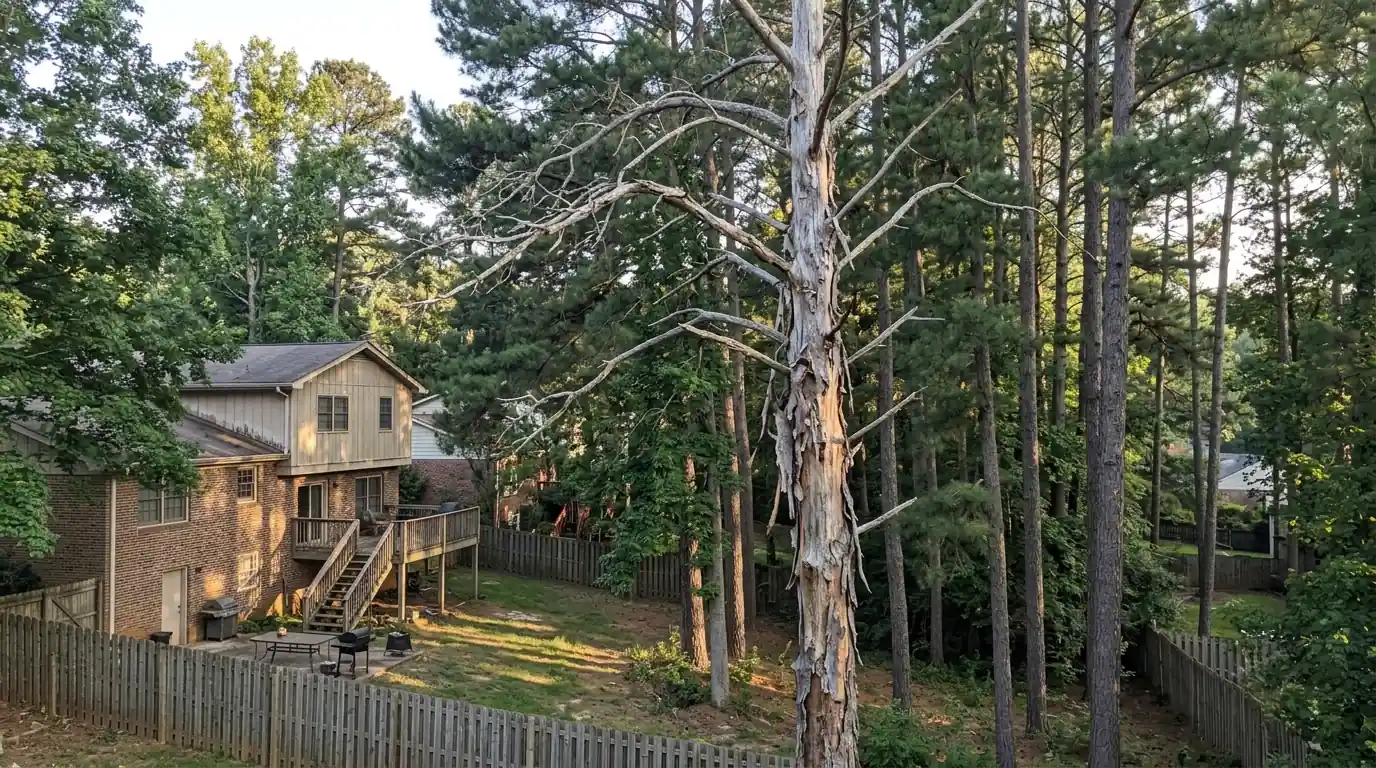
Dead tree removal is taking down a tree that has stopped living, before the dry, brittle wood starts dropping limbs or the trunk snaps. Pines killed by bark beetles dry out within months, while dead oaks stand longer but shed heavy limbs. Inside Atlanta city limits, a dead tree still needs a permit, with no application fee and a city inspection. Decatur and DeKalb ask for photos or documentation instead.
Why a dead tree gets harder to remove every month
Living wood bends. Dead wood breaks. While a tree is alive, the water in its fibers lets limbs flex under a climber's weight or a rope's pull and spring back. After it dies, the wood dries out and checks, then fungi move in and soften it from the inside. A limb that would have held a rigging load last spring may snap this fall.
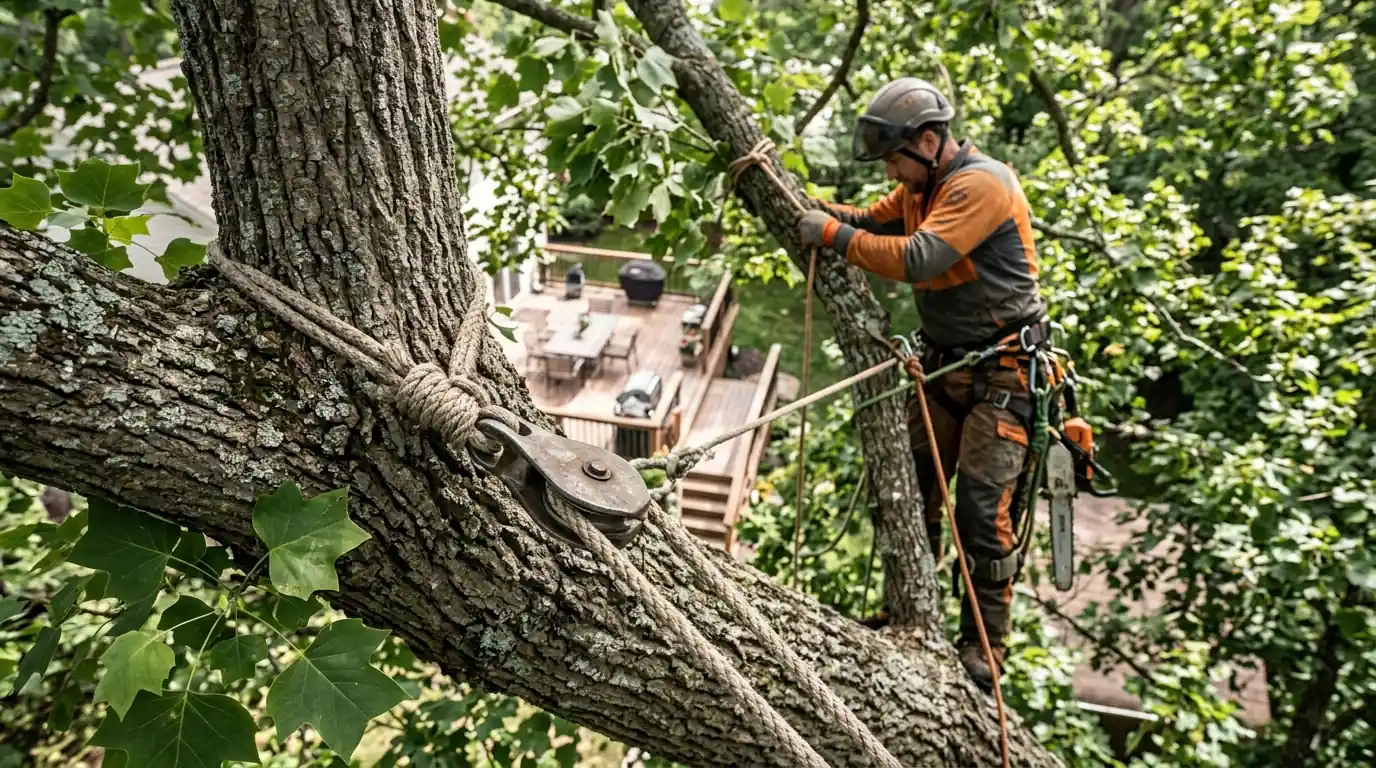
That changes how the tree has to come down. A freshly dead tree can usually be climbed and rigged like a living one. Six months or a year later, the climber may not be able to tie in, the rigging has to anchor in a neighboring tree, and pieces have to be cut smaller because the wood can shatter when it's caught on a rope.
Every one of those changes adds time, gear or both. Waiting doesn't save money on a dead tree. It usually costs more, and in the meantime, dry limbs come down on their own in summer thunderstorms, often over the driveway or the deck. A dead tree also gives a storm nothing to hold onto: no flexing, no leaves to spill the wind, just stiff wood that snaps where it's weakest.
Dead pines and dead oaks fail in different ways
Pines are the fast ones. A loblolly killed by southern pine beetle or Ips engraver beetles after a dry summer can go from green to brittle in a single season. The wood dries quickly, the top often snaps first, and the beetles that killed it can move to the next pine over. A dead pine near the house is worth removing soon, and our pine removal page covers the beetle signs in more detail.
Oaks hold together longer but fail heavier. A dead water oak or southern red oak can stand for years, but it sheds large limbs as it goes, and the root system rots below ground where you can't see it. When it finally goes over, it's a lot of very heavy wood, and the trunk often breaks low at the root flare instead of tipping, which gives no warning lean to watch for.
Hardwoods like tulip poplar and sweetgum sit somewhere in between. Poplar wood is already brittle when it's alive, so a dead one sheds limbs quickly. In every case, the sooner the tree comes down after it dies, the more of it can be climbed and rigged normally, and the fewer of its pieces land in the yard on their own first.
When a climber can work a dead tree and when a lift is safer
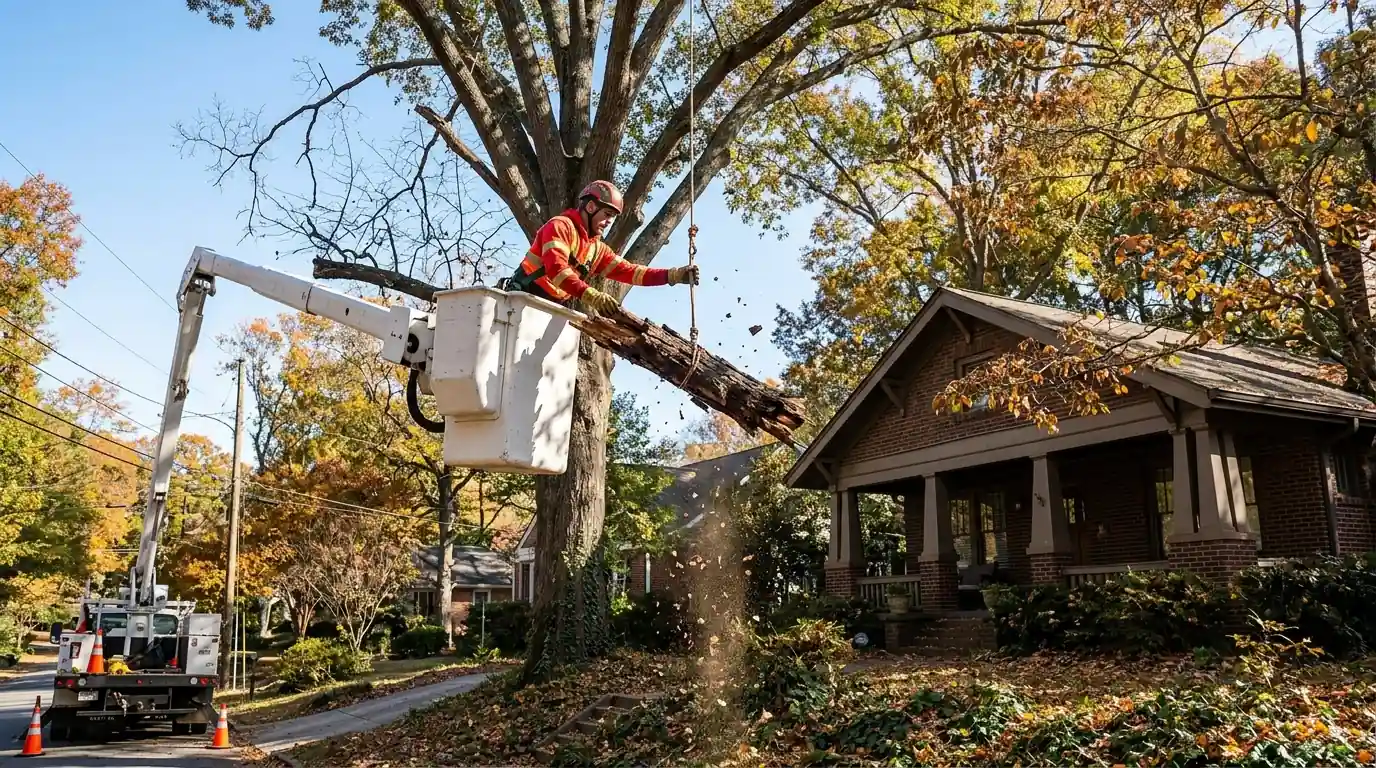
The climb or lift decision comes down to what the tree can carry. A climber puts body weight, a lanyard and every rigging load on the trunk and the limbs the rope runs through. On a tree that died this year, with tight bark and sound wood under the mallet, that's normal work. On a tree with loose bark, open cracks and fungi along the trunk, it isn't.
A bucket lift takes the tree out of the equation. The cutter stands in a basket on a boom parked outside the fall zone, and nothing about the work depends on the strength of the dead wood. The catch is access: the lift needs a firm path to the tree, which wet red clay, a steep backyard or a narrow side gate can rule out. When neither works, a crane holds each piece from above.
How to tell a tree is dead, not just dormant
In late winter, plenty of healthy trees look dead. These signs hold true in any season.
No buds in spring
When neighboring trees of the same kind have leafed out and yours still shows bare, dry twigs with no swelling buds, the tree is likely dead.
Brown under the bark
Scratch a twig or thin bark with a fingernail. Living tissue underneath is green and moist; dead tissue is brown and dry.
Bark falling away
Bark peeling off in sheets, especially on pines and oaks, means the layer that fed the tree has died and dried.
Needles turned rust
A pine whose crown fades from green to yellow to reddish brown in a few weeks is dying, often from bark beetles.
Mushrooms and conks
Fungi growing from the trunk or the root flare are feeding on dead or dying wood inside the tree.
Limbs snapping clean
Dead branches break off sharply with a dry crack instead of bending or tearing, and you'll find more of them on the ground after every storm.
How we take down a dead tree
The first decision is whether anyone goes up the tree at all.
- 1
Test the wood
We sound the trunk and main limbs with a mallet, look for cracks and fungi, and check how long the tree has been dead.
- 2
Climb or lift
If the wood is still sound, a climber ties in and works the tree. If it's brittle or rotten, the cutter works from a bucket lift and never puts weight on the tree.
- 3
Handle the paperwork
Inside Atlanta, we photograph the tree for the city's dead tree permit. In Decatur or DeKalb, we gather the photos and documentation those rules call for.
- 4
Take short pieces
Dead wood can shatter when it's caught on a rope, so pieces are cut shorter than on a living tree and lowered slowly.
- 5
Bring down the trunk
The trunk comes down in rounds, or is felled into a clear lane if the yard has room and the base is sound.
- 6
Clean up and check the neighbors
We chip the brush, haul or stack the wood, and look at nearby trees of the same species for the beetles or disease that killed this one.
What sets the price of a dead tree removal
| Job | Typical range | Priced |
|---|---|---|
| Dead tree, still sound enough to climb | $340 to $2,180 | per tree |
A tree that died recently and can still be climbed costs about what a living tree of the same size would. The price climbs as the wood gets more brittle, because a lift may have to replace the climber, pieces get smaller and more of the job is done slowly. Targets underneath, like a roof, a fence or power drops, add rigging time.
That's why the range below is wide. The low end is a small, recently dead tree with open access. The high end is a large dead oak over a house that can't be climbed. Cleanup and hauling are included, and stump grinding is priced separately on our cost page.
Dead tree rules in Atlanta, Decatur and DeKalb
Inside Atlanta city limits, a dead tree still needs a permit from the city Arborist Division. There is no application fee, the city inspects to confirm the tree is dead, and no replacement charge applies. In Decatur, residents send a dead tree affirmation statement by email with photos of the tree. In unincorporated DeKalb County, dead, diseased or hazardous trees can be removed at any time when a certified professional documents the condition.
The dead trees we remove most are beetle-killed loblolly pines in the north and east metro after dry summers, and water oaks that have declined for years in older intown neighborhoods. In Kirkwood and East Lake, it's often a tall pine standing dead behind a bungalow. Our guide to the signs a tree is dying can help you spot the next one early.
Where we do dead tree removal around Atlanta
Crews work from our Atlanta office near the 30340 ZIP and our Duluth office. These are the places we cover most, with their main ZIP codes. See all 56 areas.
- Buckhead 30305
- Virginia-Highland 30306
- Druid Hills 30307
- Morningside 30324
- Grant Park 30312
- Kirkwood 30317
- Cascade Heights 30311
- Sandy Springs 30328
- Dunwoody 30338
- Brookhaven 30319
- Decatur 30030
- Duluth 30096
- Lawrenceville 30046
- Marietta 30060
- Smyrna 30080
- Roswell 30075
- Alpharetta 30009
- Johns Creek 30097