Why crape murder happens
"Crape murder" is the nickname for topping a crape myrtle: cutting every trunk back to the same height, usually at chest or head level, and repeating it every winter. It spreads mostly by example. One yard on the street gets topped, the neighbors assume that's how it's done, and soon every crape on the block looks the same.
There are a few real reasons behind it. Many crapes were planted in spots too small for their mature size, under windows, beside driveways or next to the house, and topping is a quick way to keep them in bounds. Some people believe topping makes a crape bloom more. And topping is fast work for a crew with a lot of yards to get through in a short season.
What topping actually does to the tree
Topping removes most of the tree's branch structure every year, then forces it to rebuild from the cut ends. The results show up in a few predictable ways.
Knuckles
When you cut the same spot year after year, the tree forms a swollen knob of tissue at each cut. These knuckles get bigger and uglier each season. They're the trademark of a topped crape myrtle, and they never go away on their own.
Weak sprouts
Each knuckle sends up a cluster of long, thin shoots. Those shoots are attached only to the outer layer of wood, not anchored deep in the branch the way a natural limb is. When they carry heavy flower clusters, especially after rain, they bend over or break off. The tree ends up with a mop of floppy growth instead of a strong branching frame.
Decay and stress
Large cuts on thick trunks don't seal well, and decay can enter the wood behind the cut. Rebuilding a crown from scratch every year also uses up the tree's stored energy. And while topped crapes do produce big flower clusters on those long shoots, an unpruned crape of the right variety usually produces more total bloom over a fuller, more natural crown.
How to prune a crape myrtle the right way
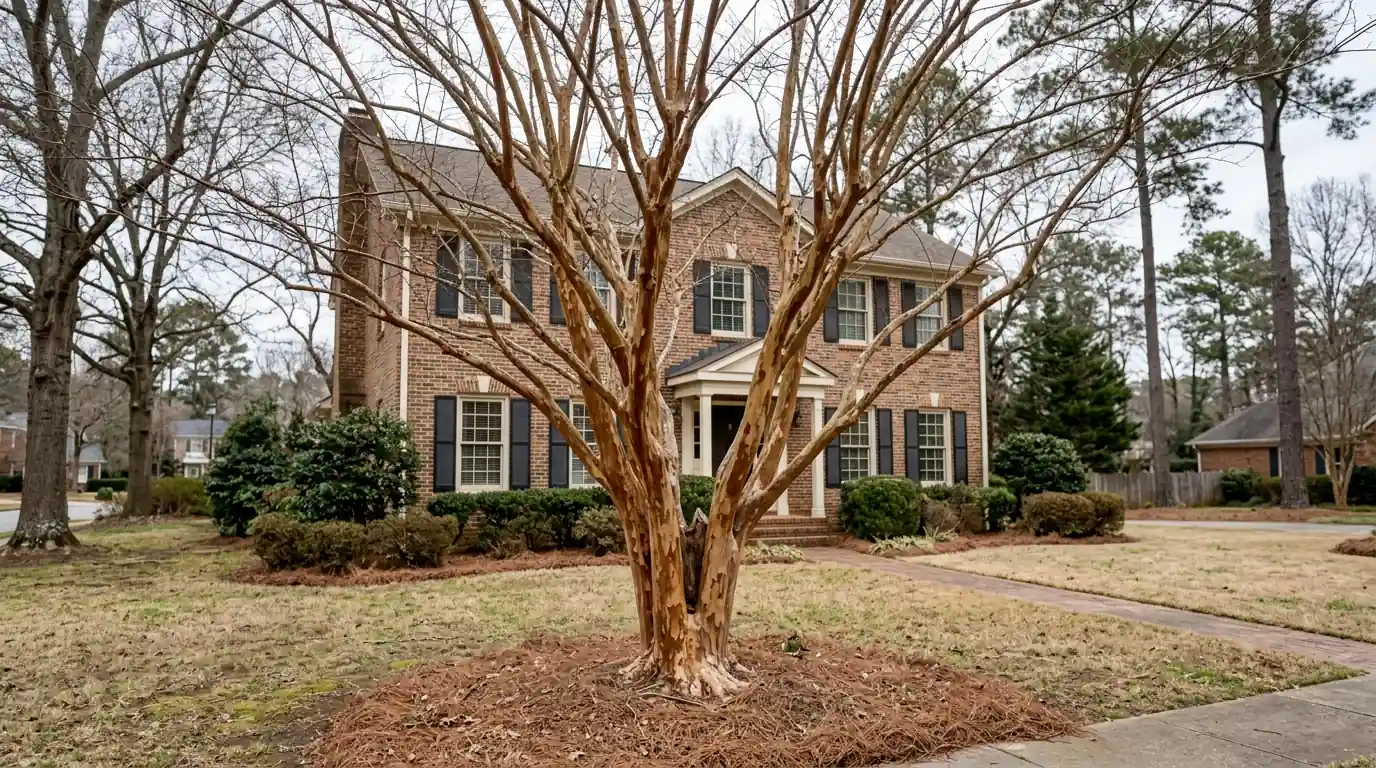
Crape myrtles need far less pruning than most people think. Late winter, roughly February into early March in Atlanta, is the right time, after the coldest weather and before new growth starts. Crapes bloom on new wood, so pruning then doesn't cost you any of this summer's flowers. The goal is a tree with three to five main trunks, a clear vase shape and smooth bark you can see.
- Remove suckers growing from the base and roots, cutting them flush to the ground.
- Pick three to five strong, well-spaced main trunks and remove extra ones at the base.
- Take off branches that cross, rub or grow back toward the center of the tree.
- Remove side branches on the lower part of the trunks to show off the bark.
- Cut out dead, broken or diseased wood back to healthy tissue.
- Make each cut back to a side branch or the trunk, just outside the branch collar, never as a stub in the middle of a limb.
- Leave the top alone unless a branch is rubbing the house or hanging over a walkway.
When a crape truly has to be smaller
Sometimes a crape really is crowding a roof, a window or a walkway. The fix is a reduction, not a topping. Follow an overlong branch down to a point where a healthy side branch grows in the direction you want, and cut just above it. That side branch takes over as the new tip, so the tree stays shorter without forming a knuckle. Take a little each winter rather than a lot at once, and never cut every trunk to the same height.
How to fix a crape that has already been topped
You can bring a topped crape back toward a natural shape, but it takes two or three seasons. The tree won't look perfect the first year, and the knuckles will stay visible for a while. Here is the approach we use.
Year one: choose new leaders
In late winter, look at the cluster of sprouts on each knuckle. Pick one or two of the strongest, well-placed shoots growing upward and outward, and cut the rest off cleanly at the knuckle. Those chosen shoots will become the new branches. Do not cut them back.
Year two: thin and shape
The chosen shoots will thicken and start branching. Remove any new sprouts that came back at the knuckles, thin crossing branches and keep the vase shape open in the middle. The tree will start looking like a tree again.
Year three and after: maintenance
By now the new limbs have their own structure. From here, pruning is the same as on a crape that was never topped: suckers, crossing branches and dead wood only.
The other option
If the knuckles are severe, a crape can be cut down to near the ground and allowed to regrow from the base. It's a drastic step that costs a season of bloom, but it gives you fresh trunks to start over with. This only makes sense on a healthy, established plant.
Choose a variety that fits the space
Most topping happens because a crape was planted where it can't reach its natural size. Crape myrtles come in a wide range of mature heights, from dwarf shrubs that stay under 5 feet to large tree forms that reach 25 feet or more. The plant tag tells you the mature size of each named variety, and it's worth believing.
If you have a crape that's too big for its spot and you're tired of fighting it, moving it or replacing it is often the better long-term fix. A dwarf or semi-dwarf variety under a window, and a full-size tree variety in the open lawn, will each look right without heavy pruning. Our planting service can help match the variety to the space.
Watch for crape myrtle bark scale
Crape myrtle bark scale has become a common pest on Atlanta crapes. Look for white or gray felt-like patches on the bark, often in branch crotches and on pruning wounds, and for black sooty mold coating the trunks and the ground below. Heavily infested trees bloom less and look dingy.
Bark scale is easiest to spot on the smooth trunks of a well-pruned tree, which is one more reason to keep them open. If you see it, insect treatment can bring it under control, and washing the trunks helps remove the sooty mold.
Getting help with your crapes
Our crape myrtle pruning keeps the natural vase shape and never tops the tree. For other small flowering trees, like Japanese maples and dogwoods, our ornamental pruning uses the same light touch. You'll see a lot of crape myrtles in older neighborhoods such as Ormewood Park and Lilburn, and plenty of them are recovering from years of topping.
For pruning timing on other species, see our guide to when to trim trees in Georgia.
Key takeaways
- Topping a crape myrtle every year creates knuckles, weak sprouts and more decay, with no real gain in bloom.
- Prune crapes in late winter by removing suckers, crossing branches and dead wood, cutting back to a branch or trunk.
- An already topped crape can be restored over two or three seasons by choosing new leaders on each knuckle.
- Picking a variety with the right mature size avoids most of the pressure to top in the first place.
- White felt patches and black sooty mold on the trunk point to crape myrtle bark scale.