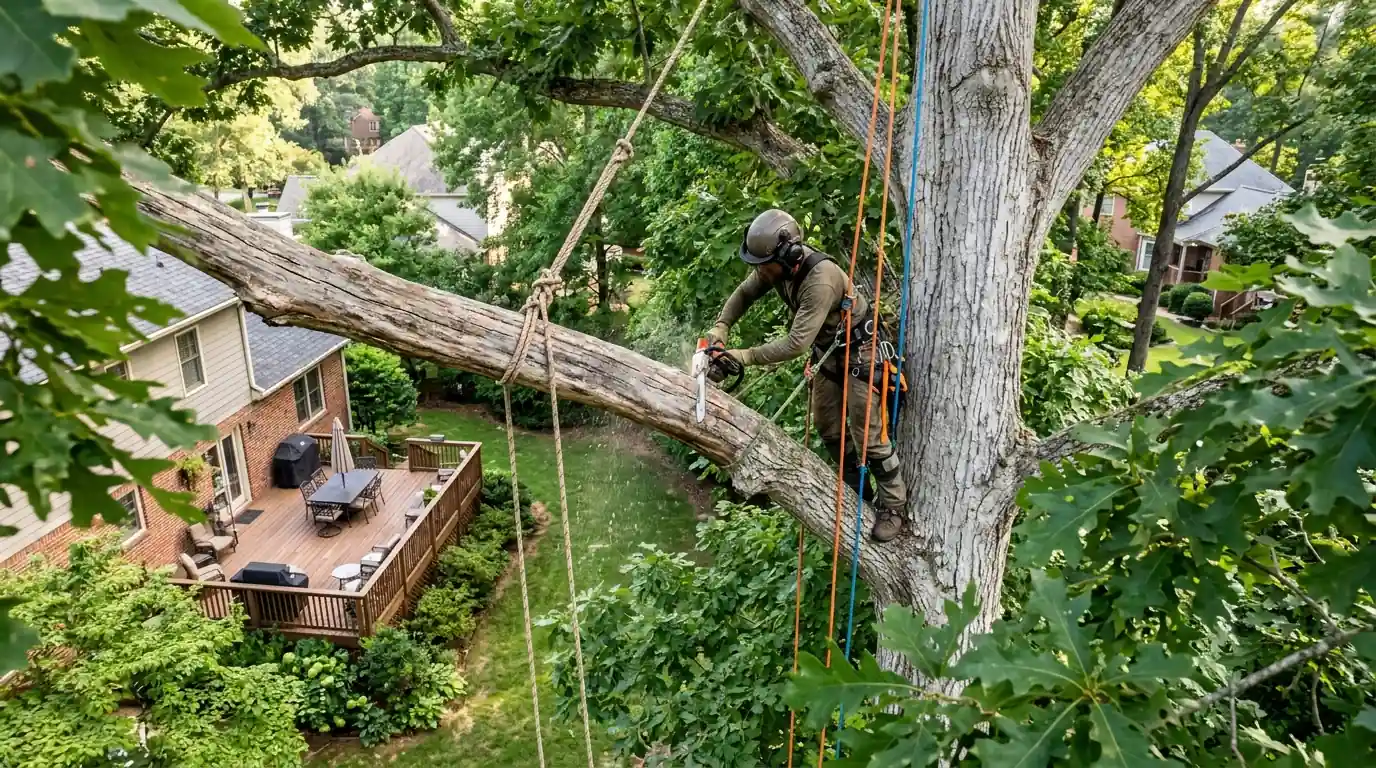
Deadwood removal means cutting dead branches out of an otherwise living tree. Dead limbs dry out, lose their bark and eventually break, often in a summer thunderstorm or under the weight of ice. From the ground you can spot many of them by missing bark, no buds or leaves in season, fungus and cracks. In Atlanta, where big oaks and pines tower over roofs and driveways, clearing deadwood is one of the simplest ways to make a tree safer without changing how it looks.
Why dead branches fall and when they usually do
Every tree sheds some wood as it grows. Lower limbs get shaded out, branches die back after root damage or drought, and storms leave broken stubs that never recover. Once a limb dies, it stops adding wood and starts drying out. Over months and years, the bark loosens and falls away, fungi move in, and the wood gets lighter and more brittle until it can't hold its own weight.
Dead limbs tend to come down at the worst times. A summer thunderstorm can snap them in a single gust, and a winter ice storm adds weight they can't carry. Some simply let go on a calm day when the last fibers give out. Because they're dry and brittle, they break suddenly rather than bending first, and a limb the size of your arm falling sixty feet can do real damage.
Deadwood removal takes those limbs out before they choose their own moment. It's routine maintenance for big trees over roofs, driveways, patios and play areas, and it's often the first job we suggest for a mature tree that's healthy overall but has been ignored for years. The tree looks the same afterward from the street. The difference is that nothing dead is left hanging over the places you use.
Deadwood in a healthy tree versus a hazard tree
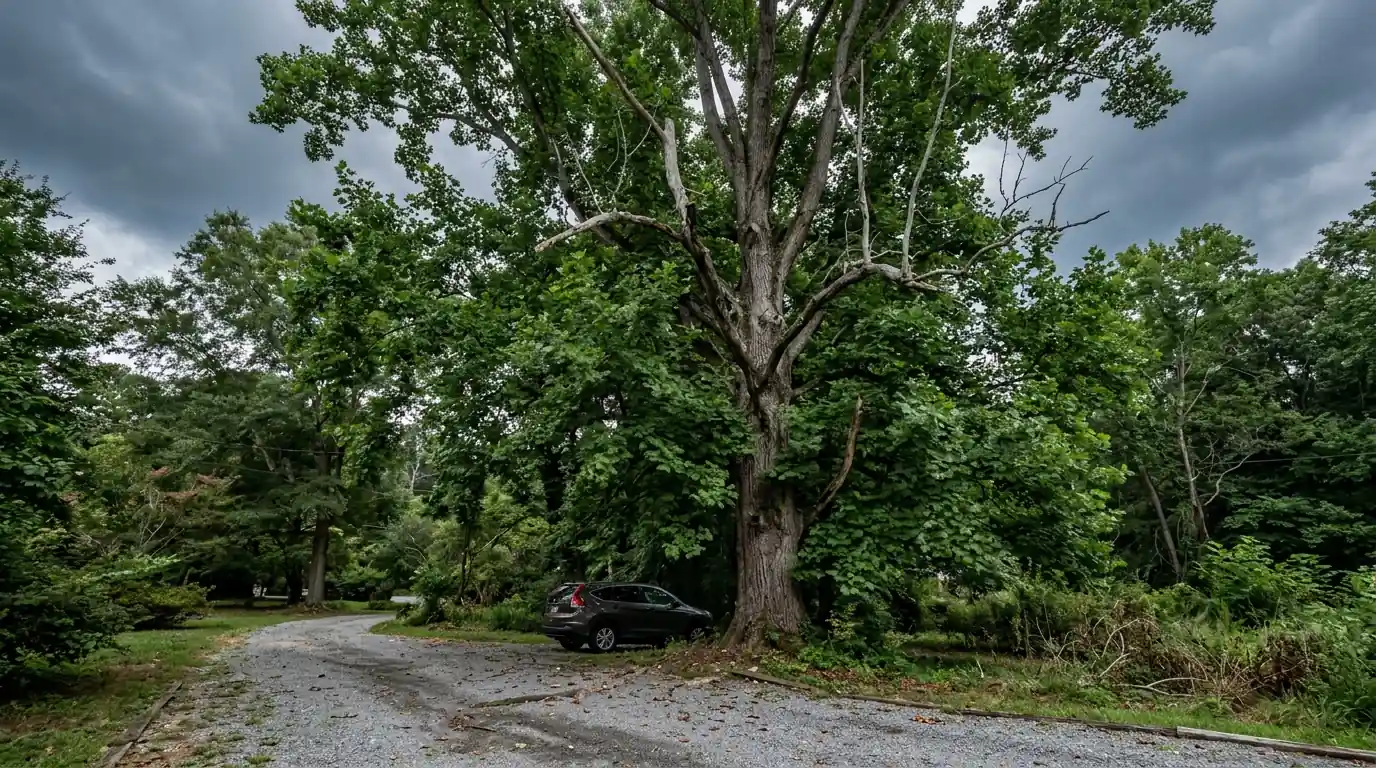
A few dead limbs in an otherwise green, full crown are normal and easy to fix. The tree is shedding wood it no longer needs, and removing that wood makes it safer without changing its health. Most mature oaks, poplars and maples around Atlanta carry some deadwood, and a cleanup every few years keeps it under control.
It's a different situation when the deadwood is widespread. If a large share of the crown is dead, if dieback is moving from the top down, or if the trunk shows decay, the tree may be in decline. Pulling out deadwood won't fix that. In those cases we'll recommend a closer risk assessment or, when the tree is too far gone, a conversation about removing the hazard.
Signs of deadwood you can spot from the ground
Binoculars help, but most of these show up with a slow walk around the tree.
Bare, gray wood
Dead limbs lose their bark over time, leaving smooth gray or bleached wood that stands out against the living branches.
No leaves in season
In late spring and summer, a limb with no leaves while the rest of the crown is green is almost always dead.
No buds in winter
Living twigs carry plump buds through winter. Dead ones are dry, brittle and bare, and they snap rather than bend.
Fungus on the limb
Shelf fungi, crusty growth or soft, punky wood along a branch means decay has taken hold.
Cracks and splits
Long cracks running along a limb or where it meets the trunk often show wood that has died and dried.
Twigs and bark on the ground
A steady drop of dead twigs and bark pieces under one part of the crown points to dieback above.
Deadwood sizes and what each one can do
Not every dead branch is worth a climb, so we sort what we see by size and by what sits below it.
Twigs under an inch
These break off and drop harmlessly in most yards. We take them as we pass, but they're rarely the reason to schedule a visit.
Branches one to three inches
Big enough to crack a windshield or dent a gutter from height. Over a car or a deck, these are worth removing.
Limbs three to six inches
Heavy enough to punch through shingles or injure someone below. These are the core of most deadwood jobs and are usually lowered on rope.
Dead limbs over six inches
These can take out a fence section, a car roof or a porch rail. Over any target, we treat them as a priority.
Hangers caught in the crown
Broken limbs lodged in the canopy after a storm can shift and drop with no warning, so they come down before anything else.
What we protect while deadwood comes down
Dead limbs break unpredictably, so protecting what sits below matters as much as the cutting.
- Roofs, gutters and skylights directly under the crown.
- Cars in the driveway, the carport and on the street.
- Decks, patio furniture, grills and outdoor kitchens.
- Fences, sheds and the neighbor's yard on the other side.
- Garden beds, young plantings and shrubs near the trunk.
- Lawns that can be dented by heavy limbs, especially after rain softens the clay.
- Overhead utility lines, which we never cut near and coordinate with the utility if a dead limb threatens them.
How a climber finds and lowers deadwood safely
Dead branches are hard to see from the ground and brittle to handle, so the work is careful and methodical.
- 1
Map the targets below
We note everything under the crown, such as the roof, the cars, the deck, the fence and the garden, and plan where wood can safely land.
- 2
Clear the drop zone
Outdoor furniture, grills and vehicles are moved, and people and pets stay out of the work area while the climber is up.
- 3
Climb and tie in
The climber ties into strong, living wood, never into a dead limb, and works systematically through the crown.
- 4
Find every dead limb
From inside the canopy, dead branches the ground can't see become obvious, and the climber works through each section.
- 5
Cut and lower
Small deadwood is dropped into a clear zone. Larger limbs or anything over a target are tied off and lowered on a rope.
- 6
Clean cuts and cleanup
Each dead limb is cut back to living wood at the collar, and the yard is raked and the brush chipped before we leave.
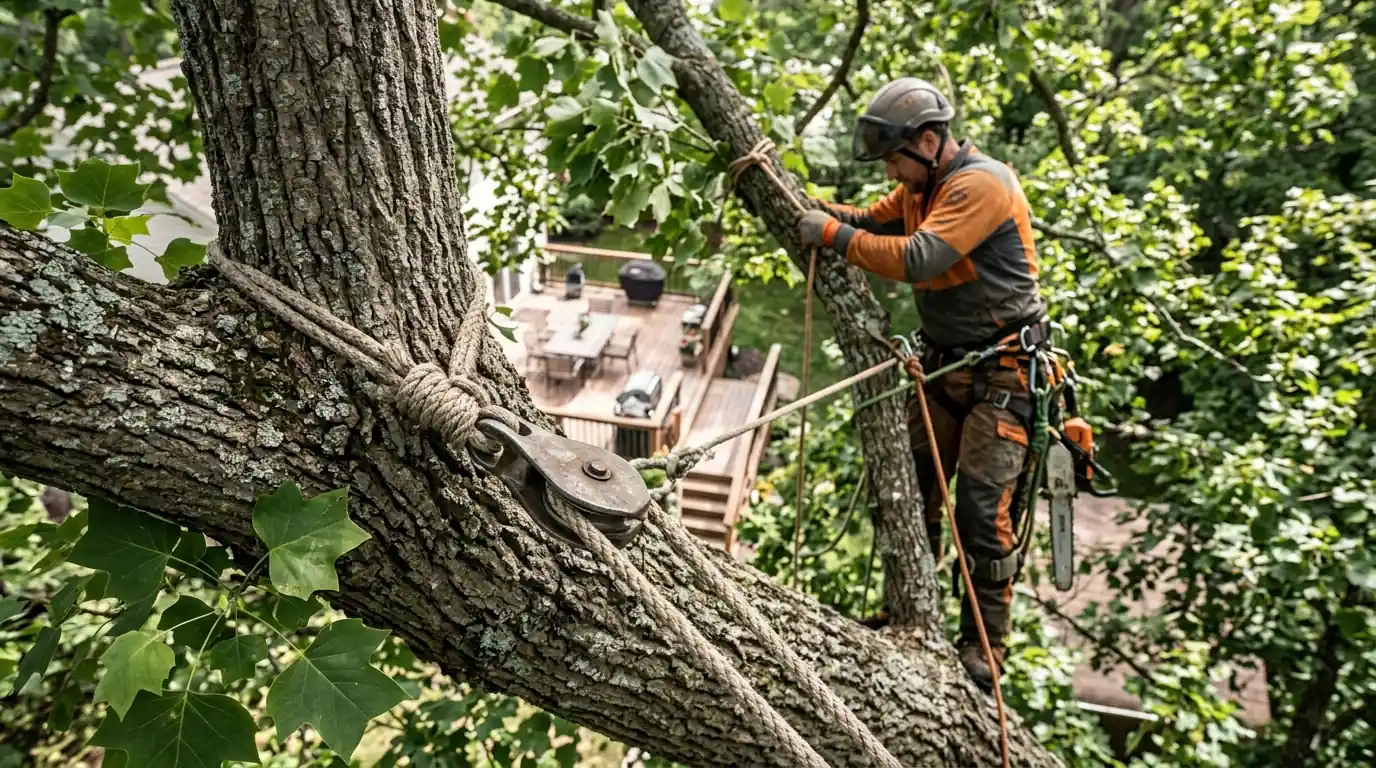
Deadwood in Atlanta oaks, poplars and pines
Water oaks are one of the biggest deadwood producers in metro Atlanta. Many were planted in the 1950s and 1960s, they're relatively short-lived, and they often drop dead upper limbs as they age, sometimes because of heart rot inside. In Grant Park and East Atlanta, water oaks over old homes are some of the most common deadwood calls we get.
Tulip poplars carry brittle limbs that die back in drought, and loblolly pines shed lower branches as they grow tall. Out in Roswell and Alpharetta, tall poplars and pines over long driveways often have dead limbs high enough that no one notices them until one comes down. Inside Atlanta city limits, cutting deadwood out of a private tree counts as pruning and needs no permit, so a cleanup is quick to schedule. Our guide to a dying tree covers when dieback means more than a few dead limbs.
What deadwood removal costs and why it varies
| Job | Typical range | Priced |
|---|---|---|
| Deadwood cut out of the crown | $285 to $1,240 | per tree |
Deadwood removal depends on the size of the tree, how much dead wood it carries and what lies beneath. A large oak over a house with dozens of dead limbs takes much longer than a tree in an open yard with a handful of small ones. Any limb that has to be roped down over a roof or car adds time.
Chipping, raking and hauling the wood are part of the price. If the tree also needs trimming for clearance or a light thinning, doing it on the same climb is usually the better value, since the climber is already tied in and the setup is done once. Typical ranges for deadwood work sit next to our other services on the cost guide.
Where we do deadwood removal around Atlanta
Crews work from our Atlanta office near the 30340 ZIP and our Duluth office. These are the places we cover most, with their main ZIP codes. See all 56 areas.
- Buckhead 30305
- Virginia-Highland 30306
- Druid Hills 30307
- Morningside 30324
- Grant Park 30312
- Kirkwood 30317
- Cascade Heights 30311
- Sandy Springs 30328
- Dunwoody 30338
- Brookhaven 30319
- Decatur 30030
- Duluth 30096
- Lawrenceville 30046
- Marietta 30060
- Smyrna 30080
- Roswell 30075
- Alpharetta 30009
- Johns Creek 30097