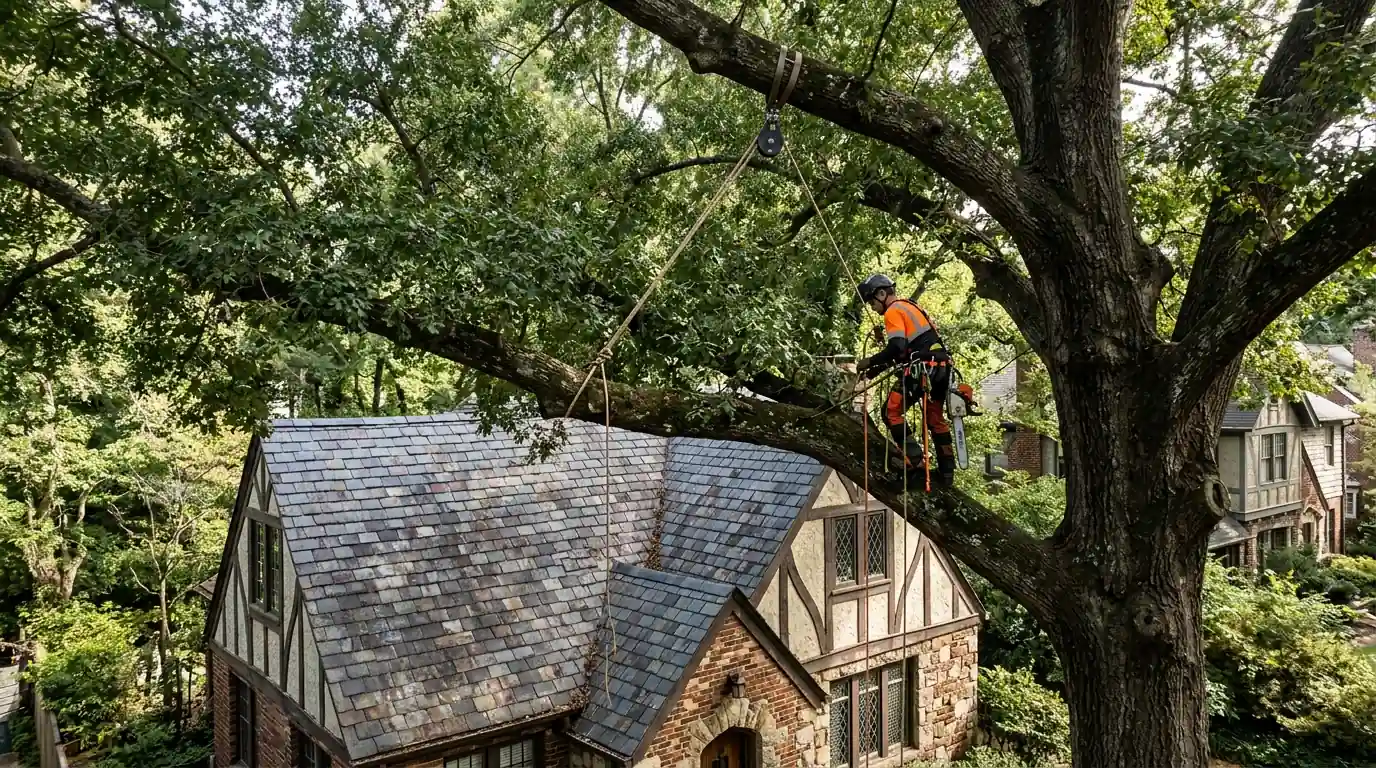
Oak tree removal is taking down water oaks, willow oaks, southern red oaks and other oaks that are declining, damaged or simply too close to the house. Water oaks are the most common removal in Atlanta, because they're relatively short-lived and prone to heart rot, hollow trunks and dead upper limbs. Oak wood is heavy, so these jobs need more rigging and often a crane. Some oaks can be kept with pruning or cabling instead.
Why water oaks come down more than any other Atlanta tree
Water oaks were planted and left standing all over Atlanta's postwar neighborhoods because they grow fast and give shade quickly. The trade-off is a shorter life. Many of those trees are now well past their prime, and the decline follows a familiar path: heart rot works up the center of the trunk, cavities open at old pruning wounds, and the upper limbs start dying back.
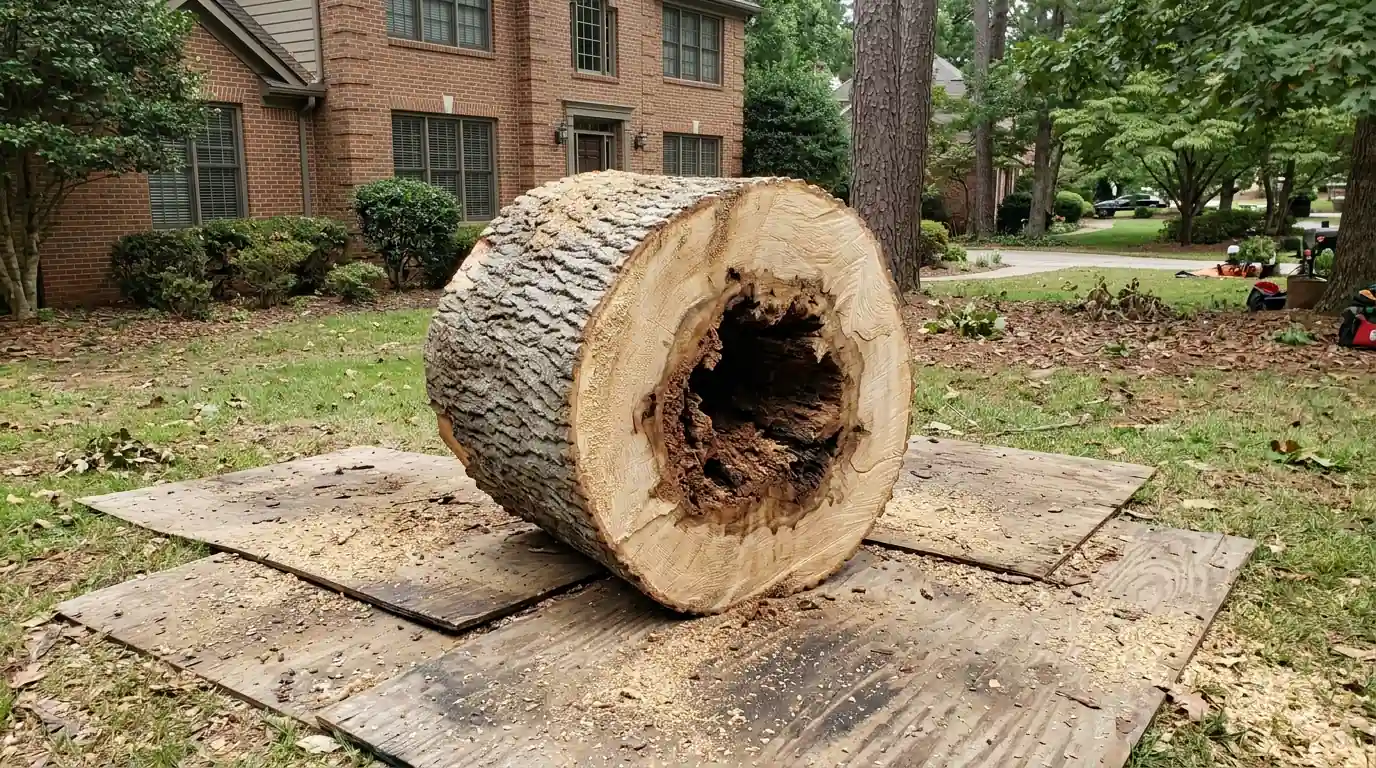
A water oak in decline can look leafy from the street while it's hollow inside. The first warning is often dead limbs high in the crown, or a big limb dropping on a calm day. By then, the trunk may have only a shell of sound wood left around a rotted core.
Willow oaks and southern red oaks tend to hold up longer, and white oaks longer still, but any of them can decline after root damage, drought or construction nearby. Stressed oaks are also where hypoxylon canker and armillaria root rot take hold, and both speed the decline once they're in. Our article on why water oaks are failing goes deeper on what drives it.
Roots near foundations and sewer lines
Oak roots spread wide and shallow in Atlanta's red clay, and a big oak near the house often has roots under the driveway, along the foundation and around older clay or cast iron sewer lines. People sometimes ask us to remove an oak because of the roots. Sometimes that's the right call, and sometimes the roots can be managed without losing the tree.
When an oak comes out, its roots stop growing but don't vanish. They decay slowly over years, which can leave soft spots in the lawn. Large roots under a slab or walk usually stay put, because pulling them can do more damage than leaving them. If you're planning to pave or build, full stump and root removal is a different job from grinding, and it needs a Georgia 811 locate first.
Timing matters, too. Oaks come out cleanest when the ground is firm, because heavy wood on wet red clay leaves ruts that take a season to fix. If a storm hasn't forced the decision, late fall through winter is often the easiest window for a big oak, with leaves off, limbs easier to read and less brush to chip.
What we look for when an oak may need to come down
These are the signs we check on every oak before we recommend removal over saving it.
Dead upper limbs
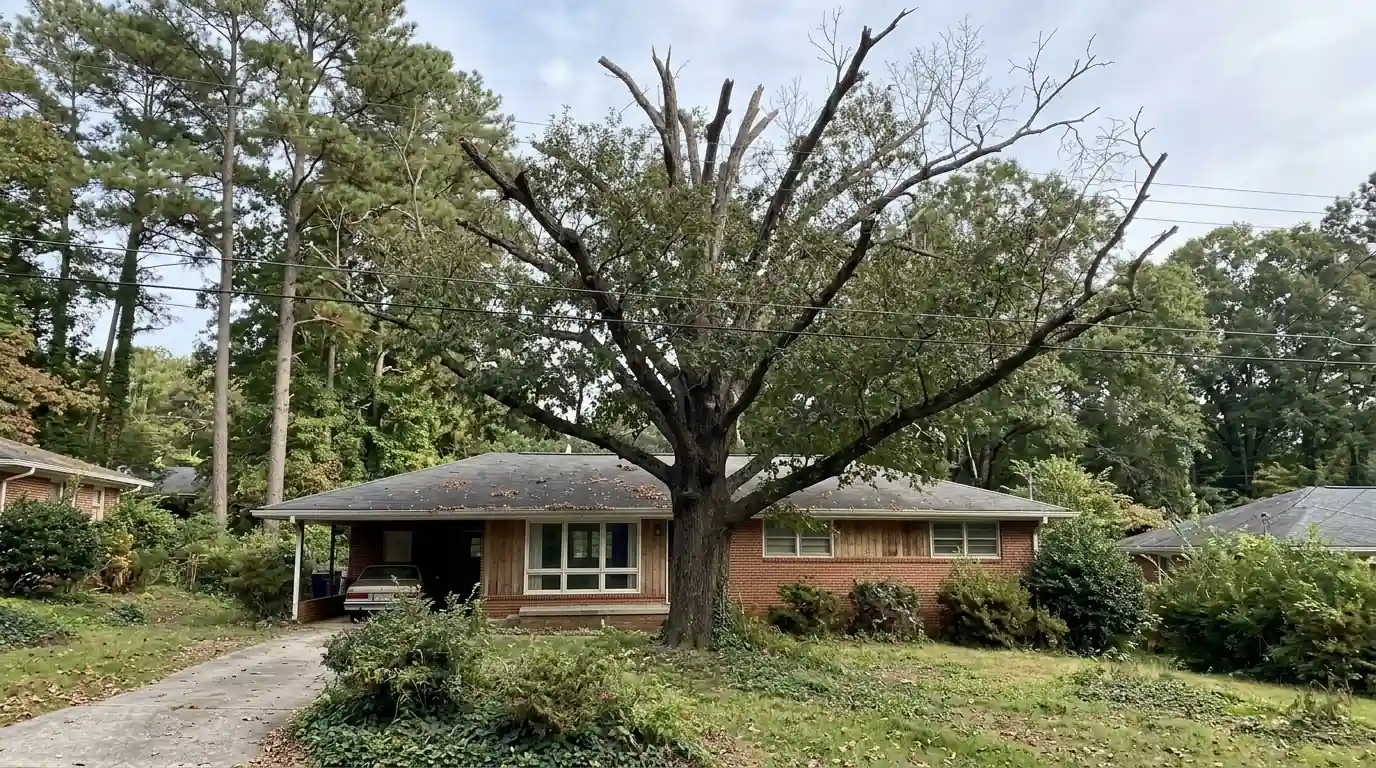
Bare branches in the top of the crown while the lower limbs still leaf out are a classic sign of a declining water oak.
Hollow trunk or cavities
Openings along the trunk or at the base, and a hollow sound under the mallet, mean heart rot has taken out much of the center.
Fungus at the base
Shelf fungi, mushrooms around the root flare, or sloughing bark from hypoxylon canker point to decay in a stressed oak.
Large limbs over the house
Heavy horizontal limbs spreading over the roof put a lot of weight in one direction, especially if the union below them is cracked.
Root damage
Trenching, a new driveway or soil piled over the roots can kill a large share of an oak's roots and start a slow decline.
Leaf scorch year after year
Brown, scorched leaf edges by late summer, repeating each year, can mean bacterial leaf scorch, which slowly weakens oaks.
How we take down a big oak over a house
A large oak is mostly limbs by weight, so the order of cuts matters as much as the gear.
- 1
Map the weight
We look at which limbs are the heaviest, where they hang and what each one would hit, then plan the order of cuts so the tree stays balanced.
- 2
Set rigging for oak
Rigging blocks and lowering devices are sized for heavy hardwood, and anchored high in the strongest part of the tree or in a sound neighboring tree.
- 3
Choose rope or crane
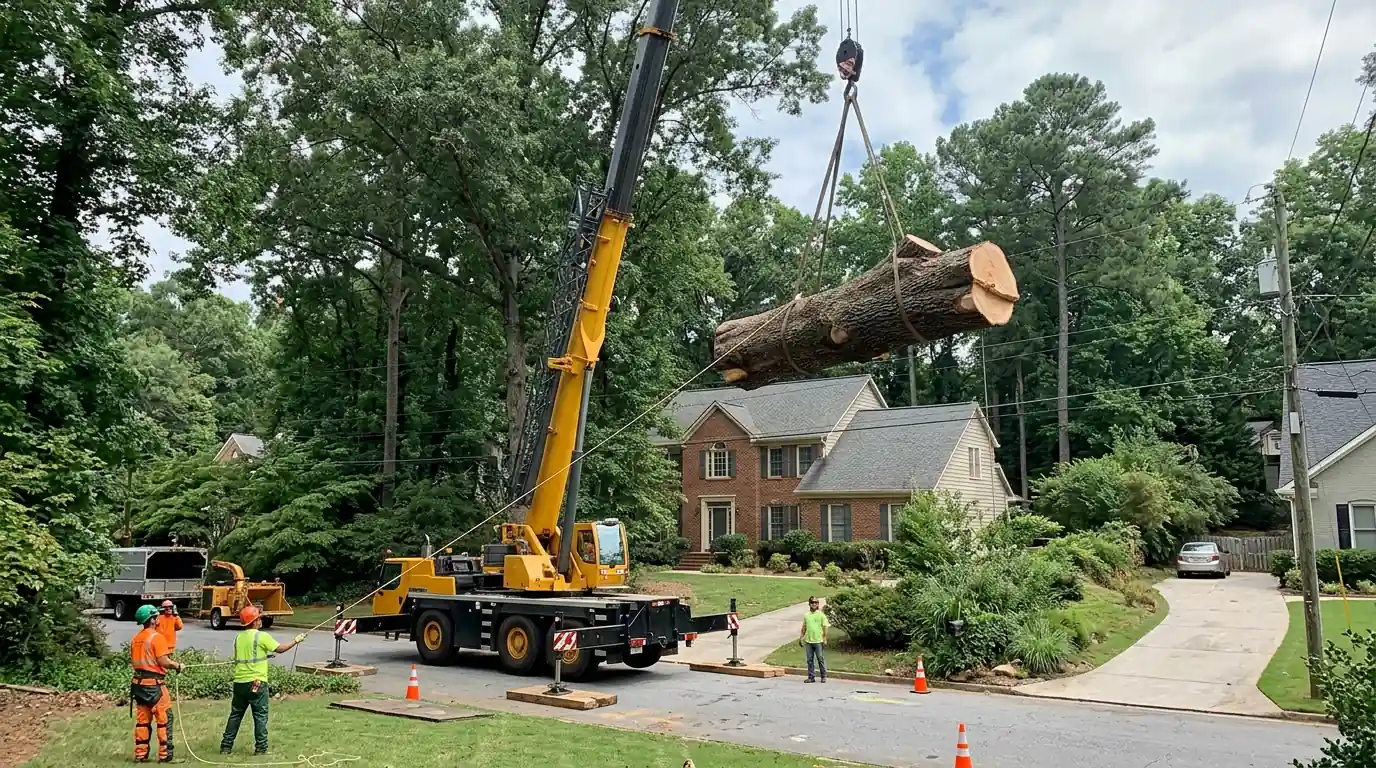
If the trunk is sound and there's room to lower pieces, we rig it. If it's hollow or boxed in, a crane holds each section before it's cut.
- 4
Limb from the outside in
Heavy limbs come off in pieces, starting at the tips, so the weight on the rope stays manageable and nothing swings into the roof.
- 5
Spar in short rounds
Oak rounds are heavy, so trunk sections are cut shorter than they would be on a pine, then lowered or lifted one at a time.
- 6
Protect and clean up
Plywood mats protect the lawn from the heavy wood. Brush is chipped, logs are hauled or split for firewood, and the yard is raked clean.
What drives the price of oak removal
| Job | Typical range | Priced |
|---|---|---|
| Water or willow oak, 50 to 80 ft | $880 to $4,600 | per tree |
Weight and spread drive oak pricing more than height. A big oak with long limbs over the roof needs more pieces, more rigging and more time than a pine of the same height. A hollow trunk that can't be climbed may mean a crane, and an oak behind the house with no side access means carrying or lifting every piece out.
The range below covers water and willow oaks from about 50 to 80 feet in metro Atlanta. Cleanup and hauling are included, and cutting the wood to firewood length is an option. Stump grinding is separate, and an oak stump is usually wide, so it takes longer than a pine of the same height. See our full price guide for how the add-ons compare.
Remove the oak, or prune or cable it instead
Not every oak with a problem has to come down. Here's how we weigh it.
| Prune | Cable and brace | Remove | |
|---|---|---|---|
| Good fit when | The trunk is sound and the problem is deadwood or weight over the roof | A healthy oak has one weak fork or a heavy leader | Heart rot, a hollow trunk or root failure runs through the tree |
| What changes | Dead and heavy limbs come out and end weight drops | Cables or rods share the load across the crown | The tree and its risk are gone |
| Upkeep | A check every few years | Hardware inspected on a schedule | None, beyond the stump and a replacement tree |
| Typical tree | A willow oak with a few dead limbs | A white oak with a cracked co-dominant union | A water oak with dead upper limbs and a hollow core |
Oaks across Atlanta's older neighborhoods
Oaks give Atlanta much of its canopy, and many of the biggest stand in older intown neighborhoods. In Druid Hills and Ansley Park, tall water and willow oaks shade houses with slate or tile roofs that crack under a dropped limb. In Chastain Park, larger lots hold oaks that have been growing since the neighborhood was laid out.
Inside Atlanta city limits, removing a healthy oak 6 inches or more in diameter at 4.5 feet needs a city permit, and healthy trees removed under construction or landscape permits owe recompense. A dead, dying or hazardous oak still needs a permit but carries no application fee and no recompense once the city verifies the condition. If an oak is worth keeping, structural pruning or cabling can buy it years.
Where we do oak tree removal around Atlanta
Crews work from our Atlanta office near the 30340 ZIP and our Duluth office. These are the places we cover most, with their main ZIP codes. See all 56 areas.
- Buckhead 30305
- Virginia-Highland 30306
- Druid Hills 30307
- Morningside 30324
- Grant Park 30312
- Kirkwood 30317
- Cascade Heights 30311
- Sandy Springs 30328
- Dunwoody 30338
- Brookhaven 30319
- Decatur 30030
- Duluth 30096
- Lawrenceville 30046
- Marietta 30060
- Smyrna 30080
- Roswell 30075
- Alpharetta 30009
- Johns Creek 30097