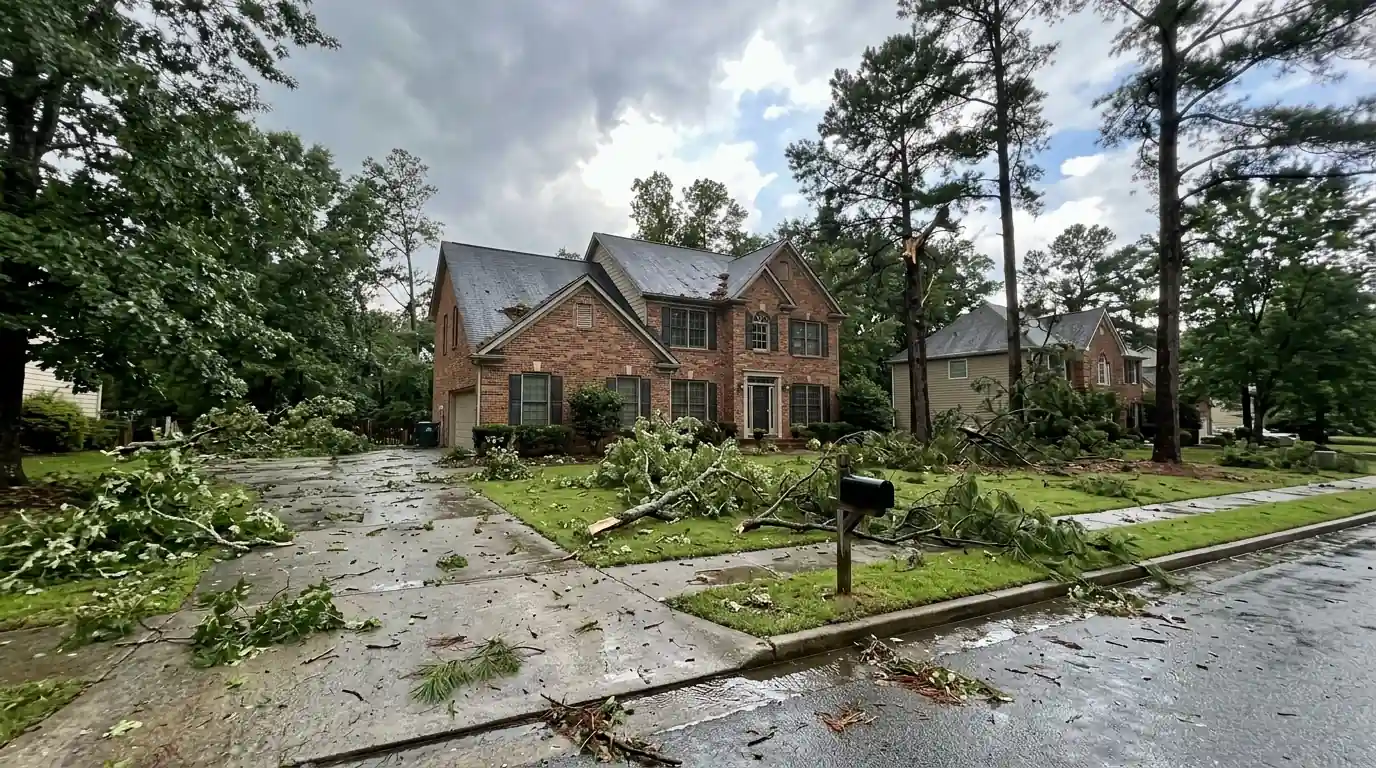
Storm damage cleanup is clearing broken limbs, split tops, uprooted trees and debris piles after thunderstorms, tropical systems and ice storms. The first job is always the overhead hazards, like hangers caught in the crown and trees leaning on others, before anyone works below them. After that, brush is chipped on site and wood is cut and hauled. Georgia Power treats storm debris on your property as the owner's job, even when its crews cut a tree off a line.
Storm damage we clear most often
Every storm leaves a slightly different mix, but these show up after almost all of them.
Hangers in the crown
Broken limbs caught high in the canopy are lowered on rope from a climber or a lift before anyone works underneath.
Split tops and forks
A top or a co-dominant fork split down the middle is usually removed back to sound wood, or the whole tree comes down if the split runs deep.
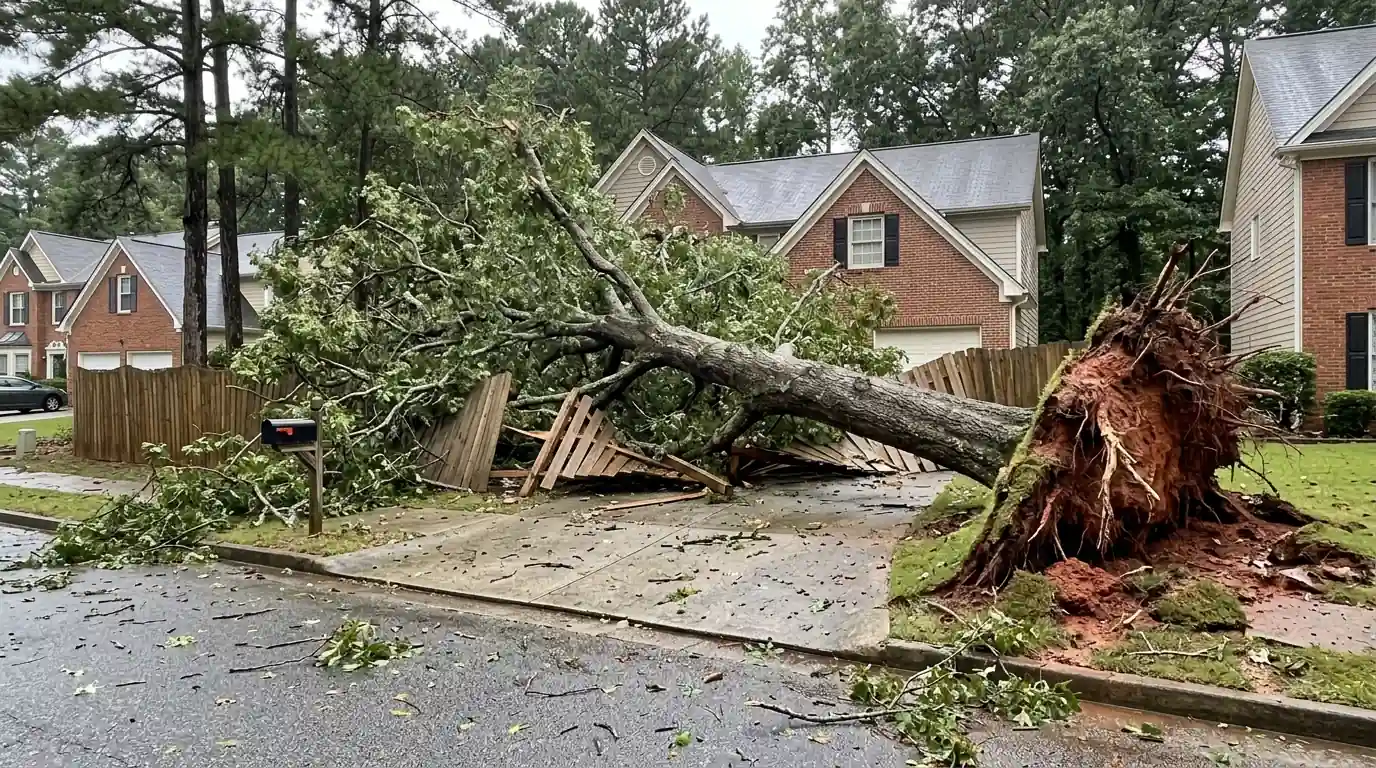
Uprooted trees
Trees tipped out of soaked clay often lift a root plate that can settle back once the trunk is cut, so the cuts are planned around it.
Trees leaning on trees
A tree hung up on its neighbor is loaded like a spring. It's rigged and taken down in stages, never cut loose from below.
Debris piles across the yard
Broken limbs, twigs and leaves are gathered, chipped on site and hauled, or the chips are left for mulch if you want them.
Limbs on fences and sheds
Wood resting on a structure is lifted off in pieces so the fence or roof doesn't take a second hit when it shifts.
Ice-loaded limbs
After an ice storm, bent and cracked limbs are checked before the thaw, because ice-weakened wood often breaks days later.
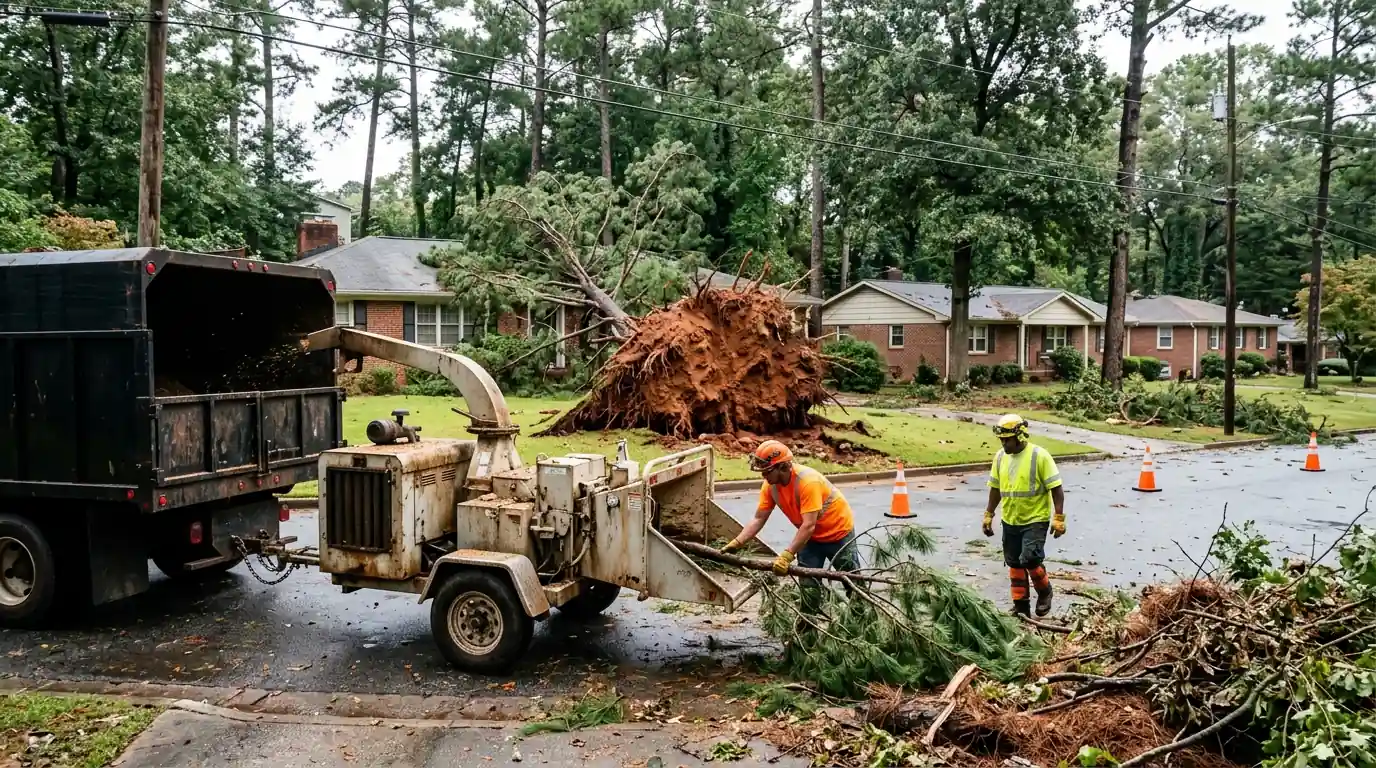
How we work a storm-damaged yard
The order is the same whether it's one limb or a dozen trees.
- 1
Check for wires first
We look for any line touching a tree or lying in the yard. If one is involved, it's reported to Georgia Power and treated as live until made safe.
- 2
Photograph the damage
Before anything moves, we photograph the trees, the debris and any damage to roofs, fences and cars, so you have a record for insurance.
- 3
Make the overhead safe
Hangers, split tops and leaning trees are dealt with first, using rope and a climber or a lift, until nothing is left that can fall.
- 4
Cut and stack the wood
Downed trees and big limbs are cut into manageable pieces, starting with anything blocking the driveway, walks or doors.
- 5
Chip the brush on site
Smaller limbs go through the chipper at the curb. You can keep the chips for mulch or we haul them.
- 6
Haul and rake
Logs are hauled or stacked as firewood, and the yard, the drive and the gutters we can reach are raked and blown clear.
Why the overhead hazards come before the cleanup
The natural instinct after a storm is to start clearing the yard. But the limbs on the ground already fell. The ones that can still hurt someone are the ones that haven't: a broken limb hanging in the crown, a split top waiting for the next gust, or a tree leaning against another tree with its roots half out of the ground.
Arborists call a broken limb caught in the canopy a hanger, and it's one of the most dangerous things in tree work. It can fall with no warning, from a breeze, a squirrel or the vibration of a chainsaw on the trunk below. Nobody should rake, chip or cut under a tree with a hanger in it.
So we work in two stages. The safety cuts come first: hangers lowered on rope, split tops taken off, leaning trees rigged and brought down. Only once nothing is left overhead do we start on the debris. On a heavy storm day, that sometimes means making several yards safe before we come back to clean any of them.
Thunderstorms, tropical systems and ice each break trees differently
Summer thunderstorms bring short, hard gusts that snap limbs and tops, especially on tulip poplars, Callery pears and water oaks with old decay. The damage is often scattered: a few hangers here, a split fork there. These storms also come back often in a Georgia summer, so a cracked limb left after one storm tends to come down in the next.
Tropical systems are a different problem. They drop days of rain that soak Georgia red clay before the wind arrives, and wet clay can't hold roots. Instead of snapping, whole trees tip over with their root plates attached, often tall pines and oaks that had stood through many dry storms.
Ice storms load every twig with weight. Limbs bend and crack, and pines with dense needles and brittle wood are especially prone to losing their tops. The breakage often keeps going for days after the storm as the ice melts and cracked wood gives way, which is why we look up before we look down on any job that follows a freeze.
What to do in the yard before the crew gets there
A few simple moves keep you safe after a storm and make the cleanup go faster.
- Look up before you walk under any tree, and keep everyone away from trees with broken limbs still in the crown.
- Stay clear of any wire on the ground or in a tree, and report it to Georgia Power.
- Photograph every tree, limb and damaged structure before anything gets moved or cut.
- Don't start a chainsaw on a tree that's bent, leaning or pinned, because the wood can spring when it's cut.
- Clear cars from the driveway and the curb so the chipper and trucks can park close to the work.
- Pull any small limbs you can safely reach off walkways and doors, and leave the rest for us.
- Make a quick list of the trees you're worried about so nothing gets missed on the walk-around.
Storm damage around Atlanta and who handles what
On September 27, 2024, Tropical Storm Helene soaked the ground and uprooted trees onto homes across metro Atlanta. Storms like that one don't only take sick trees. Tall pines and oaks standing in soaked red clay can tip over with sound wood, because the soil lets go before the tree does. In Candler Park and Kirkwood, storm calls usually mean a tall tree across a narrow lot and the neighbor's fence. In Norcross and Peachtree Corners, it's more often pines down across driveways and back fences.
Georgia Power prunes trees that threaten its lines on its own maintenance cycle, but storm debris cleanup on your property is your job. When utility crews cut a tree off a line to restore power, they usually leave the wood where it falls. Inside Atlanta city limits, a fallen tree held up by the ground, another tree or a structure needs no permit, but photograph it and notify the city's Arborist Division.
What storm cleanup costs, and why it varies so much
| Job | Typical range | Priced |
|---|---|---|
| Broken limbs, hangers and downed wood | $380 to $2,950 | per job |
The range is wide because storm jobs are. A handful of limbs on the lawn takes part of a visit. A yard with hangers in three trees, a split oak and an uprooted pine across the back fence takes rigging, a climber and a full day. Overhead safety work costs more than ground cleanup, because it's slower and done at height.
Chipping and hauling are part of the job. Stump grinding for uprooted or cut trees is separate. If a tree is on the house, emergency removal is priced on its own. Our price guide has typical ranges for both, and our brush hauling handles piles you've already gathered yourself.
Where we do storm damage cleanup around Atlanta
Crews work from our Atlanta office near the 30340 ZIP and our Duluth office. These are the places we cover most, with their main ZIP codes. See all 56 areas.
- Buckhead 30305
- Virginia-Highland 30306
- Druid Hills 30307
- Morningside 30324
- Grant Park 30312
- Kirkwood 30317
- Cascade Heights 30311
- Sandy Springs 30328
- Dunwoody 30338
- Brookhaven 30319
- Decatur 30030
- Duluth 30096
- Lawrenceville 30046
- Marietta 30060
- Smyrna 30080
- Roswell 30075
- Alpharetta 30009
- Johns Creek 30097