We clear English ivy and Chinese privet, remove ivy-loaded trees and prune hardwoods across East Atlanta, from the 1920s to 1940s homes near the village to the steep wooded lots along creek ravines. Tulip poplars, water oaks and beech-lined slopes are common. Though it's on the DeKalb side, East Atlanta is part of the city, so the Arborist Division's permit applies from 6 inches at 4.5 feet, pines from 12. Call us at any hour.
Ravine lots where the ivy got there first
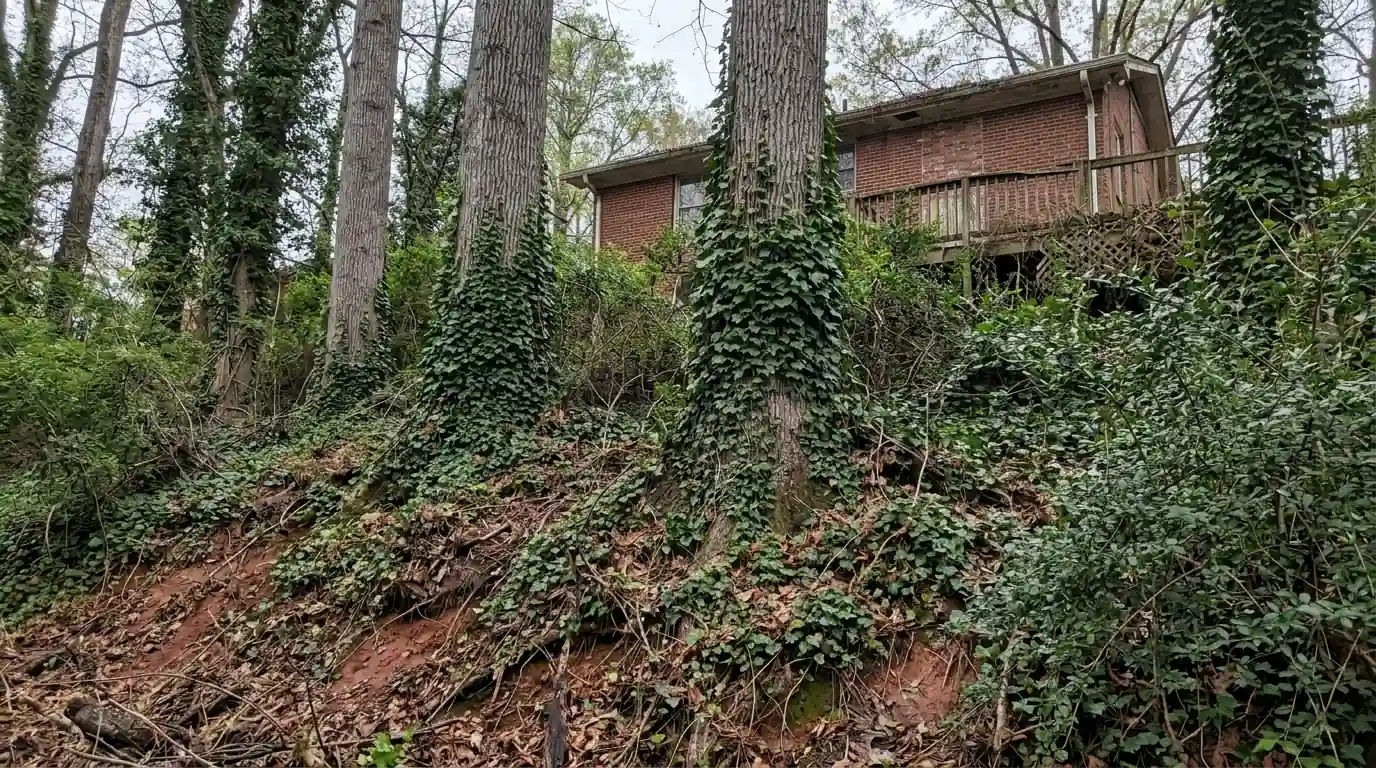
Many East Atlanta homes from the 1920s through the 1940s sit at the top of a slope, with the back of the lot falling away into a creek ravine. Those ravines were never cleared, and over the decades English ivy and Chinese privet moved in. Today the ivy runs up the trunks of tulip poplars and oaks, sometimes reaching the crown, while privet fills the space beneath them so densely that you can't see the creek from the deck.
The ivy causes more harm than it seems to. It adds weight high in the tree, catches wind like a sail and holds moisture against the bark, which invites decay. It also hides the trunk, so a crack or a cavity goes unnoticed until the tree fails. Our article on ivy and kudzu explains why vine-covered trees fall more often than clean ones.
How we take the vines and the understory back
We start by cutting every ivy vine at the base of each tree and clearing a band of trunk at about shoulder height. Up in the crown, the severed vines are left alone to wither, because ripping living ivy out of a canopy tears bark and can pull deadwood down with it. Ground ivy on the slope is cut back from the trunks so it can't climb again right away.
Privet comes out next. Smaller stems are pulled with the roots, larger ones are cut low and the brush is chipped or hauled up the hill. Once the understory is open, the slope can be replanted with natives. Our ivy removal service and brush clearing work hand in hand on these lots.
Removing trees on a slope without losing control
A tree on a ravine bank behaves differently from one on flat ground. Its roots grip a slope of red clay that softens after long rains, its lean usually points downhill toward the creek and the wood has nowhere safe to go if it's cut loose. We rig every removal on these lots so pieces lower under control and land where the ground crew can catch them, never sliding toward the water or a neighbor's fence.
Getting wood back up the slope takes time. Brush is dragged or winched to the top, logs are cut into rounds a person can carry and we leave the slope stable, often with chips spread to slow erosion. When a vine-covered tree has already shown signs of failing, our hazard tree service handles it before the next storm.
The village, Brownwood Park and the city rule
East Atlanta Village, centered on Flat Shoals Avenue, gives the neighborhood its feel, while Brownwood Park offers open lawn and mature trees a few blocks away. The houses between them are mostly modest, and so are their front yards, with the big trees concentrated in back where the ground slopes off.
Vine and privet clearing needs no permit at all. Taking a tree down does, even on the DeKalb side, because these streets fall within the city and Atlanta's threshold of 6 inches at 4.5 feet, rising to 12 for pines, is the one that counts. We also work the same ravine terrain across Ormewood Park and north toward Kirkwood.