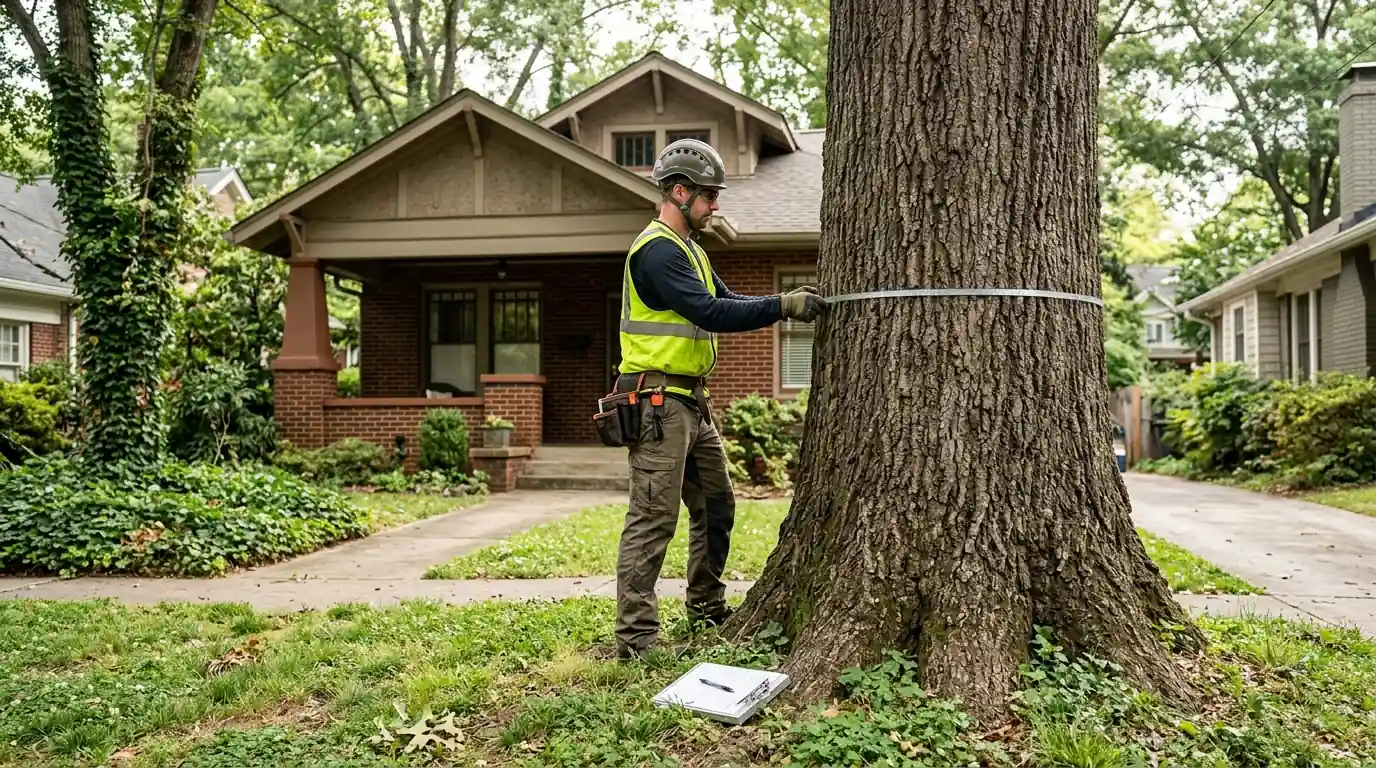
Tree removal permit help is our service for the measuring, photos, site plan sketch and application that a city or county wants before a tree can come down. Inside Atlanta city limits, most private trees 6 inches or more across at 4.5 feet need a permit, and pines start at 12 inches. Brookhaven, Decatur and the counties each run their own rules. We prepare the paperwork, but the decision is always the city's or county's.
What tree removal permit help covers
A tree permit application asks for a handful of things that are easy to get wrong if you've never done one: the trunk diameter at the right height, the species, photos that show the tree's condition, and a site plan showing where the tree stands. Our permit help covers all of that, and we prepare the application so it's complete the first time.
We start by confirming which rule applies to your address. City limits in metro Atlanta don't always match mailing addresses, so a home with an Atlanta mailing address can sit in unincorporated DeKalb, or in Brookhaven, and a Decatur address can sit outside Decatur. Getting that right decides everything else: the size threshold, the paperwork, who inspects and whether a permit is needed at all.
Once the paperwork is ready, we walk you through sending it in, or file it for you with your written authorization where the city allows that. Either way, the city or county weighs the application and makes the call. We can't promise approval, but we can make sure the reviewer has what they need to decide.
Why the reason for removal changes the paperwork
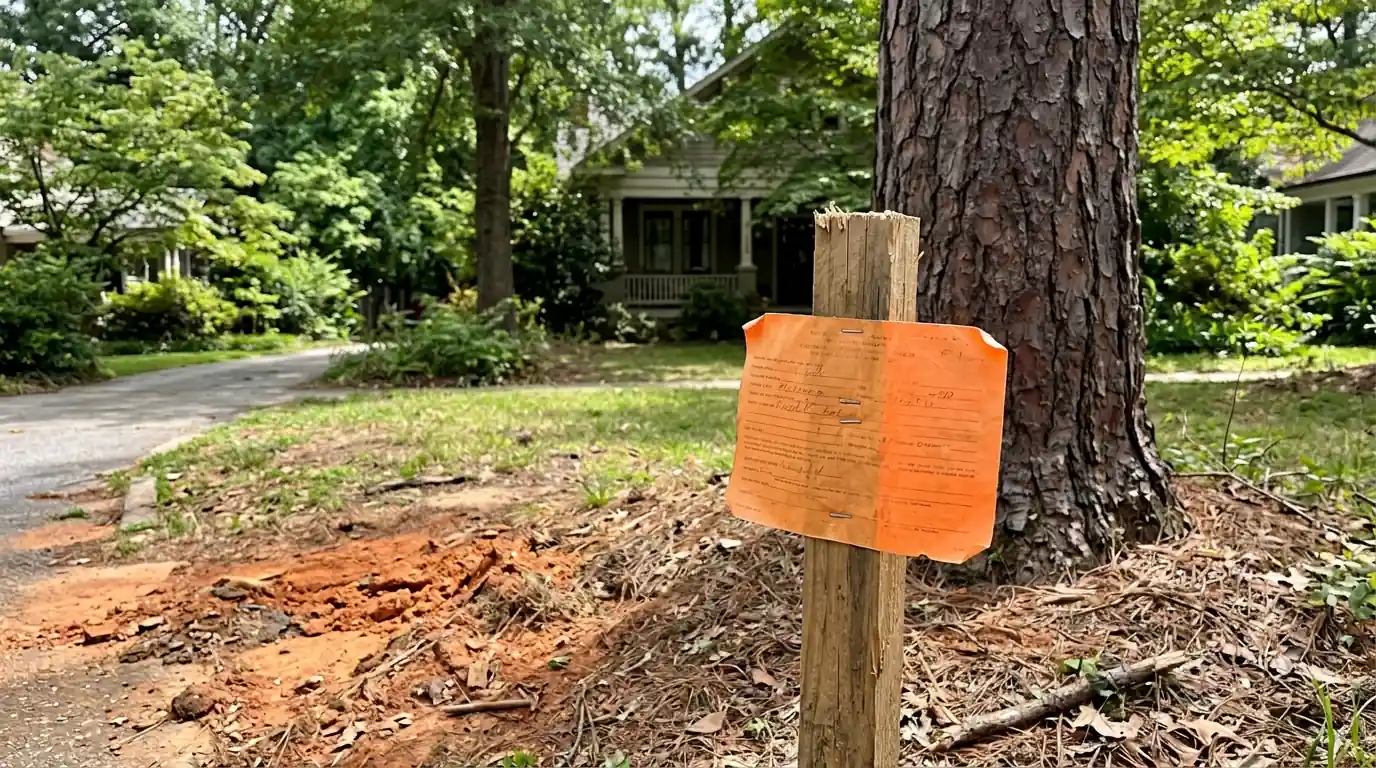
Most tree rules treat a healthy tree very differently from one that's dead, diseased or likely to fail. A healthy tree is protected canopy, so cities ask harder questions and may charge replacement fees. A tree that's already dead or hazardous is a safety problem, and the rules usually make room for it. That's why the photos and notes matter so much: they're the evidence for which category the tree falls in.
For a declining tree, we photograph the specific defects, like a cavity, a crack, conks at the base or a dead crown, and note them on the application. When a city asks for a professional's written opinion, a tree risk assessment puts the findings in writing the reviewer can use. For a dead tree, the clearest proof is often a bare crown photographed beside living trees of the same species.
Details that slow permits down
These are the problems we see most often on applications that come back for more information.
Wrong measuring height
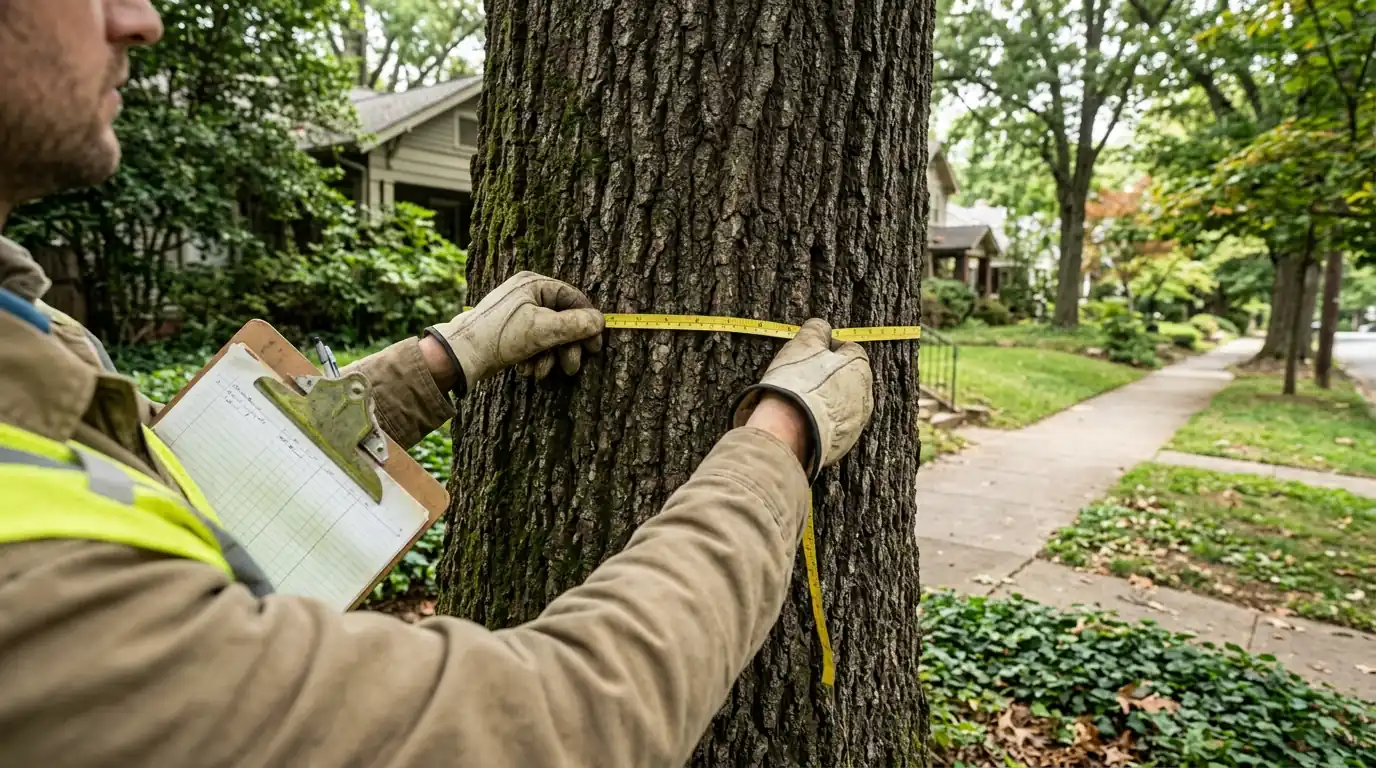
Diameter has to be measured at 4.5 feet above grade. Measuring at the base or at waist height gives the wrong number.
Photos that don't show the problem
A photo of a leafy crown doesn't show the cavity at the base. The photos need to show the reason the tree should come down.
Wrong jurisdiction
An Atlanta mailing address doesn't mean Atlanta city limits. Filing with the wrong city or county wastes weeks.
Missing site plan
Brookhaven asks for a site plan showing the tree's location with the application. A rough phone photo of the yard isn't enough.
Unclear species
Pines and specimen trees follow different rules, so naming the species correctly matters, especially for DeKalb specimen sizes.
Unknown buffers
A stream buffer, a zoning buffer or the Chattahoochee River Corridor can change the rules on a lot that otherwise needs no permit.
How we prepare a tree removal permit
Most permit jobs follow the same order, whichever city or county is involved.
- 1
Confirm the jurisdiction
We check whether your property sits inside a city with its own tree rule or in an unincorporated county area, and which rule applies to the tree.
- 2
Measure at 4.5 feet
We measure the trunk diameter at 4.5 feet above grade, the standard height most tree rules use, and note the species.
- 3
Photograph the tree
We take clear photos of the whole tree, the trunk, the root flare and any decay, cracks or dead limbs that support the reason for removal.
- 4
Sketch the site plan
A simple site plan shows the tree's location in relation to the house, the property lines and any other trees, buffers or streams nearby.
- 5
Prepare and file
We fill in the application and walk you through sending it in, or file it for you with your authorization where the city or county allows.
- 6
Post and inspect
Once a permit is issued, it's posted where it can be seen. If the city wants an inspection, we meet the inspector on site when we can.
What to have ready before the permit visit
None of these are required for us to start, but each one makes the application faster and cleaner.
- The property address and, if you have it, the parcel number from your tax bill.
- A survey or plat of the lot, which helps the site plan show property lines accurately.
- Any old permits, HOA approvals or construction plans that mention the tree.
- Photos of the tree from past years, which can show a lean or dieback getting worse.
- Your neighbor's name if the tree sits on or near the property line.
- Whether you plan to replant, so the site plan can show where a new tree would go.
- How you want the application handled: sent in by you with our help, or filed by us with your authorization.
What tree permit help costs
| Job | Typical range | Priced |
|---|---|---|
| Permit paperwork, measurements and photos | $145 to $295 | per visit |
Permit help is priced per visit and covers the measuring, photos, site plan sketch and preparing the application. Price moves with the number of trees, how much documentation the jurisdiction asks for, and whether a site plan has to show buffers, streams or many trees. City or county application fees and any replacement charges are separate and paid to them.
If we're also doing the removal, the permit work is often scheduled on the same visit as the quote, so you aren't paying for two trips. A tree that turns out to need no permit at all costs you nothing more than the visit. Our price guide shows the range for permit help alongside the removal itself.
How tree rules differ around Atlanta
These are the main rules for the cities and counties where we work most, in plain terms.
| Size or trigger | Dead or hazard trees | How it's filed | |
|---|---|---|---|
| City of Atlanta | 6 inches at 4.5 feet; pines 12 inches | Permit still needed, no application fee, city inspects | Through the city Arborist Division |
| Brookhaven | 4 inches DBH or larger | Permit still needed, subject to city arborist approval | Online Project Portal with photos and a site plan |
| Decatur | Healthy trees covered by the 2022 canopy ordinance | Dead tree affirmation with photos; hazard needs a certified arborist report | Email for dead trees; permit for diseased or hazard trees |
| Unincorporated DeKalb | More than five per lot per year, or any specimen tree | Can be removed when a certified professional documents the risk | Notice of Tree Removal reviewed by the County Arborist |
| Unincorporated Gwinnett | Generally no permit on a developed single-family lot | In the river corridor, removed by hand with the stump left | Only for buffers, conservation areas, river corridor or street trees |
Atlanta, Brookhaven, Decatur, DeKalb and Gwinnett rules in more detail
Inside Atlanta city limits, a dead, dying or hazardous tree still needs a permit from the Arborist Division, but there's no application fee for it, and no recompense applies once the city verifies the condition. Healthy trees removed under construction or landscape permits owe recompense, and City Council raised tree fees and fines in 2025, with the new rules in effect from January 2026. In Brookhaven, any tree 4 inches DBH or larger needs a permit, including dead or hazardous trees, filed through the city's Project Portal.
In Decatur, diseased trees and hazard trees that a certified arborist places at moderate or higher risk need a permit, and dead trees need an emailed affirmation with photos. In unincorporated DeKalb, specimen trees start at 30 inches for overstory species like oak and pine, 10 inches for understory species like dogwood. In unincorporated Gwinnett County, the river corridor covers land within 2,000 feet of the Chattahoochee. Our permit rules guide covers each one.
Where we do tree removal permit help around Atlanta
Crews work from our Atlanta office near the 30340 ZIP and our Duluth office. These are the places we cover most, with their main ZIP codes. See all 56 areas.
- Buckhead 30305
- Virginia-Highland 30306
- Druid Hills 30307
- Morningside 30324
- Grant Park 30312
- Kirkwood 30317
- Cascade Heights 30311
- Sandy Springs 30328
- Dunwoody 30338
- Brookhaven 30319
- Decatur 30030
- Duluth 30096
- Lawrenceville 30046
- Marietta 30060
- Smyrna 30080
- Roswell 30075
- Alpharetta 30009
- Johns Creek 30097