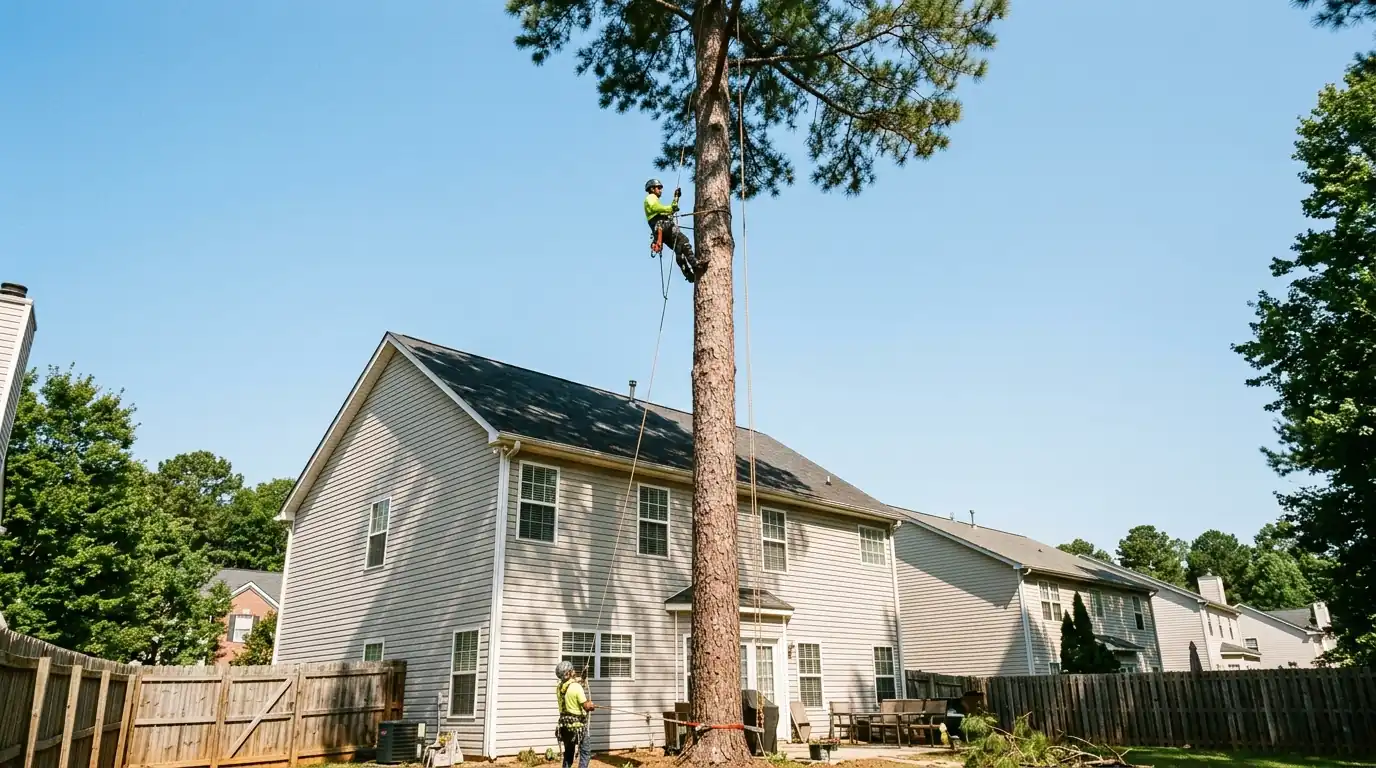
Pine tree removal is taking down loblolly, shortleaf and other pines, usually tall single-stem trees standing close to houses in north and east metro subdivisions. The most urgent cases are pines dying from southern pine beetle or Ips beetles after drought, and pines leaning in wet red clay after long rains. Inside Atlanta city limits, pines need a removal permit starting at 12 inches in diameter, not the 6 inches that applies to most other trees.
Why tall pines near houses need careful removal
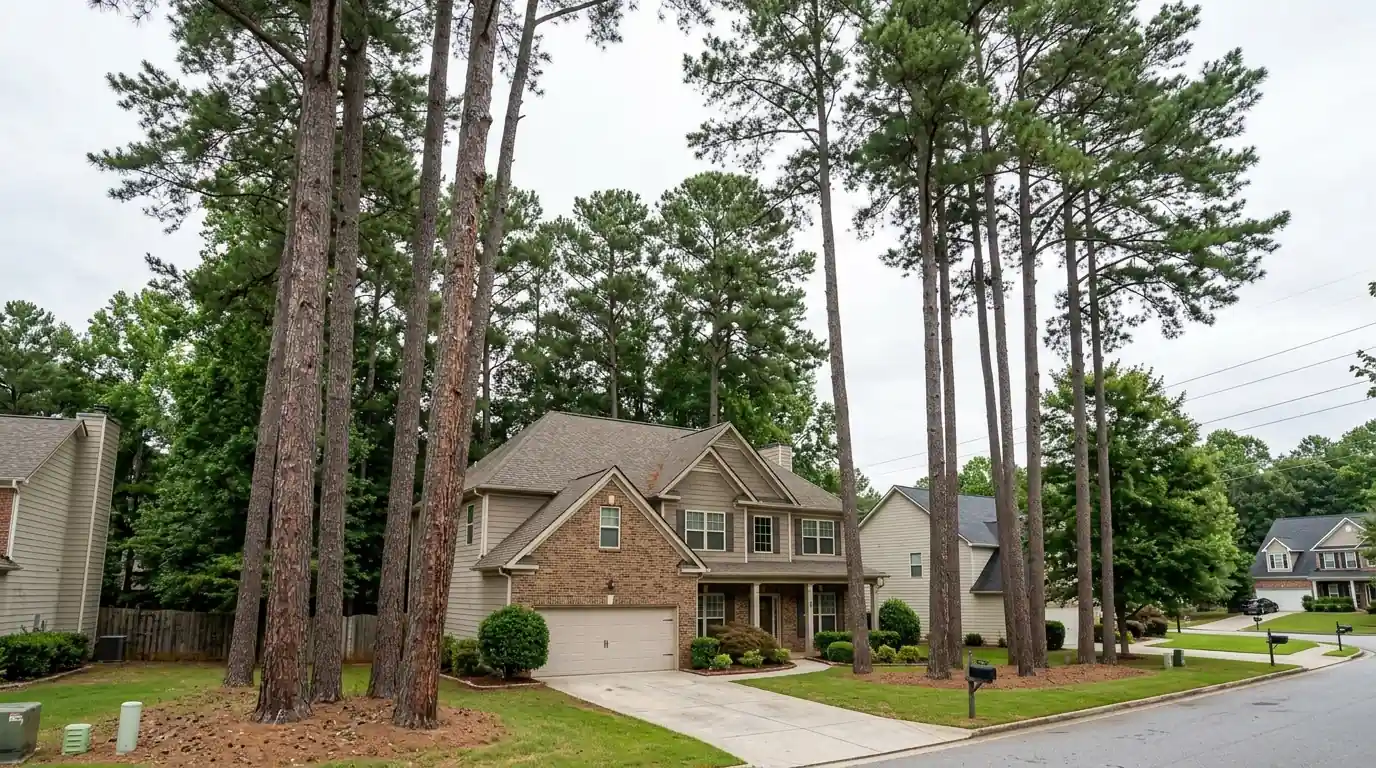
Loblolly and shortleaf pines grow fast and straight, and when subdivisions in the north and east metro were built, many were left standing between houses for shade. Decades later, those same pines can stand far taller than the houses they shade, with tall bare trunks and small crowns perched at the top. All that height and very little crown makes them easy to catch in wind and hard to drop in a small yard.
There's rarely room to fell a tall pine in one piece on a suburban lot. The usual method is a climber on spurs going up the trunk, removing the limbs from the top down, then taking the top out and cutting the trunk into rounds. Each round is lowered on a rope or, if the yard has a clear lane, dropped in a controlled direction.
Pine wood is lighter than oak, which helps with rigging, and a healthy loblolly trunk is usually sound enough for a climber to spur all the way up. But dead pines dry out and turn brittle fast, so a beetle-killed pine needs a different approach. If the top is already dry or cracked, we often take it off from a lift or with a crane instead of sending anyone past it.
Bark beetles after drought: the clock starts fast
Southern pine beetle and Ips engraver beetles are always around in Georgia pine stands, but they don't usually kill a vigorous tree. They turn deadly when pines are stressed. A dry summer, a hot spell, or roots damaged by construction or compaction gives them their opening. Once a pine is infested, the inner bark that feeds it gets girdled, and the tree usually can't be saved.
Speed matters for two reasons. First, the beetles that develop in a dying pine fly to the next pine over, so prompt removal reduces the pressure on the trees around it. Second, a dead pine dries quickly. Within months, the wood can turn brittle, the top can snap, and climbing becomes more dangerous.
When we find an infested pine, we look at the neighbors too. If nearby pines are still healthy, preventive beetle treatment may protect them, and the pine that's already gone comes down soon. We don't leave the infested wood stacked under the other pines, either. Logs from a beetle-killed tree are hauled off or chipped rather than kept as firewood beside the house.
Signs a pine is dying or ready to fail
Pines don't decline slowly the way oaks do. When something goes wrong, it usually shows in weeks, not years.
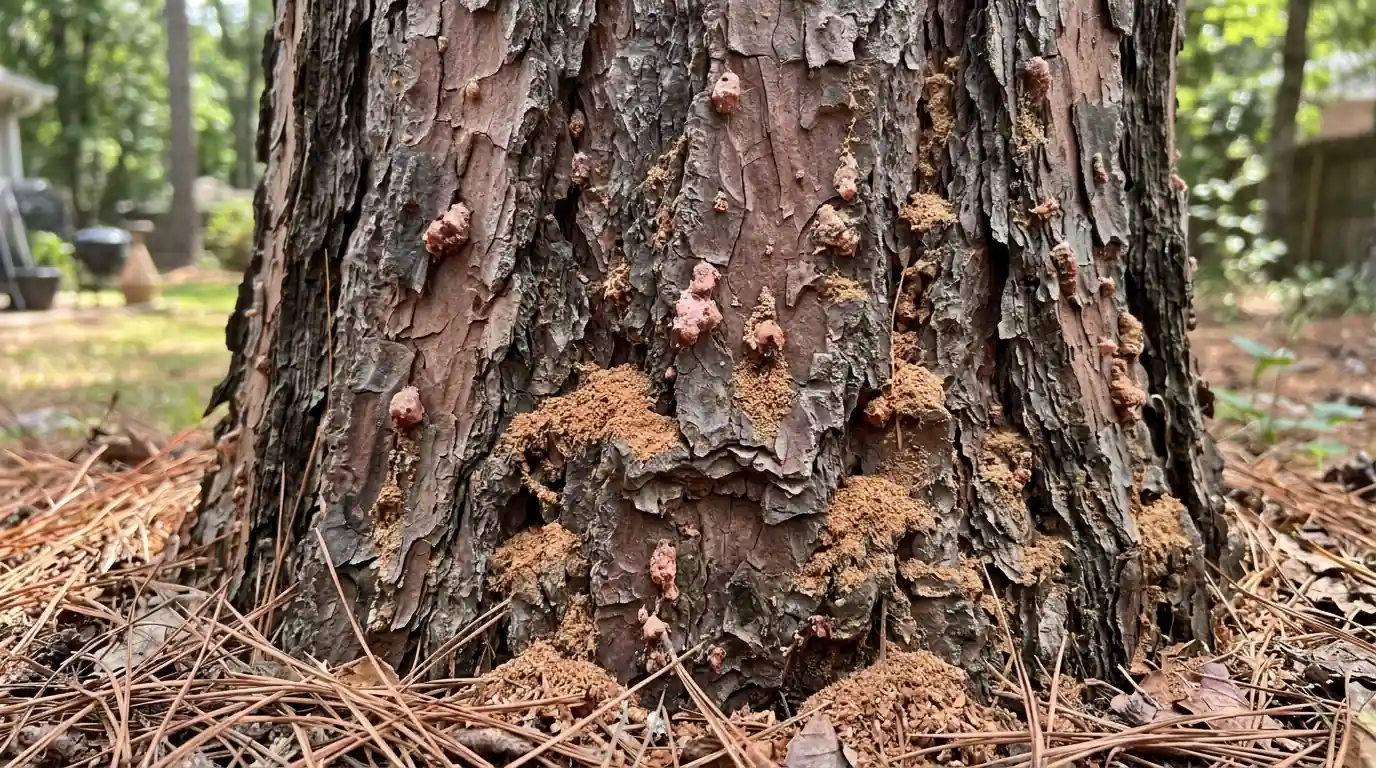
Pitch tubes on the bark
Small, popcorn-sized blobs of resin on the trunk show where bark beetles have bored in, and the tree is trying to push them out.
Fine sawdust in crevices
Reddish-brown boring dust in the bark furrows and at the base of the trunk means beetles are tunneling under the bark.
Needles fading fast
A crown that turns from green to yellow to rust in a few weeks, often starting at the top, is usually beetle-killed.
A new lean after rain
A pine that tipped toward the house after a wet week, with a lifted mound of clay on the far side, has roots letting go.
Bark sloughing off
Bark falling off in plates, revealing gray or blue-stained wood underneath, means the pine has been dead for a while.
Snapped or dead top
A broken or dead leader on a tall pine leaves heavy dead wood high in the air, right where it can do the most damage.
How we take down a tall pine next to a house
Most pine removals follow the same order, with changes for dead trees and tight yards.
- 1
Check the trunk and lean
We measure the diameter at 4.5 feet, read the lean and check for beetle signs, decay at the base and any dead top.
- 2
Clear the permit
Inside Atlanta city limits, a pine 12 inches or more across needs a permit before removal. Elsewhere we check the city or county rule.
- 3
Climb and limb
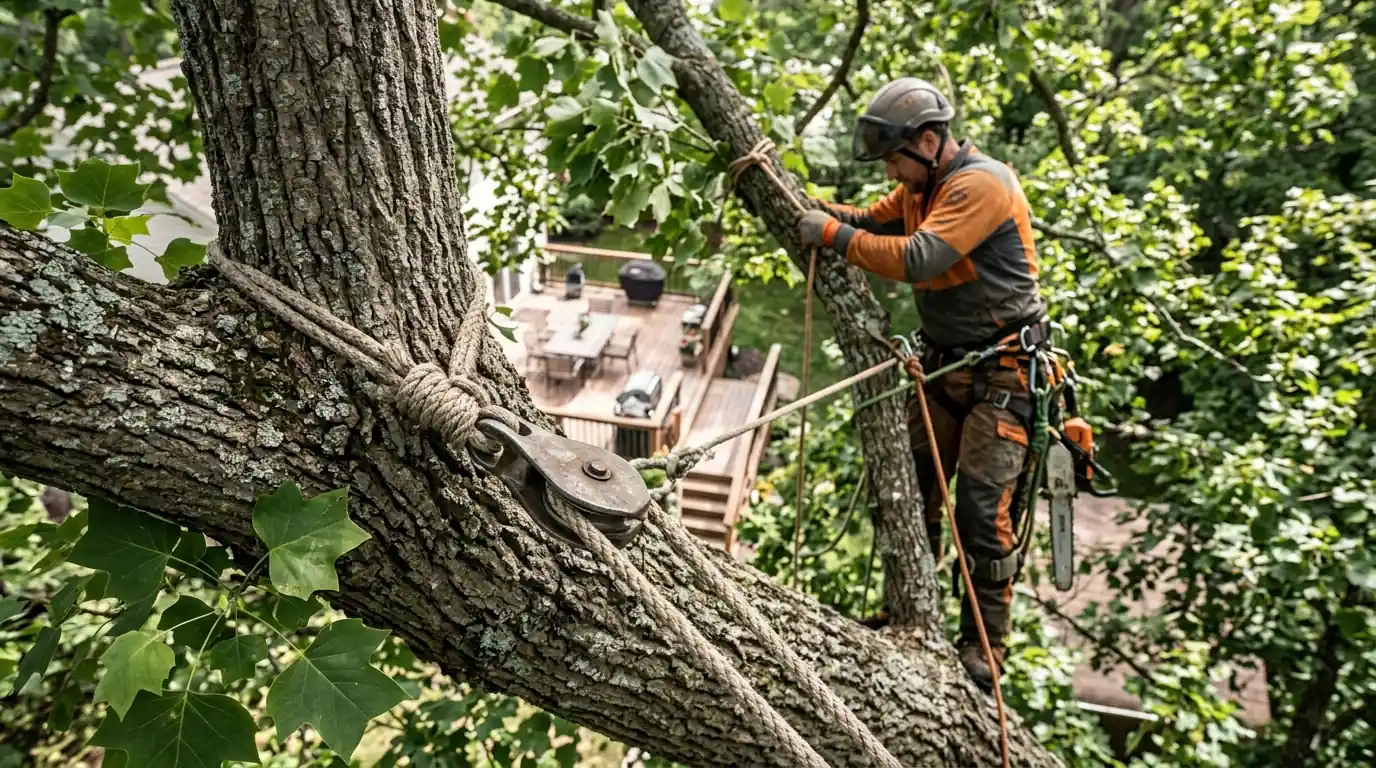
On a healthy pine, a climber goes up on spurs, removing limbs on the way. On a dead or brittle pine, a lift or crane may replace the climb.
- 4
Top the tree
The top section is cut and lowered on a rope, or dropped into a clear lane if there's room, so the trunk below it can be worked safely.
- 5
Rounds down the trunk
The trunk is cut into rounds from the top down, each sized so the lowering system can stop it before it hits anything.
- 6
Chip, haul and clean the sap
Brush is chipped, rounds are hauled or left, and we rake up needles and wipe sap from patios and cars near the work zone.
What to expect from pine sap and needles
Pine work is messier than hardwood work in a few specific ways.
- Fresh pine sap drips from cuts and can mark cars, patio furniture and decking, so move what you can.
- We lay tarps or plywood under the work zone when it sits over a deck or patio.
- Needles shower down during limbing and collect in gutters, so a gutter cleaning after the job may be worth planning.
- Sap on concrete can be scrubbed with a degreaser, and we remove what we can before leaving.
- Dead pines drop less sap but shed more bark, which we rake and blow off hard surfaces.
- Pine chips work well as mulch for paths and shrub beds if you'd like to keep a pile of them.
- Loblolly stumps don't send up sprouts the way many hardwoods do, so grinding the stump is only needed if you want the spot level for grass or planting.
What changes the cost of pine removal
| Job | Typical range | Priced |
|---|---|---|
| Single pine, 50 to 90 ft | $395 to $2,340 | per tree |
Height and the targets underneath set most of the price, and it's the targets that matter more. A tall pine with a clear lane to fall into is a quick job. The same pine leaning over a roof, with a fence, a deck and a power drop around it, has to be taken down in many small, lowered pieces. Dead pines can cost more because brittle wood means more careful rigging or a lift.
The range below covers single pines from about 50 to 90 feet in metro Atlanta. Cleanup and hauling are included. Stump grinding is separate, and you can compare it with the rest of our work on the price guide. Several pines on one lot often cost less per tree.
Pines in Atlanta's red clay and the 12-inch rule
Inside Atlanta city limits, removing a private pine 12 inches or more in diameter at 4.5 feet needs a city permit. For most other trees, the line is 6 inches. Dead or beetle-killed pines still need the permit, but there is no application fee and no replacement charge once the city confirms the condition. Outside the city, the county or local rule applies.
Tall pines are common in Johns Creek, Suwanee and Snellville, where subdivisions were cut into pine stands. Georgia red clay holds water after long rains and keeps pine roots shallow, so a pine that has stood through years of dry storms can tip after a wet week. Our article on tall pines near the house covers when to keep, trim or remove one.
Where we do pine tree removal around Atlanta
Crews work from our Atlanta office near the 30340 ZIP and our Duluth office. These are the places we cover most, with their main ZIP codes. See all 56 areas.
- Buckhead 30305
- Virginia-Highland 30306
- Druid Hills 30307
- Morningside 30324
- Grant Park 30312
- Kirkwood 30317
- Cascade Heights 30311
- Sandy Springs 30328
- Dunwoody 30338
- Brookhaven 30319
- Decatur 30030
- Duluth 30096
- Lawrenceville 30046
- Marietta 30060
- Smyrna 30080
- Roswell 30075
- Alpharetta 30009
- Johns Creek 30097