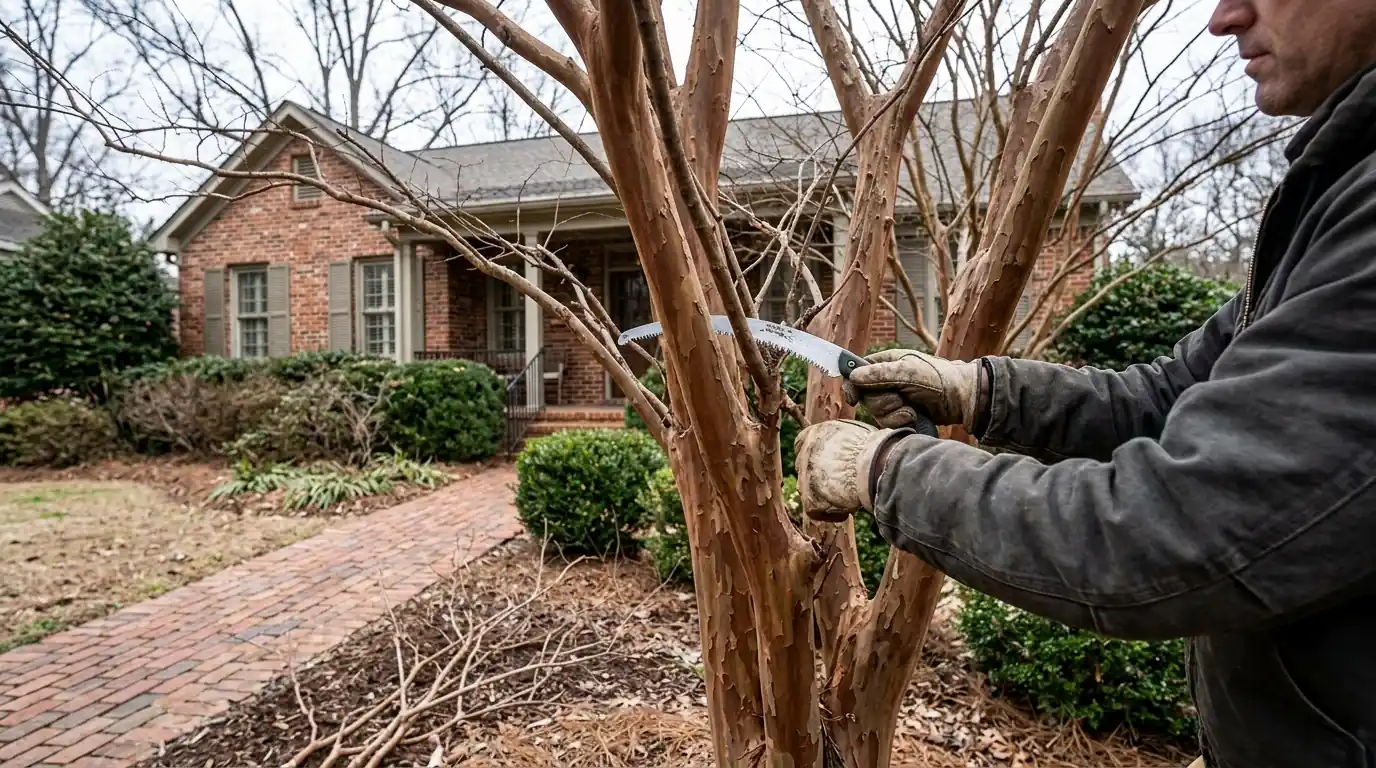
Crape myrtle pruning is light, selective late-winter work that removes root suckers, crossing and rubbing branches, and stems growing into the center, while keeping the tree's natural vase shape. It is not topping, the practice locals call crape murder, which leaves swollen knuckles and weak whippy sprouts. In Atlanta, crape myrtles also face crape myrtle bark scale, so we check the bark for the telltale black sooty mold while we prune.
Why crape myrtles get topped and why it hurts them
Every February, crews across Atlanta cut crape myrtles back to the same height, leaving a row of thick stubs at the top of each trunk. People do it because they believe it makes the tree bloom more, or because they've always seen it done. Locals have a name for it: crape murder. It doesn't help the tree, and over the years it does real damage.
Each time a crape myrtle is topped at the same point, the tree forms a swollen knot of tissue, often called a knuckle. Out of that knuckle comes a bundle of long, thin, whippy sprouts. Those sprouts do flower, but they're weakly attached and flop over when the blooms get heavy or wet. The knuckles themselves can decay, and the tree loses the smooth, sculptural trunk that makes crape myrtles worth growing.
Proper crape myrtle pruning removes a little wood at a time from the right places. The trunks are left to grow, the canopy fills out naturally, and the tree blooms on sturdier branches. If your trees have already been topped for years, we can start to correct them, as we explain further down.
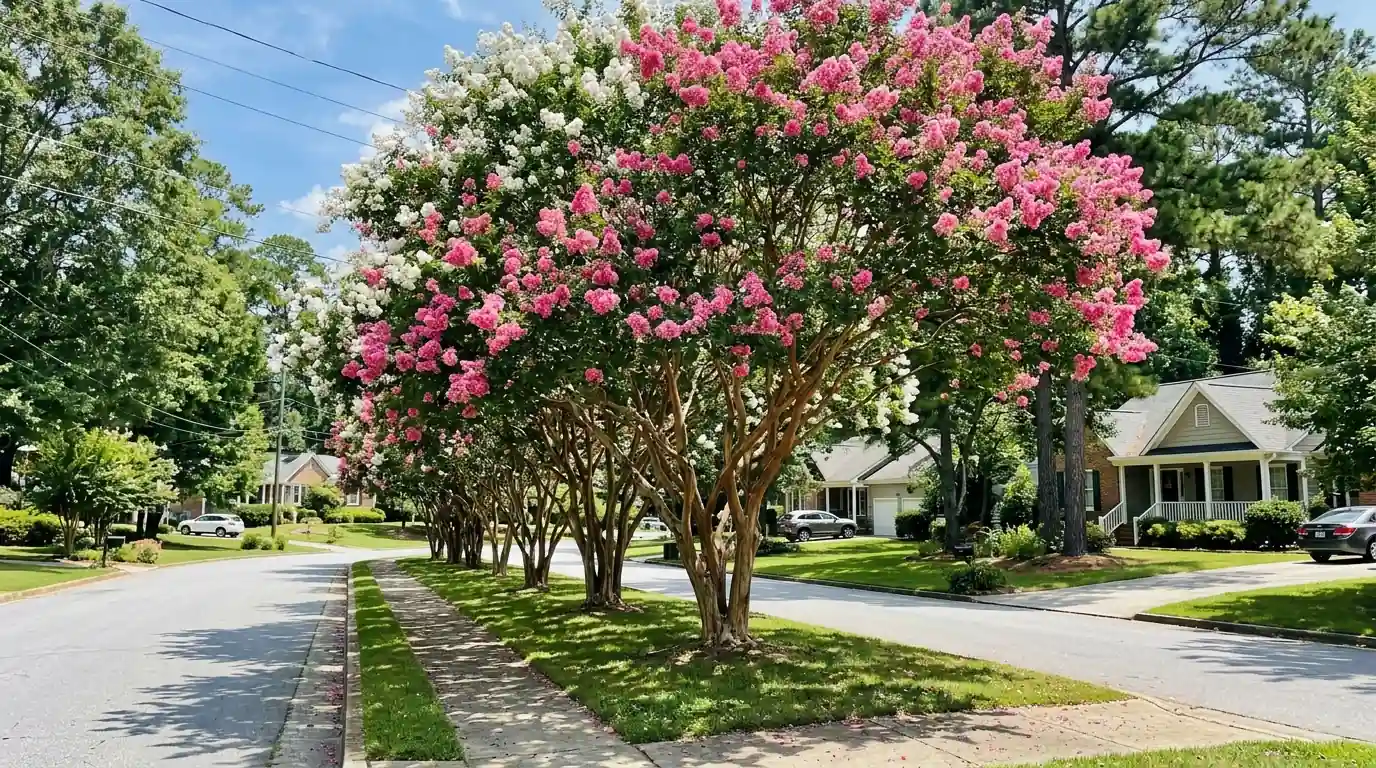
Choosing the right crape myrtle instead of cutting it back every year
A lot of crape myrtle topping happens because the tree is simply too big for its spot. Crape myrtles come in sizes from compact shrubs under five feet to tree forms over twenty-five feet tall. A large variety planted beneath a window or next to a front walk will always outgrow the space, and cutting it back every winter only treats the symptom.
If you're planting new crape myrtles or replacing old ones, choosing a variety whose mature size fits the space is the surest way to avoid ever having to top it. If you already have trees that have been topped for years, we can start restoring them by selecting a few of the strongest sprouts on each knuckle and removing the rest, then letting those grow into new branches. It takes a few seasons, but the tree regains its shape.
Crape myrtle bark scale: what to watch for
This insect has spread across the Southeast, and Atlanta crape myrtles are well within its range.
Black bark
The most visible sign is black sooty mold coating the trunks and branches, which grows on the sticky honeydew the insects produce.
White or gray crusty spots
Look closely at branch crotches and pruning wounds for small white or gray felt-like bumps. Crushed, they may ooze a pink fluid.
Sticky leaves and surfaces
Honeydew dripping onto leaves, cars and patio furniture below is another clue that scale is feeding on the tree.
Fewer blooms
A heavily infested crape myrtle may bloom less and grow more slowly as the insects drain its energy.
Spread to nearby plants
Bark scale can move to other crape myrtles nearby, so one infested tree is worth dealing with quickly.
Treatment options
Scale is controlled with targeted insect treatment, and scrubbing the trunks can remove much of the sooty mold.
What a well-pruned crape myrtle looks like afterward
Use this to judge the work on your own trees, whoever does it.
- Three to five main trunks rising from the base, evenly spaced and not rubbing each other.
- No root suckers or base shoots crowding the trunks at ground level.
- Smooth trunks clear of small side shoots up to about head height.
- An open center, with branches angled up and out rather than back toward the middle.
- Cuts made at a trunk or side branch, with no flat stubs left in midair.
- No fresh knuckles, and no row of trees all cut to the same height.
- A tree that looks lighter and more open, not shorter.
How we prune a crape myrtle in late winter
Late winter, before new leaves break, is the window for crape myrtle work in Atlanta.
- 1
Remove root suckers
Shoots coming up from the roots or the base of the trunks are cut off at the ground so they don't steal energy from the main tree.
- 2
Clear crossing branches
Stems that cross or rub each other are thinned out, keeping the stronger one and removing the other at its origin.
- 3
Open the center
Branches growing back toward the middle of the tree are removed to keep the vase shape open and airy.
- 4
Lift the lower trunks
Small side shoots along the lower trunks are taken off so the smooth bark shows, which is half the appeal of the tree.
- 5
Take seed heads if you like
Removing old seed clusters is optional and mostly cosmetic. We clip the ones within reach if you'd prefer a tidier look.
- 6
Check for bark scale
While we work, we look over the trunks and branches for crape myrtle bark scale and the black sooty mold that comes with it.
Crape myrtles on Atlanta streets and front walks
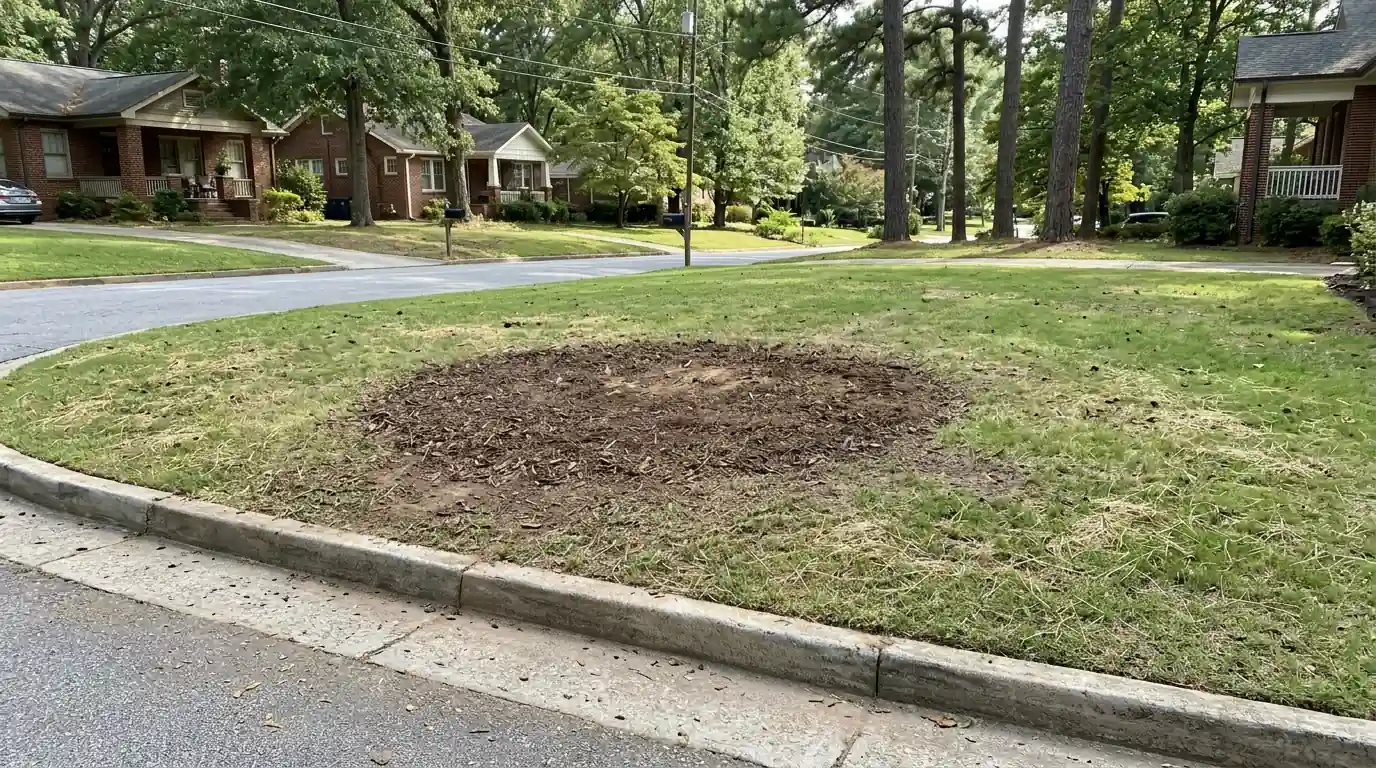
Crape myrtles are everywhere in metro Atlanta, from the medians of commercial roads to the front walks of brick ranches. In Smyrna and Marietta, many newer neighborhoods were planted with rows of them along driveways and sidewalks, and many have been topped every winter since. Correcting those trees is some of the most satisfying work we do.
Intown, older crape myrtles in Midtown courtyards and front gardens have grown into large, multi-trunk specimens with smooth, mottled bark. They need little more than a light thinning and sucker removal each winter. A homeowner inside city limits needs no permit to prune a crape myrtle, and the ordinance's pruning standards still cover how it's cut. Our post on pruning without topping has more detail if you'd like to do some of the work yourself.
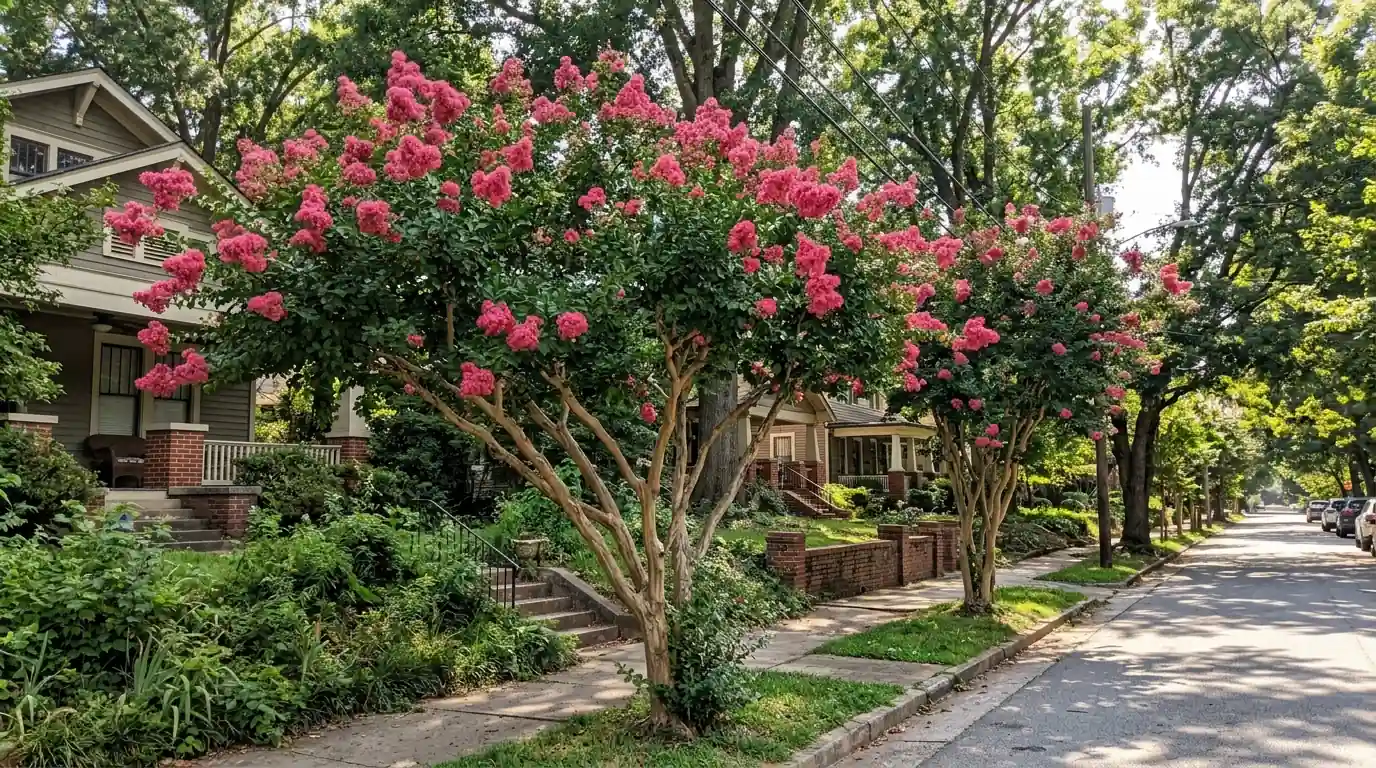
Proper crape myrtle pruning versus topping
Both happen in late winter, but the trees they leave behind look nothing alike by summer.
| Proper pruning | Topping, or crape murder | |
|---|---|---|
| Cuts made | Selective, back to a trunk or side branch | Every stem cut at one height, often mid-branch |
| What grows back | Sturdy branches spread through the crown | Clusters of long, whippy sprouts from swollen knuckles |
| Blooms | Plenty, on branches that hold them up | Heavy heads on weak sprouts that bend and flop |
| Bark and trunks | Smooth, mottled trunks on display | Trunks hidden by knobby knots and sprouts |
| Long-term health | Strong structure, fewer wounds | Repeated wounds, decay at the knuckles |
What crape myrtle pruning costs
| Job | Typical range | Priced |
|---|---|---|
| Crape myrtle pruning | $85 to $265 | per tree |
Crape myrtle pruning is one of our lower-cost services because most of the work is done from the ground or a short ladder with hand saws and loppers. The price depends on the size of the tree, the number of trunks, how many suckers have grown up and whether the tree needs restoration after years of topping.
Several crape myrtles on the same property or along one street frontage are priced together, which brings the cost per tree down. Cleanup and hauling of the cut stems are included. Restoring a tree that has been topped for years may take a visit each winter for two or three seasons, and if a tree needs scale treatment, that's priced separately. See our price guide for typical ranges.
Where we do crape myrtle pruning around Atlanta
Crews work from our Atlanta office near the 30340 ZIP and our Duluth office. These are the places we cover most, with their main ZIP codes. See all 56 areas.
- Buckhead 30305
- Virginia-Highland 30306
- Druid Hills 30307
- Morningside 30324
- Grant Park 30312
- Kirkwood 30317
- Cascade Heights 30311
- Sandy Springs 30328
- Dunwoody 30338
- Brookhaven 30319
- Decatur 30030
- Duluth 30096
- Lawrenceville 30046
- Marietta 30060
- Smyrna 30080
- Roswell 30075
- Alpharetta 30009
- Johns Creek 30097