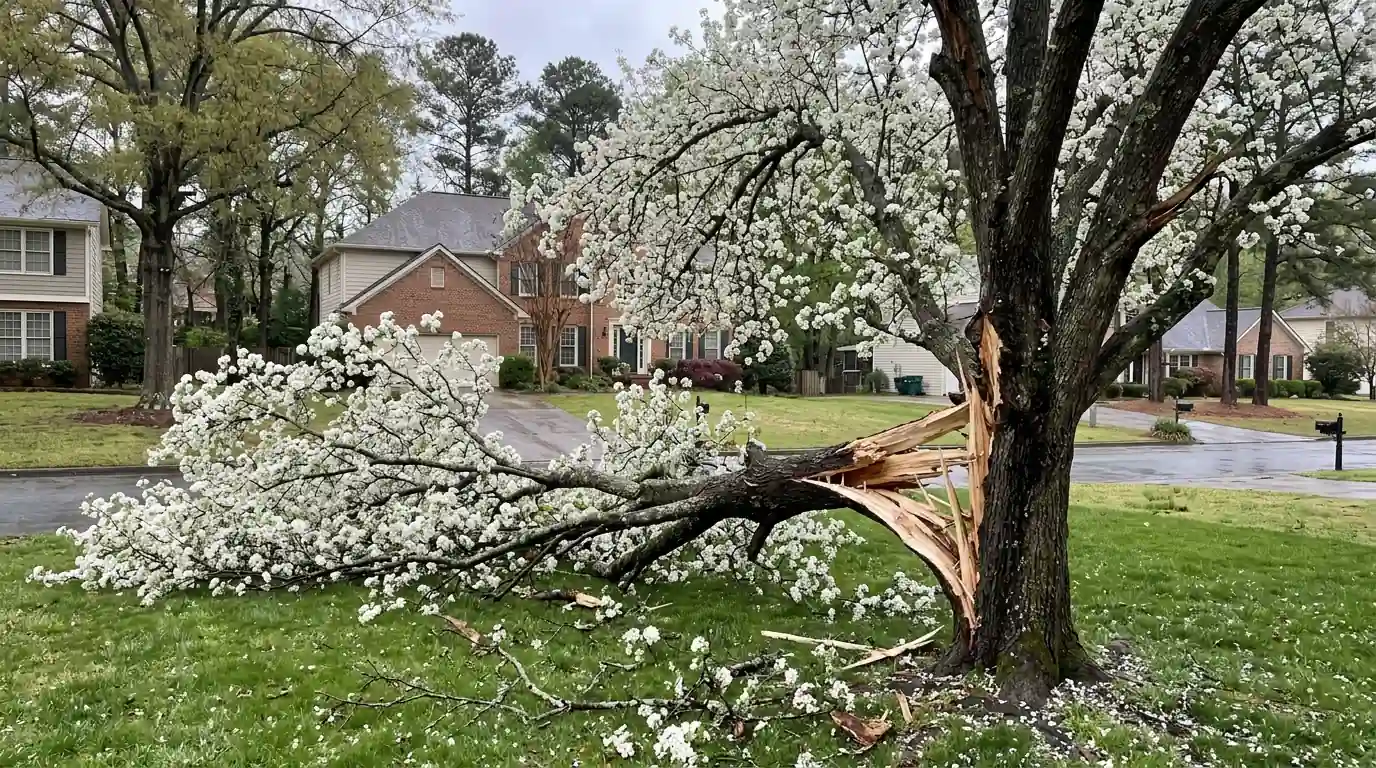
Bradford pear removal means cutting down a Callery pear, usually in sections, then grinding the stump so the roots don't send up a thicket of sprouts. Most Bradfords grow tight V-shaped forks with bark trapped inside, and those forks tend to split once the tree is 15 to 25 years old. In metro Atlanta they also seed into woods and fence lines. Inside Atlanta city limits, a pear 6 inches across or larger needs a city permit first.
Why Bradford pears split on their own
A Bradford pear grows a lot of upright limbs from almost the same spot on the trunk. Each one widens every year, and because they start so close together, the bark between them gets pinched and folded inward instead of being pushed out. That trapped strip is called included bark, and it means the limbs are pressed against each other rather than grown into each other. The fork looks solid from the yard, but there is very little wood holding it.
For the first ten years or so, the limbs are light enough that it doesn't matter. Somewhere between 15 and 25 years, the crown gets heavy and dense, and a spring thunderstorm, a wet snow or an ice glaze loads it past what those forks can carry. One limb peels away, often taking a long strip of trunk with it, and the tree is left lopsided or split in two. Pruning can lighten a young pear, but it can't fix forks that are already fused with bark.
Size makes it worse. A mature Bradford is often 30 to 45 feet tall and nearly as wide, planted close to a driveway, a sidewalk or the front of the house. When half of it comes down, it lands on whatever was underneath. Taking the tree down on your schedule, in controlled pieces, is a much smaller job than cleaning up after it splits during a storm.
The smell, the seeds and the thickets along Georgia fence lines
Every March, Bradford pears cover themselves in white blossoms, and every March people notice the smell. The flowers give off a sharp, unpleasant odor that hangs over driveways, cul-de-sacs and parking lots for a week or two. It's often the first thing homeowners mention when they call about one, even before the split forks.
The bigger problem is what happens after the flowers. Bradford pears were sold as sterile, and a single tree mostly is. But different Callery pear varieties cross-pollinate, and now that so many kinds have been planted near each other, the trees set small, hard fruit that birds eat and spread. The seedlings that come up are not the tidy Bradford shape. They revert to the wild type, often with long, sharp thorns.
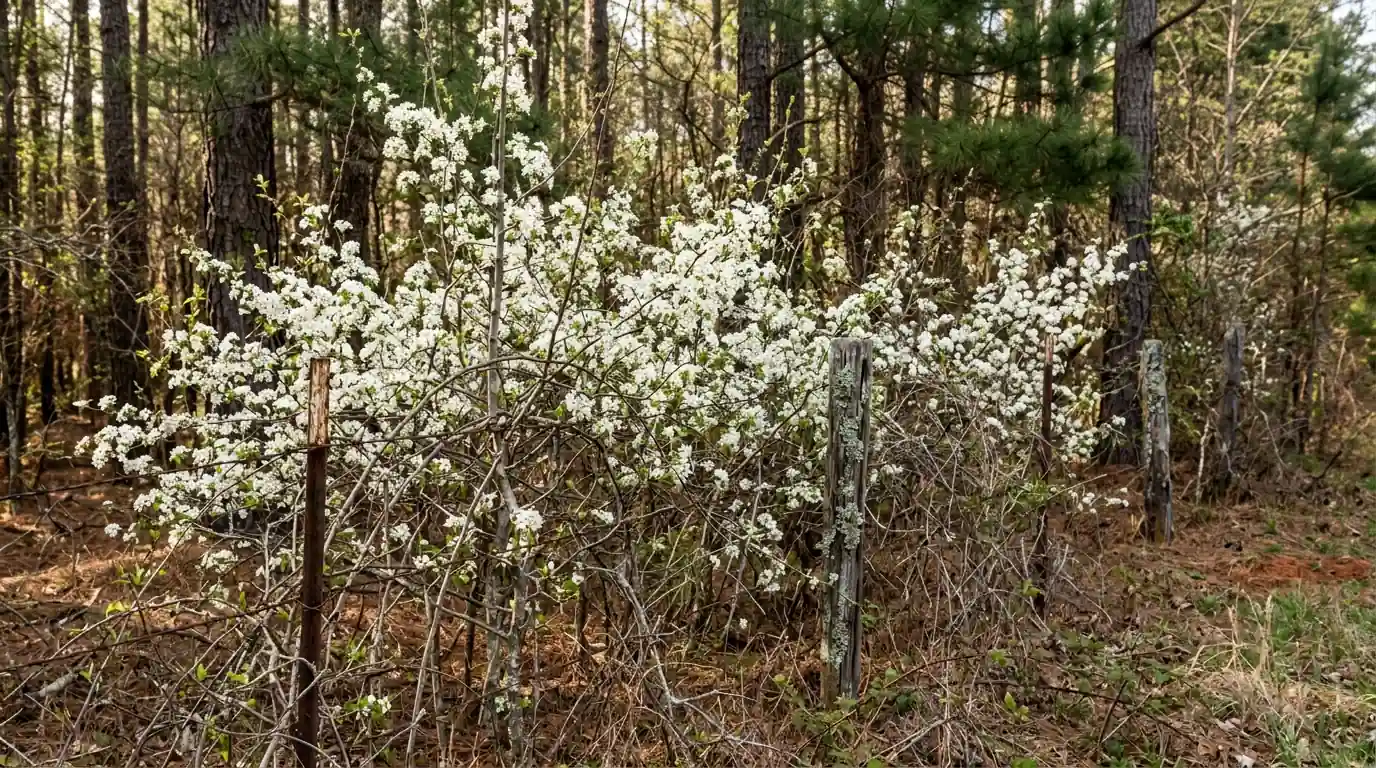
Those seedlings grow fast in open ground, and across Georgia they now grow into dense, thorny thickets along fence lines, road edges, power line corridors and the margins of woods. In spring you can see them as streaks of white along highways and in fields. Removing a pear in your own yard won't clear the countryside, but it does take one more seed source out, and it stops the seedlings in your beds and behind your fence.
Why the stump needs grinding, and what to plant instead
A Callery pear doesn't give up when it's cut down. The stump and shallow roots carry dormant buds, and within weeks a fresh stump can push up a ring of shoots that come back thicker every time they're cut. Left alone, those sprouts turn into a multi-stemmed, thorny clump that is harder to remove than the original tree. Grinding the stump and the root collar below grade is what stops most of it, and it's why we treat the grind as part of the job, not an extra. Our stump grinding page explains how deep we go.
For the spot where the pear stood, native flowering trees give you the spring show without the split or the smell. Eastern redbud blooms pink-purple on bare branches in March. Serviceberry flowers white, sets berries the birds clean up in early summer and turns orange in fall. Flowering dogwood suits partial shade near taller trees, and native black cherry or Chickasaw plum works on a sunny edge. Our tree planting crew can help you pick one that fits the space at its mature size.
Signs your Callery pear is close to splitting
Some Bradfords hang on for years after these show up, but each one says the clock is running.
A dark seam below a fork
A line of folded bark running down from where two big limbs meet is included bark, and it marks the weakest point in the tree.
A crack that opens in wind
A split you can see widen and close as the crown moves means the fork has already started to fail.
One side broken off
Once a Bradford loses a major limb, the remaining limbs are unbalanced and the next split usually follows within a few seasons.
Oozing or rot at an old wound
Dark staining or soft wood where a limb tore away lets decay into the trunk right where the remaining forks attach.
Crown wider than it is tall
A broad, dense, lollipop-shaped crown is heavy, and the extra weight sits right on the forks.
Seedlings showing up nearby
Young pears popping up in beds, woods and fence lines mean your tree, or a neighbor's, is fruiting and spreading.
How a Bradford pear comes down and stays down
The cutting is usually quick. The stump work is what keeps it from coming back.
- 1
Look and measure
We check the forks, the lean and what sits under the crown, and measure the trunk at 4.5 feet to see whether a permit applies.
- 2
Permit where needed
Inside Atlanta city limits, a pear 6 inches or larger needs a city permit, and a split or hazardous one still goes through the Arborist Division.
- 3
Limb it in sections
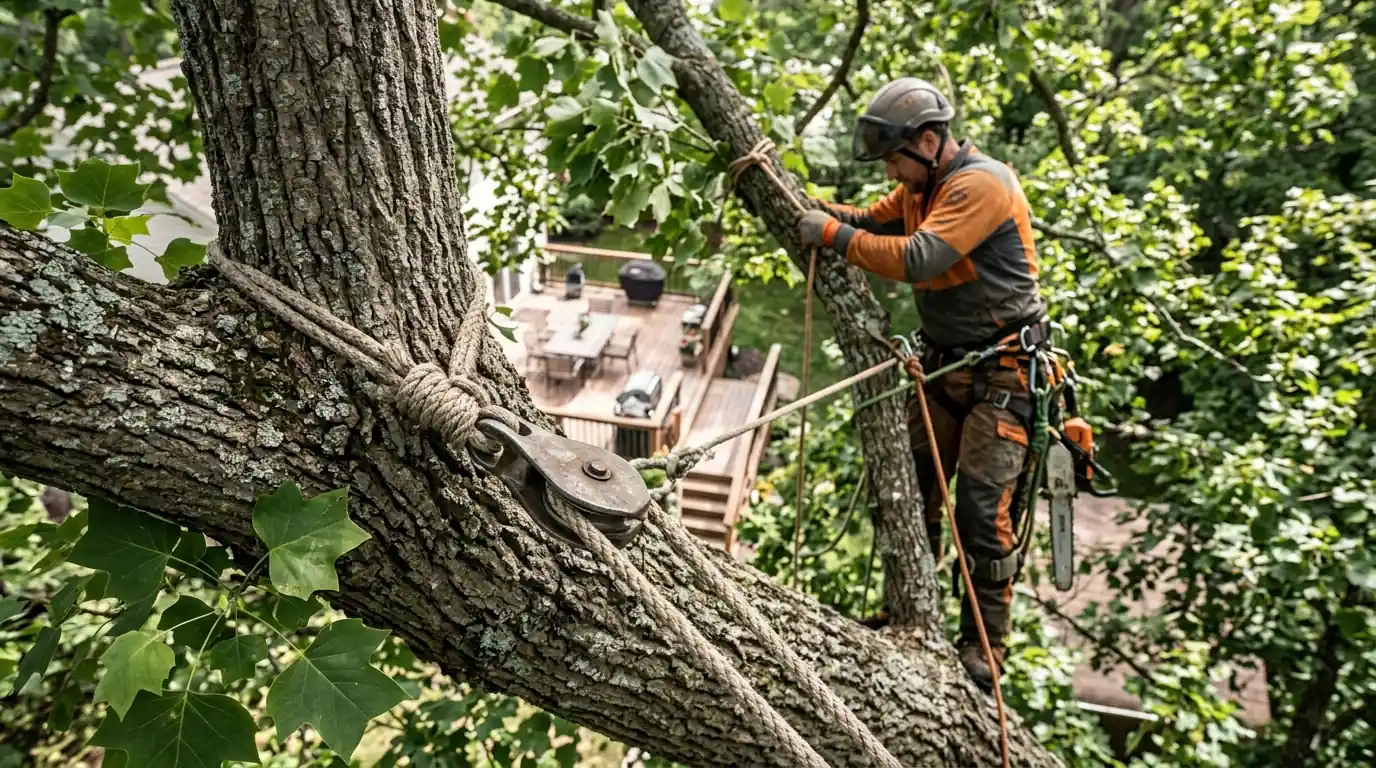
A climber or a lift takes the limbs off one at a time, lowering any over a roof, a car or a sidewalk on a rope.
- 4
Drop the trunk
The trunk comes down in rounds or is felled into a clear lane, and the brush goes straight into the chipper.
- 5
Grind the stump
After a Georgia 811 locate, we grind the stump and root collar below grade, which takes out most of the buds that would sprout.
- 6
Catch the sprouts
If a few root suckers come up the first season, mowing them or pulling them while they're small wears them out.
What moves the price of Bradford pear removal
| Job | Typical range | Priced |
|---|---|---|
| Callery or Bradford pear, 25 to 45 ft | $345 to $1,290 | per tree |
Size and what's underneath decide most of it. A 25 foot pear in an open front lawn is a short job, while a 45 foot tree spreading over a roof, a driveway and the power drop has to be taken apart limb by limb. A tree that has already split often costs more, because the broken wood is under tension and has to be cut carefully before the rest can come down.
Chipping, hauling and cleanup are included. Stump grinding is quoted with the removal and shown as its own line, though for a pear we strongly suggest doing it. Several pears in one visit, such as a row along a driveway, lower the cost of each. Typical ranges are on our tree removal price guide.
Callery pears in Atlanta subdivisions and the rules that apply
Bradford and other Callery pears were the standard builder tree for decades, so they line driveways, subdivision entrances and front yards all over the metro. In newer neighborhoods in Johns Creek, Suwanee and Alpharetta, many of those trees are now right at the age when the forks give out. We often get calls after a spring thunderstorm, when half a pear is lying across a driveway and the other half is still standing.
Inside Atlanta city limits, removing a pear 6 inches or more across needs a permit from the Arborist Division. A split or hazardous pear still needs one, but there is no application fee and no recompense once the city verifies its condition. Brookhaven requires a permit at 4 inches and up, while unincorporated Gwinnett County generally lets homeowners remove trees on a developed lot unless the tree sits in a buffer. When a pear has already split and is hanging over a roof or a walk, our hazardous tree crew handles it first and the paperwork follows the rules for a hazard.
Where we do bradford pear removal around Atlanta
Crews work from our Atlanta office near the 30340 ZIP and our Duluth office. These are the places we cover most, with their main ZIP codes. See all 56 areas.
- Buckhead 30305
- Virginia-Highland 30306
- Druid Hills 30307
- Morningside 30324
- Grant Park 30312
- Kirkwood 30317
- Cascade Heights 30311
- Sandy Springs 30328
- Dunwoody 30338
- Brookhaven 30319
- Decatur 30030
- Duluth 30096
- Lawrenceville 30046
- Marietta 30060
- Smyrna 30080
- Roswell 30075
- Alpharetta 30009
- Johns Creek 30097