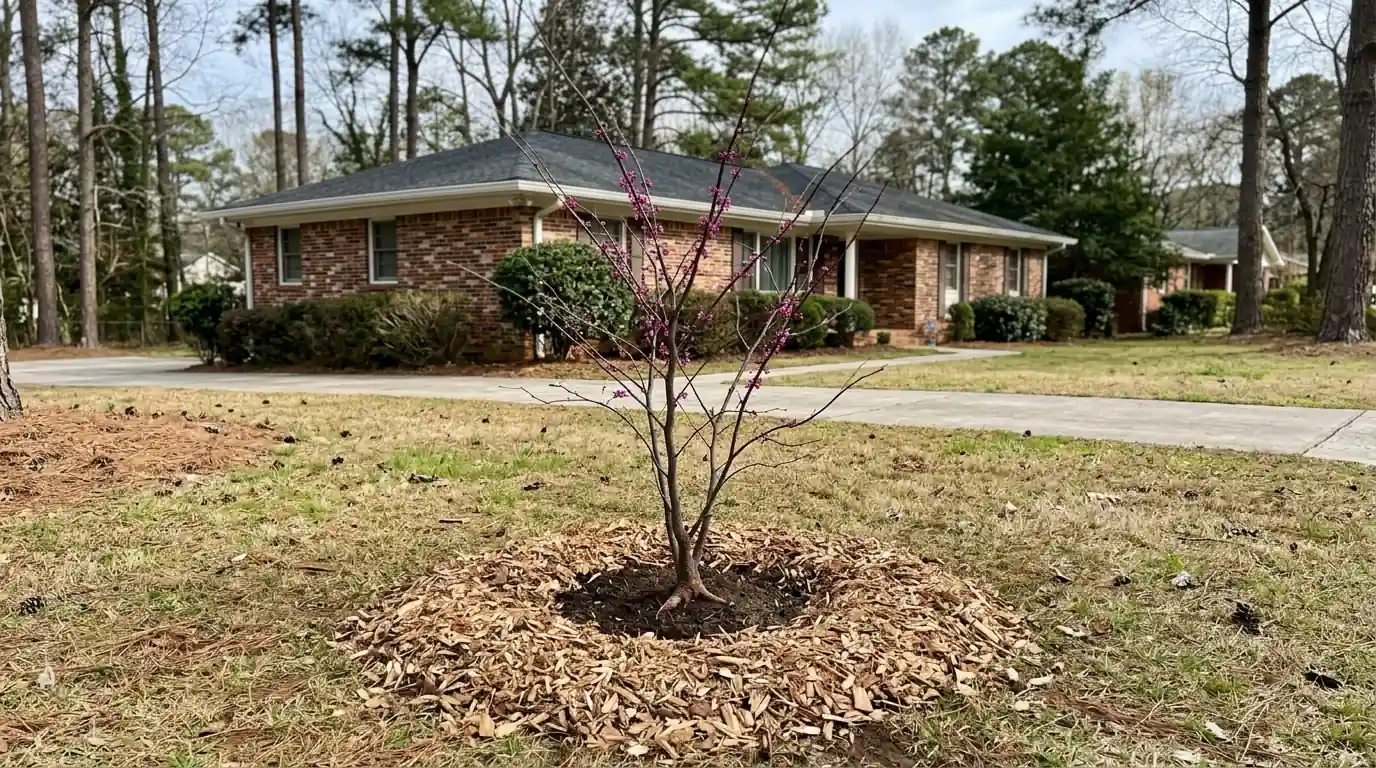
Tree planting means choosing a tree that suits the spot, digging a wide, shallow hole, setting the tree with its root flare visible at the soil line, mulching in a flat ring and watering it through its first summers. Around Atlanta that usually means natives like willow oak, white oak, red maple, tulip poplar, black gum, redbud, dogwood, serviceberry and river birch. We also plant replacement trees that a city permit requires and transplant small trees to better spots.
Right tree, right place, before the first shovel goes in
Most tree problems we fix twenty years later started on planting day. A willow oak set six feet from the foundation ends up lifting the patio and rubbing the gutters. A tulip poplar planted under a power line will be pruned into an odd shape for the rest of its life. A dogwood placed in full afternoon sun on a hot slope struggles every August. Picking the tree for the space it will fill at maturity saves all of that.
So we start by looking at the spot: how much sun it gets, how wet the soil stays after a storm, what's overhead, what's underground, and how close the house, driveway and property line are. Then we suggest a few species that fit, with their mature height and spread, so you can choose with the full picture. Shade tree, screen, flowering accent or a tree for a wet low corner all lead to different picks.
Transplanting small trees to a better spot
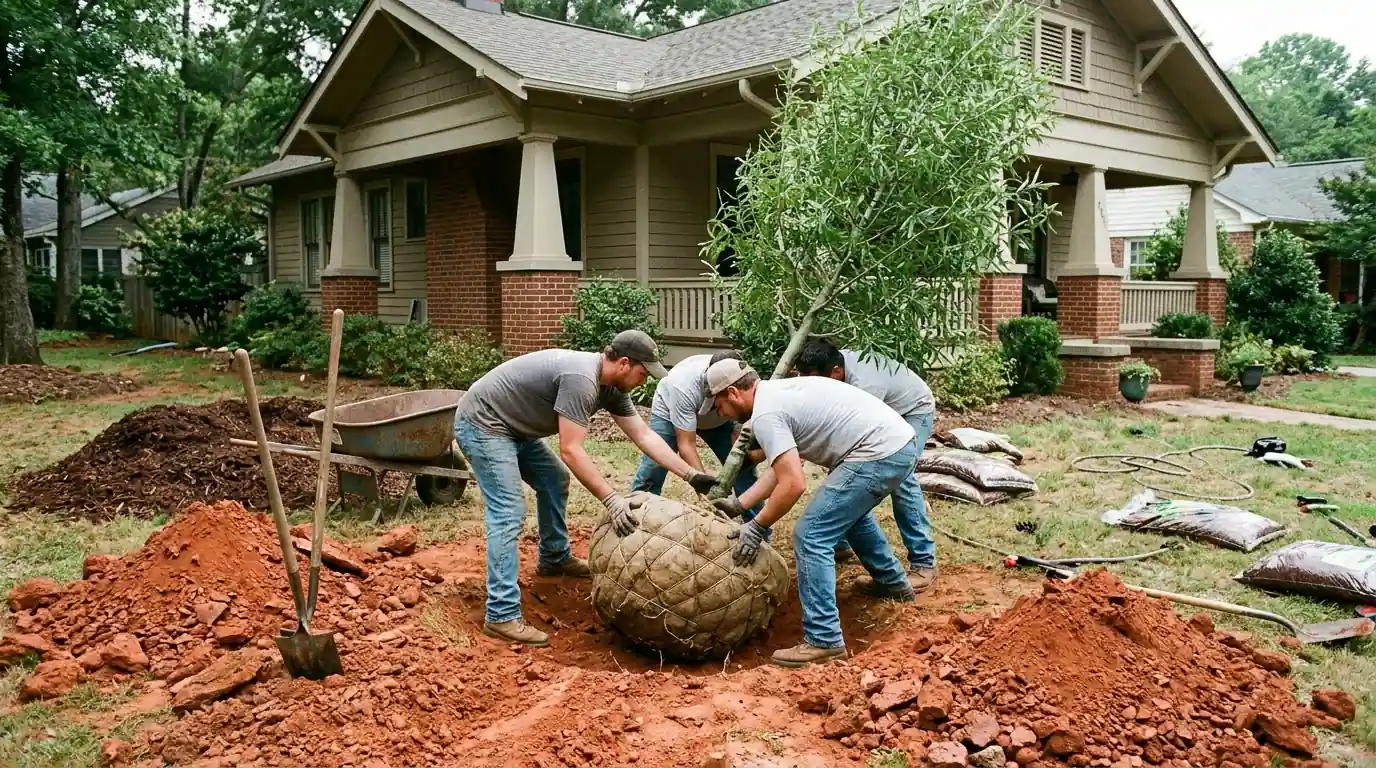
Sometimes the right tree is already in the yard, just in the wrong place. A young dogwood crowding a walkway, a Japanese maple that outgrew a foundation bed, or a volunteer oak sprouting by the fence can often be moved. Small trees handle the move far better than big ones, and the job is easiest while they're dormant, from late fall through winter.
We dig a root ball as large as we can carry for the tree's size, wrap it to hold the soil together, and move it straight to a hole already dug at the new spot. It goes in with the root flare at grade, gets mulched and watered like any new planting, and will usually sulk for a season while it regrows roots. Trees past a certain size don't move well, and we'll tell you when planting a new one makes more sense.
Trees we plant most often around Atlanta
Native species handle Georgia clay, summer heat and wet winters well when they're placed with room to grow.
Willow oak and white oak
Long-lived shade trees for big yards. Willow oak grows faster with fine, narrow leaves; white oak is slower and lives for centuries.
Red maple
Adaptable to wet or dry spots, with early red flowers and strong fall color. Give it room, because it spreads wide.
Tulip poplar
Very tall and fast-growing, and it belongs well away from the house, where its height becomes an asset instead of a worry.
Black gum
A tough native with glossy leaves and some of the brightest red fall color in Georgia, and it tolerates wet clay.
Redbud and dogwood
Small spring-flowering trees for the edge of woods, a front bed or partial shade under taller trees.
Serviceberry
A small native with white spring flowers, summer berries the birds clean up, and orange fall color.
River birch
Peeling cinnamon bark and a love of moist ground, a good choice for low spots and rain gardens.
How we plant a tree so it lasts
The details below are what separate a tree that takes off from one that just survives.
- 1
Mark utilities first
We file a Georgia 811 locate before digging with equipment, and you point out irrigation, lighting cable and drain lines.
- 2
Dig wide, not deep
The hole goes two to three times as wide as the root ball and no deeper than the ball itself, so the tree sits on firm soil.
- 3
Find the root flare
We pull back excess soil from the top of the ball until the flare, where trunk widens into roots, shows at grade.
- 4
Fix the roots
Wire baskets and burlap come off the top, and circling roots on container trees are cut or teased out so they grow outward.
- 5
Backfill with native soil
We refill with the clay that came out, broken up, rather than rich mix that leaves the roots happy in a pot-shaped hole.
- 6
Mulch flat and wide
A ring of mulch two to three inches deep goes out several feet, kept a hand's width off the trunk, never piled up like a volcano.
- 7
Water it in
The tree gets a slow, deep soak on planting day, and you get a simple watering schedule for the months ahead.
Watering a new tree through its first Atlanta summers
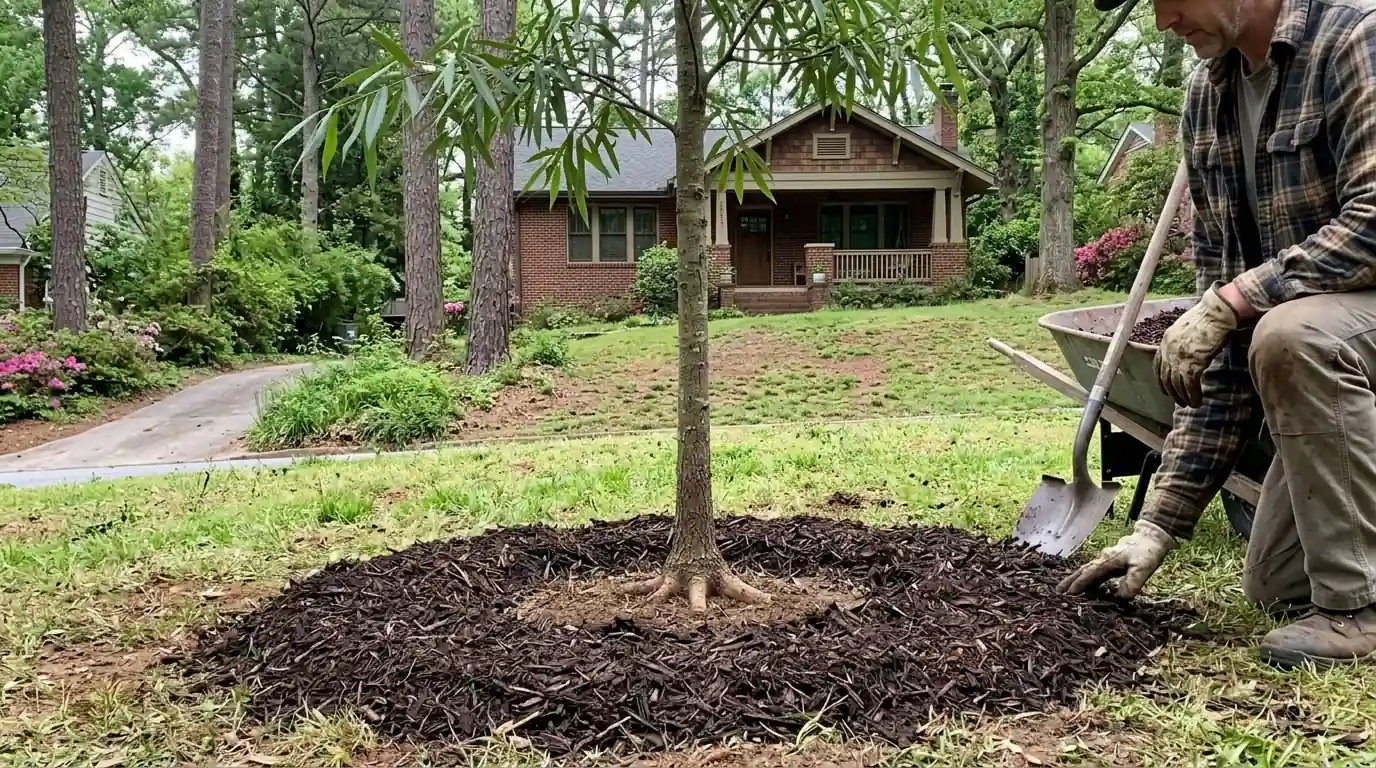
Most new trees that die are lost to dry roots in the first two summers, so this schedule matters.
- For the first few weeks, soak the root ball slowly two or three times a week.
- After that, give a slow, deep watering about once a week from spring through fall.
- In summer droughts, water twice a week, letting a hose trickle at the base for 20 to 30 minutes.
- Water the root ball and the soil just beyond it, not the trunk.
- Skip a session after a soaking rain, since wet clay can drown new roots.
- Keep the mulch ring weeded and refreshed, and keep the mower and string trimmer away from the trunk.
- Plan on watering through the second summer, and the third for larger trees.
What moves the price of tree planting
| Job | Typical range | Priced |
|---|---|---|
| Tree planted, sized by container or ball | $245 to $1,450 | per tree |
Tree size sets most of the cost. A small container redbud is a quick plant, while a large balled and burlapped oak takes more digging, more hands and sometimes equipment to move into place. Access matters too: a back yard reached only by a narrow gate or a long set of steps takes longer than an open front lawn. Clearing old roots or a ground stump from the planting spot adds time.
Price includes the tree, planting, mulch ring and watering instructions. Transplants are priced by tree size, how far it moves and how hard the new hole is to dig. If you're replacing a tree we removed, grinding the old stump first is a separate service. Typical ranges are listed on our price guide, and young trees can be added to a yearly care plan for their first few seasons.
Planting for Atlanta's canopy and its tree rules
Atlanta's tree canopy covered 45.7 percent of the city in 2023, down from 46.5 percent in 2018, and about 72 percent of the remaining trees stand on land zoned for single-family homes. That makes every yard tree count. In older intown neighborhoods like Candler Park and East Lake, we often plant young oaks and black gums to take over from aging water oaks that are nearing the end of their lives.
When a healthy tree comes down under a City of Atlanta construction or landscape permit, the owner owes recompense, and planting replacement trees on site is part of how many people meet that. We plant those trees to the spacing and species the permit plan calls for, and set them so they'll survive their first summers. Decatur and Brookhaven have their own canopy rules, and our permit help covers the paperwork side.
Where we do tree planting and transplanting around Atlanta
Crews work from our Atlanta office near the 30340 ZIP and our Duluth office. These are the places we cover most, with their main ZIP codes. See all 56 areas.
- Buckhead 30305
- Virginia-Highland 30306
- Druid Hills 30307
- Morningside 30324
- Grant Park 30312
- Kirkwood 30317
- Cascade Heights 30311
- Sandy Springs 30328
- Dunwoody 30338
- Brookhaven 30319
- Decatur 30030
- Duluth 30096
- Lawrenceville 30046
- Marietta 30060
- Smyrna 30080
- Roswell 30075
- Alpharetta 30009
- Johns Creek 30097