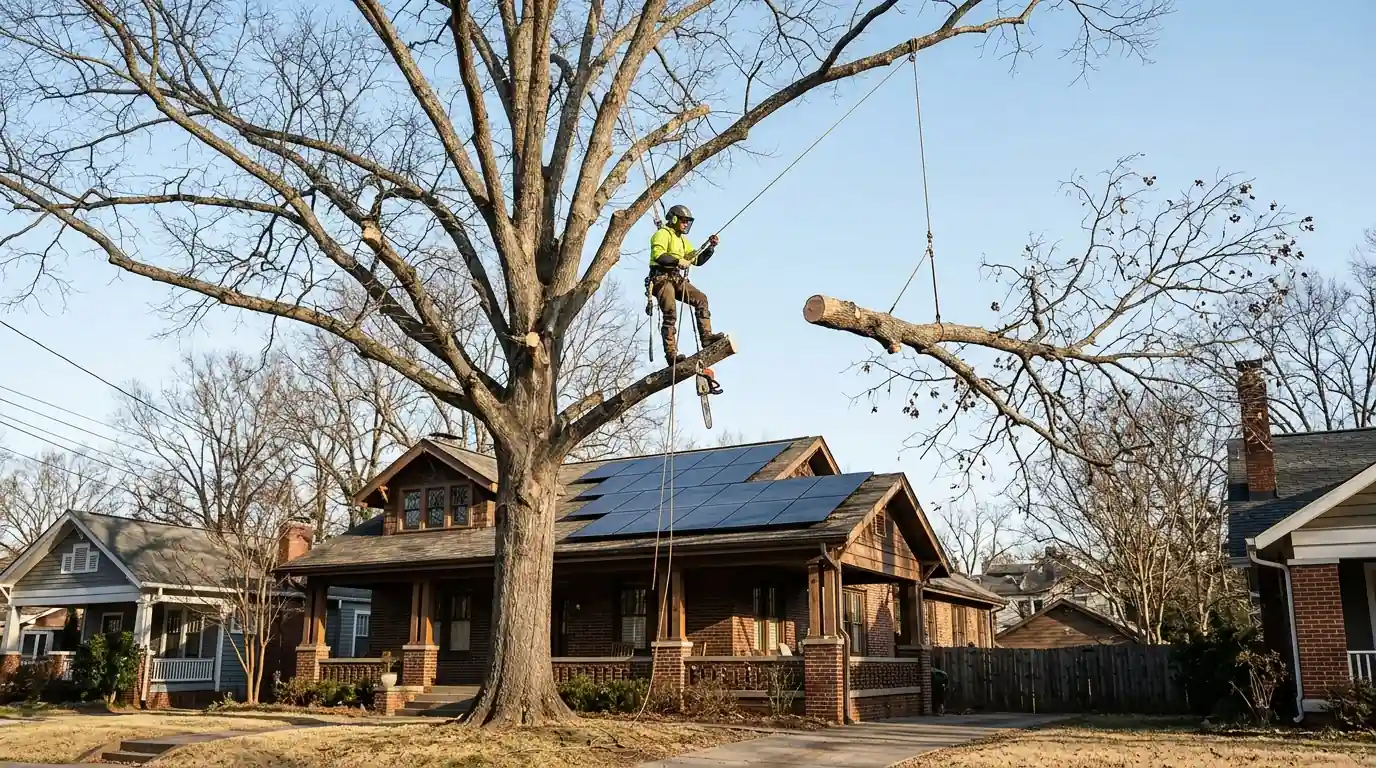
Solar panel tree clearing means reducing, raising or removing the trees that shade a rooftop or ground-mounted array, planned around where the sun actually travels over your lot. In Georgia, trees on the south and west sides matter most. Inside Atlanta city limits, removing a tree 6 inches across or larger at 4.5 feet still needs a city permit, while pruning needs none, so careful crown work often keeps both the panels and the shade you like.
Which trees actually shade a solar array in Georgia
In metro Atlanta, the sun crosses the southern half of the sky for most of the year. In summer it rises in the northeast, climbs nearly overhead at midday and sets in the northwest, so short trees close to the house barely touch the panels. In winter it stays low in the south all day, and even a tree well across the yard can throw a shadow far longer than it is tall, straight across a south-facing roof.
That makes trees on the south side of the array the first suspects, especially in the cooler months. Trees to the west matter next, because they shade the afternoon hours when a west-facing array does much of its work. Trees to the east cost you some morning production, and trees to the north rarely matter unless the panels face north or the tree towers over the roof itself.
Species matter as much as direction. A big oak, hickory or tulip poplar to the south drops its leaves in late fall, so its winter shadow is a lacy pattern of branches rather than a solid block. Loblolly pines hold their needles all year, and a stand of tall pines on the south side shades the array right through December, when the sun is lowest and every hour of light counts.
Working with your solar installer and the regrowth that follows
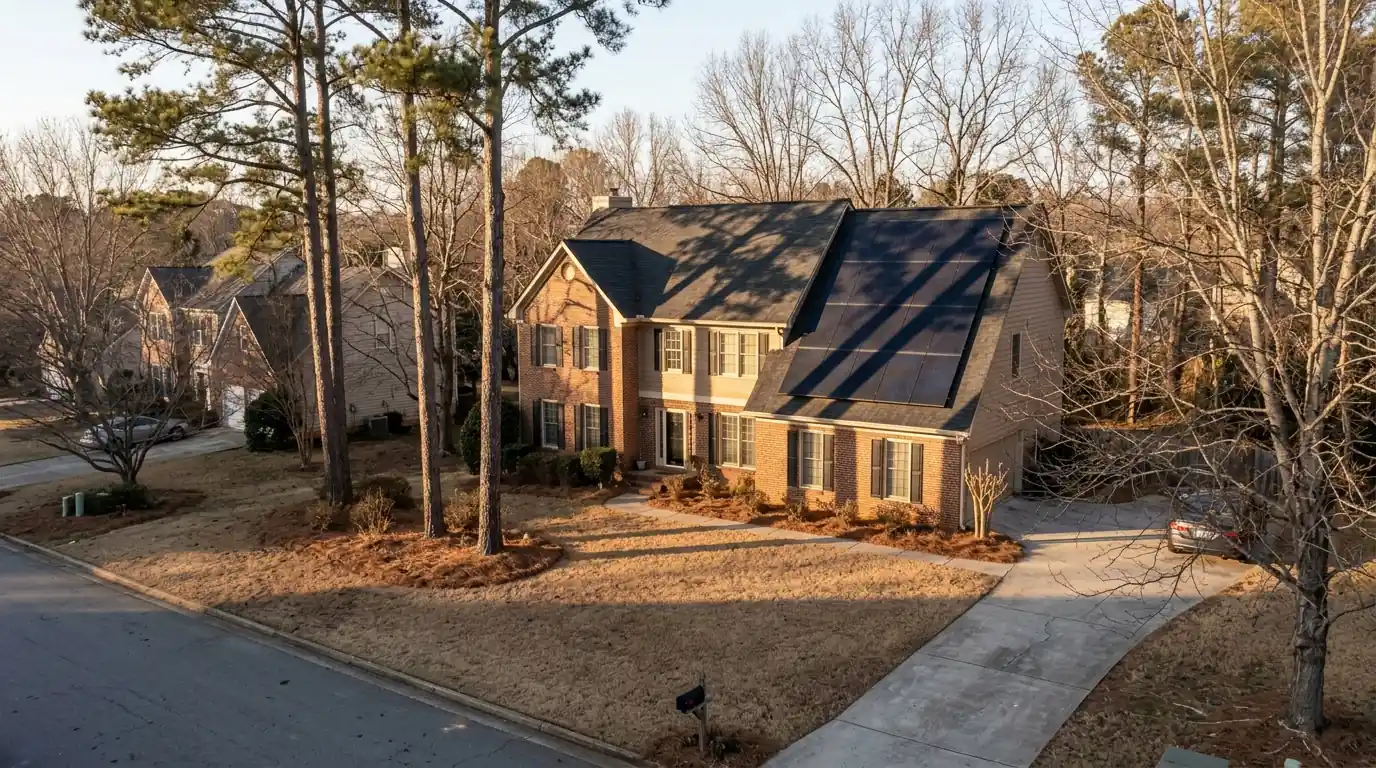
If your installer ran a shade study before the system went in, that report is the most useful map we can get. It shows which parts of the roof lose sun and when. Bring it to the walk-through and we'll match each shaded zone to a limb or a tree. If the panels aren't up yet, doing the tree work first means nobody works over new glass.
Clearing for solar is not a one-time job when the tree stays. Oaks, maples and poplars respond to a reduction by pushing new shoots from the cut points, and in a few seasons those shoots reach back toward the light over your roof. Plan on a regrowth trim every two to four years, depending on the species and how much was taken the first time. A yearly care plan keeps that on a schedule so the shade never builds back up unnoticed.
Signs the canopy is costing your panels power
Your monitoring app and a few walks around the yard at different times of day tell most of the story.
Output drops at the same hour each day
A dip that shows up every afternoon at about the same time usually lines up with one tree or one big limb to the west.
Winter production well below the estimate
If the array meets its numbers in June but falls short from November through February, low sun is passing through south-side trees.
One string or panel group lags the rest
Panel-level monitoring that shows one corner underperforming often points to a single limb shading that part of the roof.
Shadows moving across the panels
Watch the roof at midmorning and midafternoon. Moving patches of shade on the glass are lost power.
Leaves and needles collecting on the glass
Pine needles and oak leaves that pile up at the bottom edge of the panels mean limbs are close overhead and dropping debris.
Branches touching the roof or racking
Limbs rubbing the roof near an array scrape shingles and can bend panel frames or wiring as they swing in wind.
How we clear trees around a solar array without touching the panels
Working beside an array changes how every limb comes down, so the plan starts on the ground.
- 1
Map the shade
We note the array's direction and tilt, look at your monitoring data or the installer's shade report if you have one, and pick out the trees that line up with the sun path.
- 2
Choose the cuts
For each tree we decide between reduction, raising or removal, and we tell you how much light each option should give back.
- 3
Check permits and lines
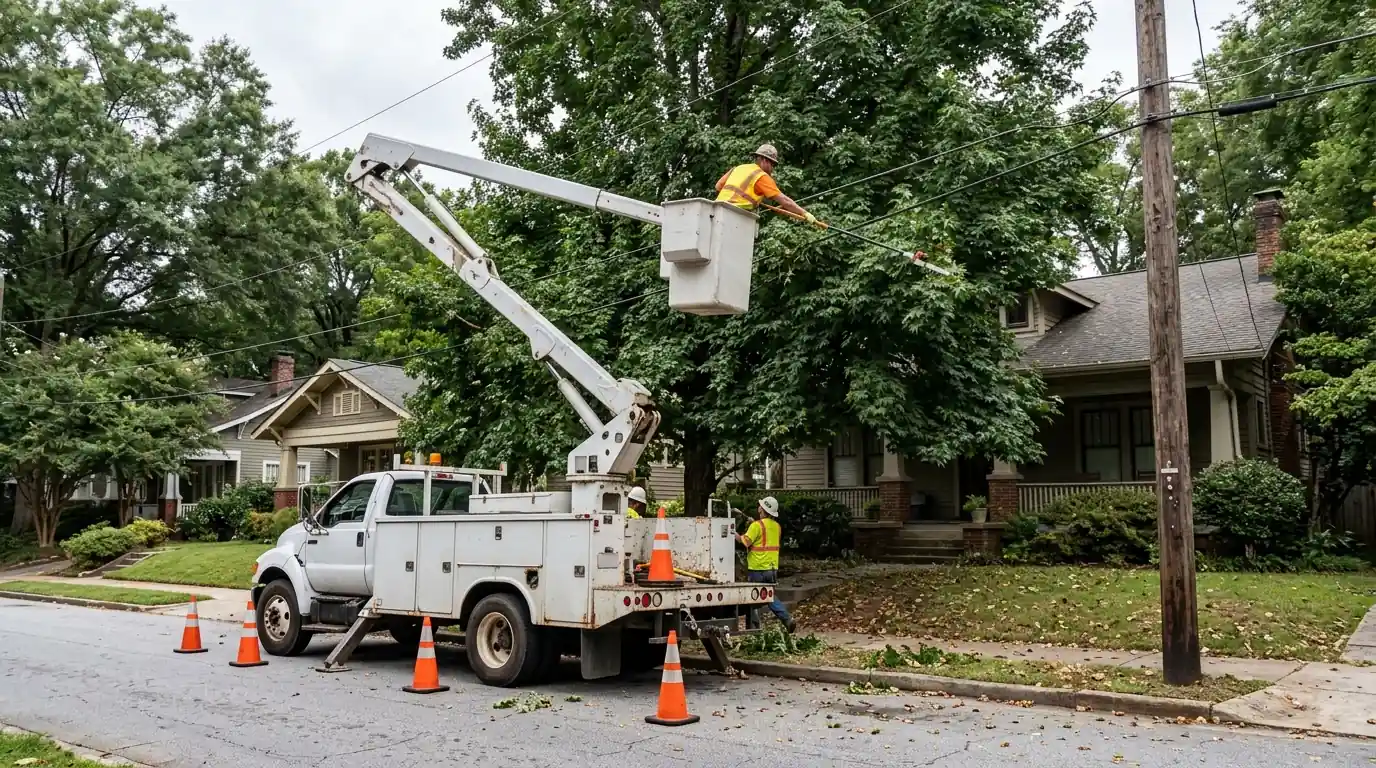
Removals inside Atlanta city limits go through the city permit first, and any limb near a service drop is handled with the utility in mind.
- 4
Rig over the roof, not onto it
The climber ties in above the work, and every limb over the house is cut in small pieces and lowered on a rope away from the panels.
- 5
Steer with tag lines
A ground crew member holds a second line on heavy pieces so they swing out over the yard instead of toward the array or the gutters.
- 6
Clear the roof edges
Twigs and sawdust are blown off the gutters and the roof around the array from a safe spot, and nobody steps on or leans a ladder against the panels.
What to have ready before a solar clearing visit
A few details from you make the plan sharper and the work faster.
- Screenshots from your monitoring app showing when output drops, ideally from both summer and winter.
- The installer's shade report or site survey, if one was done.
- The direction the array faces and whether any panels sit on a garage or a ground mount.
- Which trees you'd like to keep for summer shade on the house, the deck or the yard.
- Any trees that sit on a neighbor's side of the line, so we can talk about what's possible.
- Gate codes and pet details, since the ground crew will work all around the house.
What moves the price of solar panel tree clearing
| Job | Typical range | Priced |
|---|---|---|
| Limbs and trees shading a solar array | $385 to $2,640 | per job |
The work around the array sets most of the price. A limb over open lawn can drop in one piece, while the same limb over a roof full of panels is cut small and lowered on a rope. The number of trees, their height, whether they need climbing or a lift, and whether any come down entirely all add up.
Cleanup, chipping and hauling are included. Removals inside a city with a tree ordinance include the permit paperwork, and stump grinding is quoted as its own line. Follow-up regrowth trims usually cost less than the first visit, since the heavy wood is already gone. Our price guide shows the typical range for a clearing job.
Crown reduction, crown raising or removal for solar shade
Most arrays get their light back without losing every tree. The right cut depends on where the tree stands and what kind it is.
| Crown reduction | Crown raising | Removal | |
|---|---|---|---|
| What it does | Shortens the top and outer limbs back to side branches | Takes off lower limbs to open space under the canopy | Takes the whole tree down |
| Helps when | A hardwood near the house is just tall enough to shade the roof | A tree well across the yard blocks the low winter sun | A pine or a tree in poor health stands south or west of the array |
| Permit inside Atlanta | None needed, though the city pruning standards still apply | None needed, same pruning standards | Needed for trees 6 inches and up, pines 12 inches |
| Shade you keep | Most of it, just lower | The upper canopy | None from that tree |
| Follow-up | Regrowth trimming every few years | Occasional touch-up | Stump grinding if you want it gone |
Solar, big canopy and tree rules across Atlanta
In Kirkwood, Lake Claire and Ormewood Park, a bungalow going solar often has a big willow or water oak to the south and pines at the back of the lot. Inside Atlanta city limits, pruning those trees needs no permit, but removing a private tree 6 inches across or larger, pines from 12 inches, does. The no-fee path is for dead, dying and hazardous trees, not a healthy one that casts shade, and City Council raised removal fees and fines in 2025, effective January 2026. Our permit checker shows which rule your address falls under.
That's why we lean on reduction and raising first. In Decatur, the 2022 Tree Canopy Conservation Ordinance tightened the rules on removing healthy trees, and a tree whose only fault is shade is usually a healthy one. Out in the north metro suburbs, it's more often tall loblolly pines left standing when the subdivision was built, and those don't reduce well, so a removal is sometimes the honest answer. For the paperwork side, our permit help covers each city.
Where we do solar panel tree clearing around Atlanta
Crews work from our Atlanta office near the 30340 ZIP and our Duluth office. These are the places we cover most, with their main ZIP codes. See all 56 areas.
- Buckhead 30305
- Virginia-Highland 30306
- Druid Hills 30307
- Morningside 30324
- Grant Park 30312
- Kirkwood 30317
- Cascade Heights 30311
- Sandy Springs 30328
- Dunwoody 30338
- Brookhaven 30319
- Decatur 30030
- Duluth 30096
- Lawrenceville 30046
- Marietta 30060
- Smyrna 30080
- Roswell 30075
- Alpharetta 30009
- Johns Creek 30097