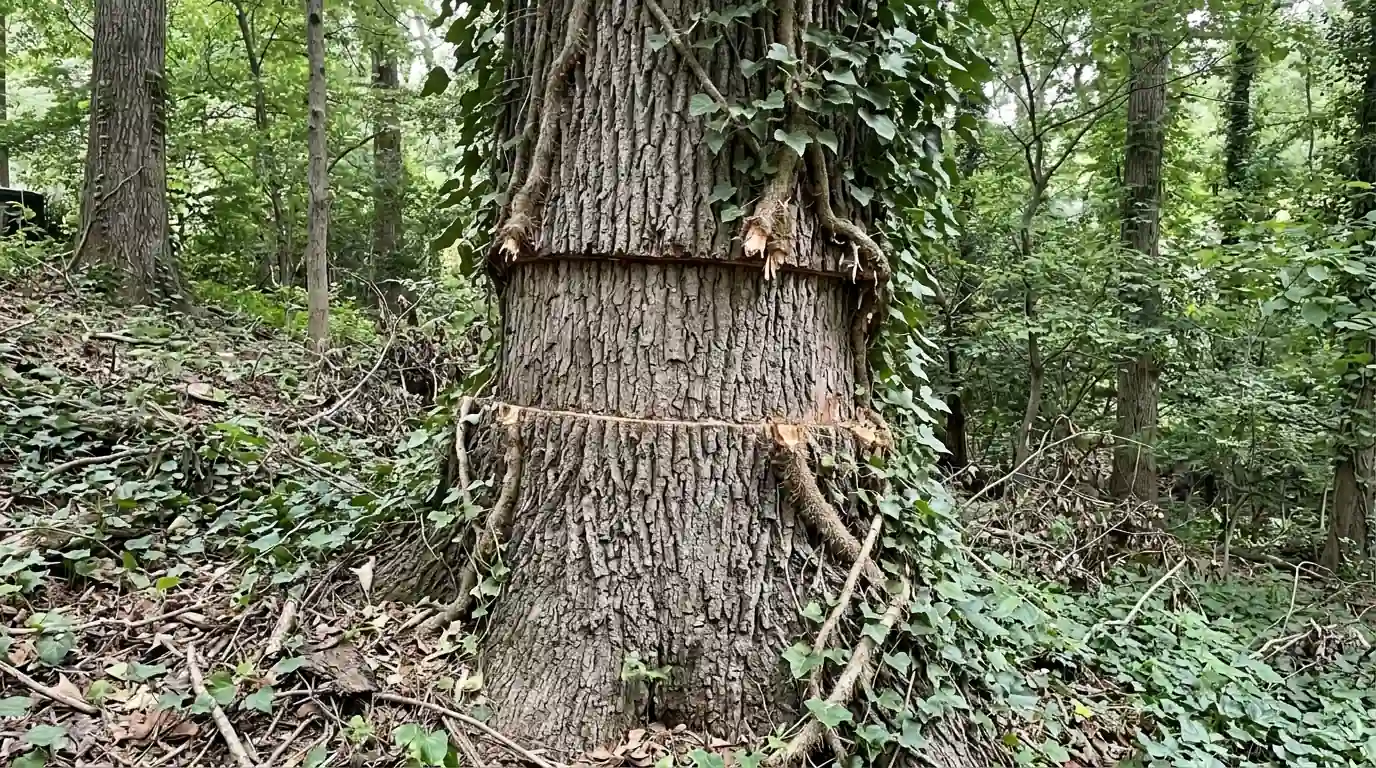
Ivy and vine removal means cutting climbing vines like English ivy, kudzu, Chinese wisteria and poison ivy off tree trunks and pulling them back from the base, so the vines above die and the tree gets its bark and crown back. You need it once vines reach the lower limbs. In Atlanta's wooded ravines and creek-side yards, vines spread from shaded slopes into trees quickly.
Why vines on a tree are more than a look
A little ivy at the base of a trunk does no harm. The problem starts when vines reach the crown. English ivy and wisteria climb into the branches, spread their leaves over the tree's own and shade it out. The extra weight of a vine-loaded crown catches wind and holds ice, and trees heavy with ivy are more likely to break or topple in a storm.
Vines also hide trouble. Cracks, cankers, cavities and fungal conks on a trunk covered in ivy go unnoticed until a limb fails. Chinese wisteria is worse still, because its woody stems twist around the trunk and limbs as they grow and can girdle a branch. Kudzu, once established, can cover a whole tree.
Poison ivy is a different case. It's native and does little direct harm to the tree, but a thick, hairy poison ivy vine on a trunk you need to work near is a hazard to people, which is reason enough to remove it from trees beside a patio, a play set or a path.
The life saver cut, and why we never rip vines from a crown
The method is simple. We cut every vine stem around the trunk at about shoulder height, then cut again near the ground and peel the vines off the bark between the two cuts, leaving a clear band. Then we pull ivy back from the base of the trunk, usually a few feet, so new runners can't climb straight back up.
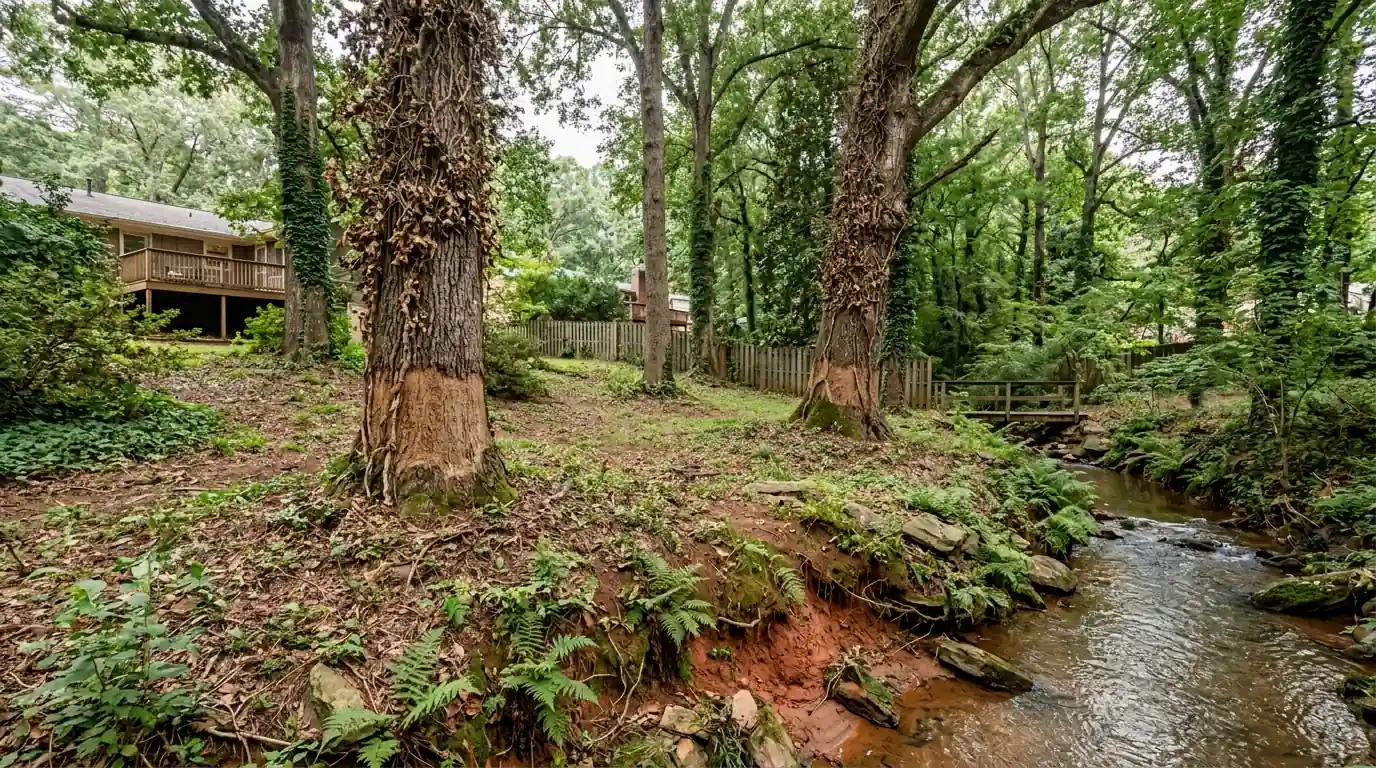
The vines above the band are left where they are. Cut off from their roots, they die and turn brown over the next few weeks, then dry out and fall away over the following months. Pulling established vines out of a crown tears bark, snaps small limbs and can bring dead wood down on whoever is pulling, so we don't do it.
The exception is a vine mass that adds dangerous weight to a limb over a roof or walk, or a dead vine hiding a defect we need to see. In those cases a climber removes the problem section carefully, cutting it into small pieces and lowering them, usually as part of a trimming visit on the same tree.
Working safely around poison ivy on trunks
Old poison ivy vines on Atlanta trees can grow as thick as a forearm, covered in brown aerial roots that look like hair. The oil that causes the rash is in every part of the plant, including dead stems and cut roots, and it stays active on tools, gloves and clothing until it is washed off. Winter vines with no leaves are just as risky as summer ones.
Our crews work poison ivy in long sleeves, gloves and eye protection, cut it the same way as other vines and bag the cuttings for hauling instead of chipping them. Burning poison ivy is especially dangerous, since the smoke carries the oil into the lungs. If you plan to clear ground vines yourself after our visit, treat every brown stem as live.
Vines we take off Atlanta trees
Each vine grows differently, and each needs a slightly different approach.
English ivy
Evergreen and shade tolerant, it carpets the ground first, then climbs trunks on aerial rootlets and fruits once it reaches the light.
Kudzu
Fast and aggressive in sunny edges and road cuts, it smothers trees and shrubs whole. Its large roots demand repeated follow-up.
Chinese wisteria
Woody, twining stems wrap trunks and limbs, girdling branches as they thicken. Old wisteria can be as thick as a small tree.
Poison ivy
Native and less harmful to the tree, but the oils cause rashes on contact, even from dead vines and cut stems.
Japanese honeysuckle
A twining vine that covers shrubs and small trees along fences and wood edges, often mixed in with ivy and privet.
Vines on fences and walls
Ivy that climbs from a tree into a fence, gutter or chimney is cut back at the same visit to keep it from returning.
Follow-up that keeps the vines from coming back
One cut kills the vines on the trunk, but the roots in the ground will keep trying.
- Check the cleared band every few months and pull any new runner that touches the bark.
- Expect kudzu and wisteria to resprout from their roots, and plan on repeat cuts or treatment.
- Where you approve it, a treatment on fresh cuts or regrowth reduces how often the vines return.
- Keep ground ivy pulled back from trunks, even if you keep it as ground cover elsewhere.
- Don't compost or chip poison ivy, since the oils stay active in dead vines and cuttings.
- Wash tools, gloves and clothes after any contact with poison ivy.
- Book a follow-up visit for the second season on heavy infestations.
How an ivy and vine removal visit runs
Most yards are done in one visit, followed by a check later in the season.
- 1
Walk the trees
We look at each vine-covered tree, note the vine types and check the trunk and crown for damage hidden under the growth.
- 2
Cut at shoulder height
Every vine stem is cut around the trunk at about shoulder height, using loppers or a saw for the thick woody stems.
- 3
Clear the band
Vines are cut again near the ground and pulled off the bark between the cuts, leaving the trunk bare for a few feet.
- 4
Pull back the base
Ground ivy is pulled back a few feet from the trunk so new runners have no easy route back up.
- 5
Leave the crown to die
The vines above are left in place to dry out and fall away on their own, without tearing bark or limbs.
- 6
Bag or haul
Cut vines are hauled, and poison ivy is bagged and handled separately, never chipped into mulch or burned.
Ravines, creeks and Atlanta's vine problem
English ivy, kudzu and Chinese wisteria are among the invasive plants found across Atlanta's yards and woods. They thrive where the canopy is shaded and the soil stays damp, which describes the ravines and creek bottoms that wind through so many older neighborhoods. In Druid Hills and Candler Park, ivy climbs out of wooded slopes and creek banks onto big oaks and poplars.
In East Atlanta and on the wooded lots along creeks in Roswell, it's often wisteria that has wrapped a tree for decades, with trunks of its own twisted around the oak. Kudzu shows up more on sunny edges, road cuts and the margins of cleared lots. Our guide to ivy, kudzu and wisteria goes into more detail on each vine and what you can do yourself.
What moves the price of ivy and vine removal
| Job | Typical range | Priced |
|---|---|---|
| Vines cut off trunks and pulled back | $265 to $1,350 | per job |
The number of trees and the thickness of the vines matter most. A few trunks with young ivy take little time, while old wisteria and ivy stems as thick as a wrist need saws and slow cutting. Steep ravines, creek banks, poison ivy and dense ground cover around the trunks all add time and care.
Removing dead vine mass from the crown or making a limb over a roof safe is extra climbing work, priced on its own. Follow-up visits and any treatment of regrowth are separate as well, and on kudzu or old wisteria they are usually worth planning from the start. Our cost guide shows the typical range for vine work.
Where we do ivy and vine removal around Atlanta
Crews work from our Atlanta office near the 30340 ZIP and our Duluth office. These are the places we cover most, with their main ZIP codes. See all 56 areas.
- Buckhead 30305
- Virginia-Highland 30306
- Druid Hills 30307
- Morningside 30324
- Grant Park 30312
- Kirkwood 30317
- Cascade Heights 30311
- Sandy Springs 30328
- Dunwoody 30338
- Brookhaven 30319
- Decatur 30030
- Duluth 30096
- Lawrenceville 30046
- Marietta 30060
- Smyrna 30080
- Roswell 30075
- Alpharetta 30009
- Johns Creek 30097