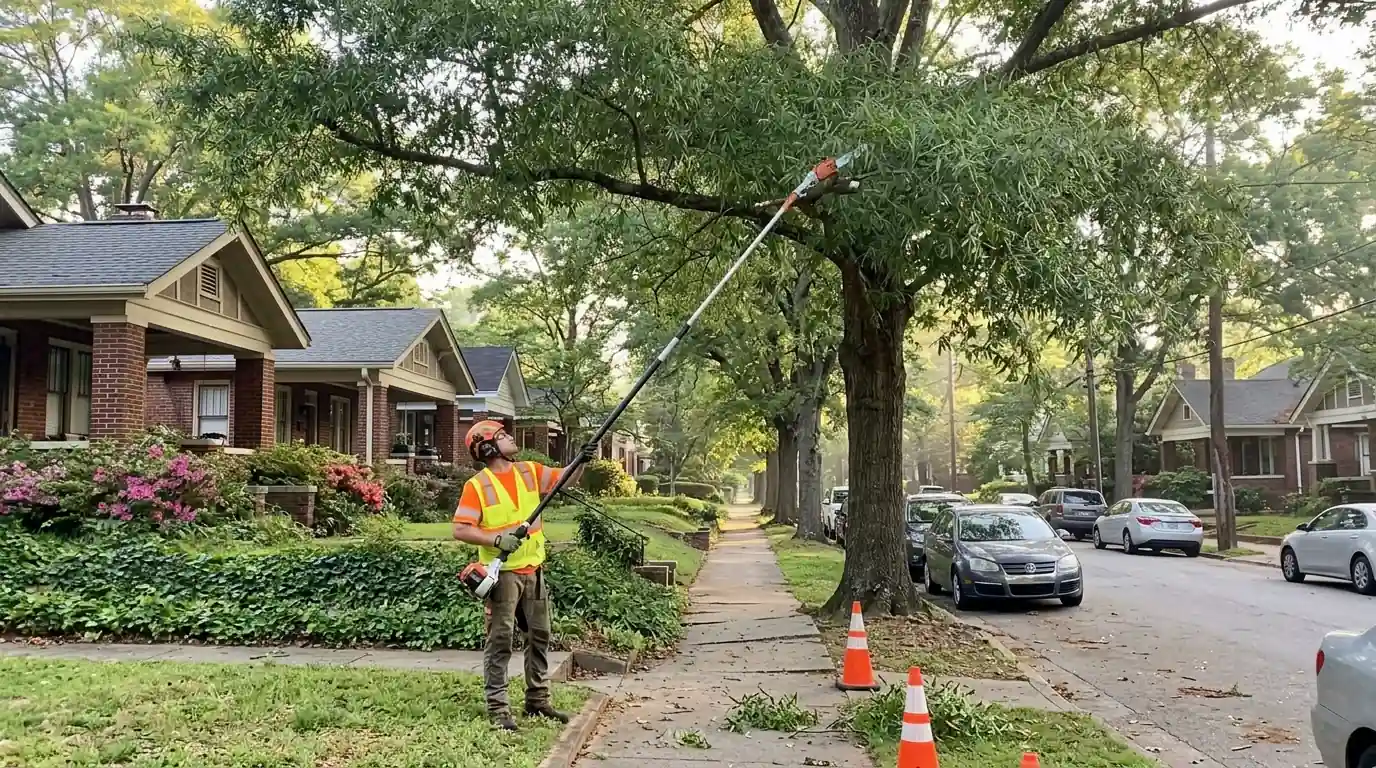
Crown raising means removing the lowest limbs of a tree to create clearance underneath, over sidewalks, driveways, streets, play areas, windows and lawns. Done well, it keeps enough lower crown for the trunk to taper and stay strong, and on young trees it happens in stages over several years. On Atlanta's tree-lined streets, it is often what keeps school buses, garbage trucks and moving vans from tearing limbs off as they pass.
What crown raising changes under your tree
Trees grow their lowest limbs first, and as the crown spreads those limbs reach out over whatever is below. A branch that cleared the sidewalk ten years ago can hang at head height today, droop over the drive after a heavy rain or sit right in front of a bedroom window. Crown raising lifts the bottom edge of the crown so that space is usable again.
The work is simple to describe and easy to overdo. We remove or shorten the lowest limbs back to the trunk or to a side branch, working up only as high as you need. The upper crown stays as it is. The goal is a clean, open trunk to a set height with a full, healthy canopy above it.
Crown raising is often combined with other work on the same climb. If the tree is also crowding the roof, a trimming pass takes care of that, and if the upper crown is dense, a light thinning can be done at the same visit. Doing it together means one setup, one cleanup and one day of ropes and chipper noise in the yard.
How high to raise a crown and how much to leave
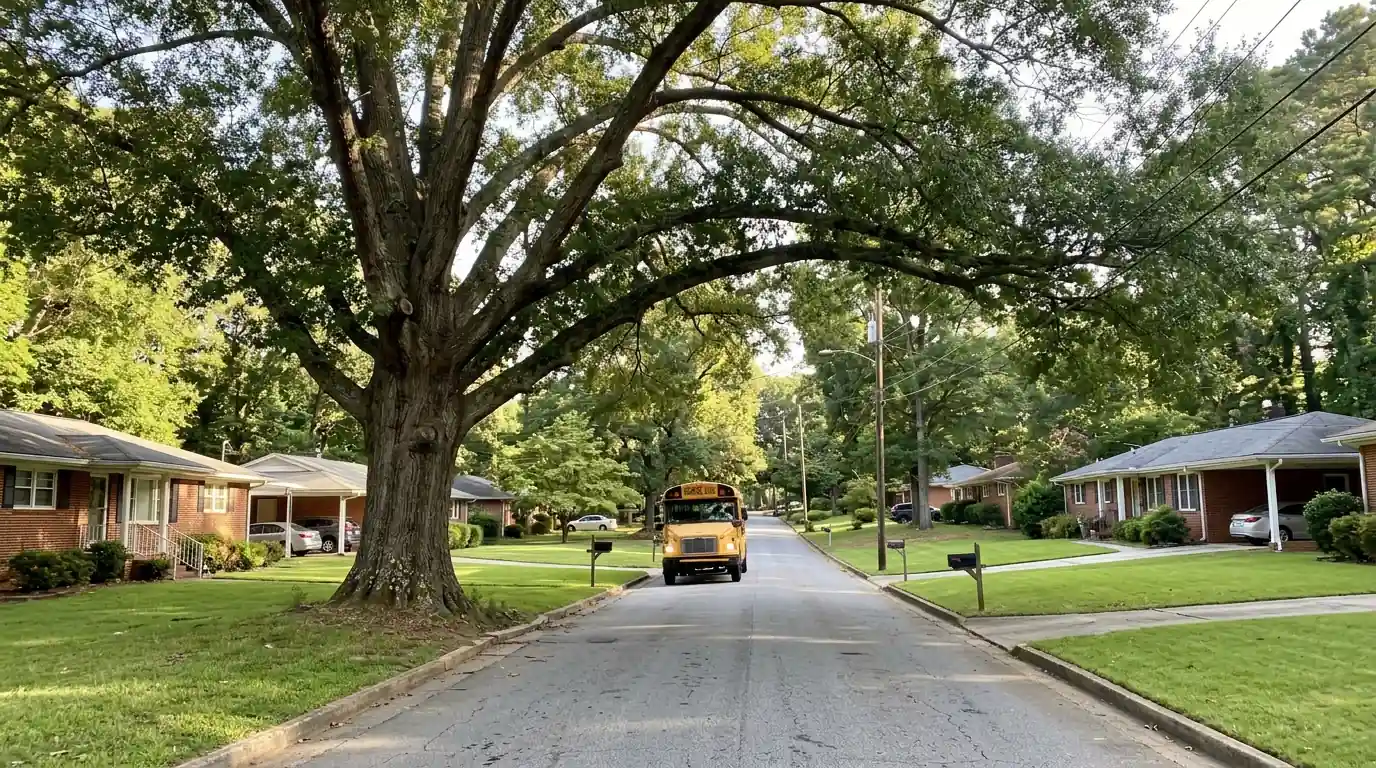
The most common mistake is taking too much. When too many lower limbs come off, the crown sits on top of a bare pole. The trunk then loses the taper it needs to resist wind, more weight concentrates high in the tree, and exposed bark can scald in summer sun. A raised tree should still have live crown along a good share of its height, usually at least the upper two-thirds.
Clearance heights depend on what's underneath. Sidewalks need room to walk without ducking, driveways need clearance for the tallest vehicle that uses them, and streets need enough room for buses and trucks. We set the height with you before we start, then raise to that line and no further. If the clearance you need would leave too little crown, we may suggest raising in stages or a different approach.
Where crown raising makes the most difference
These are the clearance spots that bring most crown raising calls in metro Atlanta.
Sidewalks and front walks
Limbs at head height make people duck or step into the street, and wet foliage brushes everyone who walks by.
Driveways and carports
Low branches scratch car roofs, block the view backing out and catch on roof racks and moving vans.
Streets with truck traffic
School buses, garbage trucks and delivery vans tear low street-side limbs, leaving ragged wounds that decay.
Play areas and swing sets
Raising limbs over a play set gives kids room and keeps low branches from becoming climbing handholds.
Second-story windows
Lifting the lower crown away from upstairs windows brings in light and keeps branches from scraping glass.
Lawns and mowing paths
Mowing under a low canopy means bending double or hitting branches, and the grass under them never gets enough sun.
Raising a young tree in stages
Young trees need their lower limbs longer than most people think, so we lift them gradually.
- Low branches on a young tree help the trunk thicken and taper, so they stay longer than you might expect.
- We shorten temporary low limbs first rather than removing them, which slows them down while they still feed the trunk.
- Each visit, a few of the lowest limbs come off at the trunk while they're still small enough for clean cuts.
- Over several visits a few years apart, the clearance line rises to its final height.
- We keep the permanent lowest limbs well spaced so they don't all come out of the trunk at one spot.
- Staging keeps cuts small, so they close over quickly instead of leaving large wounds.
- A tree raised this way ends up with clean clearance and a strong, tapered trunk.
How we raise a crown without stripping the trunk
Raising is planned so the tree keeps its taper and the clearance lasts.
- 1
Agree on the clearance line
We confirm the height needed over each target, such as the walk, the drive, the street or the window.
- 2
Check the live crown ratio
We look at how much crown the tree has and make sure enough will remain after raising for the trunk to stay strong.
- 3
Choose the limbs
We pick which low limbs come off entirely and which ones get shortened to a side branch to give clearance without a large cut.
- 4
Cut in the right order
Heavy limbs come off with a three-cut sequence so the bark doesn't tear down the trunk when the weight drops.
- 5
Lower over targets
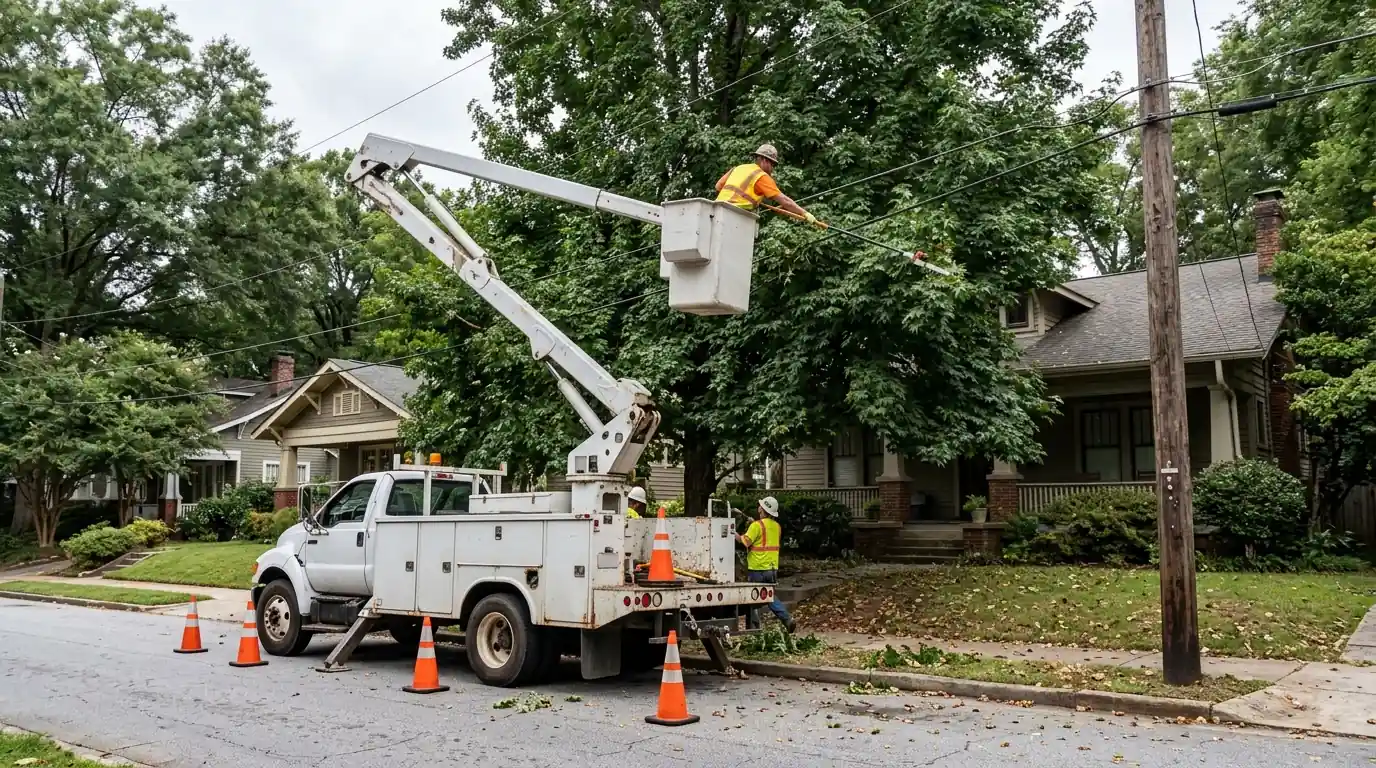
Any limb hanging over a car, fence or roof gets a rope tied on before the cut, and the ground crew lets it down slowly.
- 6
Clean up and recheck
Brush is chipped, the area under the tree raked, and we walk the clearance with you to make sure it's right.
Street trees, school buses and clearance in Atlanta
Many Atlanta neighborhoods were built with oaks along the street, and decades later those trees arch over the road. In Candler Park and East Lake, we raise crowns so school buses and garbage trucks stop snapping low limbs on the morning route. Along intown sidewalks, it's mostly about letting people walk without ducking under wet branches. Raising the crown of a tree that stands on your own property needs no city permit, though the ordinance's pruning standards still govern the cuts.
In the suburbs, the clearance problem is usually the driveway and the lawn. Out in Snellville and Lilburn, oaks and sweetgums along long driveways get raised so moving vans and boat trailers can pass. In backyards, raising a crown lets sun reach the grass and makes mowing possible again. If limbs over the house are the bigger issue, see our overhanging limb work.
Remove the low limb or shorten it back
Not every low limb has to come off at the trunk, and the choice changes how the tree heals.
| Remove at the trunk | Shorten to a side branch | |
|---|---|---|
| When it fits | Small to mid-size limbs, or limbs that will never be permanent | Large limbs where a trunk cut would leave a big wound |
| Clearance gained | All of it, from that limb | Enough over the target, with the base of the limb kept |
| Wound size | Matches the limb, at the collar | Smaller cut farther out on the limb |
| Effect on the tree | Clean trunk, but more foliage lost at once | Keeps more leaves feeding the trunk this year |
What crown raising costs and what changes it
| Job | Typical range | Priced |
|---|---|---|
| Crown raising | $195 to $720 | per tree |
Crown raising is usually one of the less expensive pruning jobs because the work is close to the ground. Many limbs can be reached from a ladder or a pole saw, and only larger trees need a climber. The number and size of limbs, what's underneath them, and whether they have to come down on a rope over a car or a fence all affect the price.
Brush chipping and cleanup are included. Raising several trees along a street frontage or a driveway in one visit often costs less per tree than doing them one at a time, since the chipper and ground crew are already set up. Our price guide has the typical range for crown raising and the other pruning services.
Where we do crown raising around Atlanta
Crews work from our Atlanta office near the 30340 ZIP and our Duluth office. These are the places we cover most, with their main ZIP codes. See all 56 areas.
- Buckhead 30305
- Virginia-Highland 30306
- Druid Hills 30307
- Morningside 30324
- Grant Park 30312
- Kirkwood 30317
- Cascade Heights 30311
- Sandy Springs 30328
- Dunwoody 30338
- Brookhaven 30319
- Decatur 30030
- Duluth 30096
- Lawrenceville 30046
- Marietta 30060
- Smyrna 30080
- Roswell 30075
- Alpharetta 30009
- Johns Creek 30097