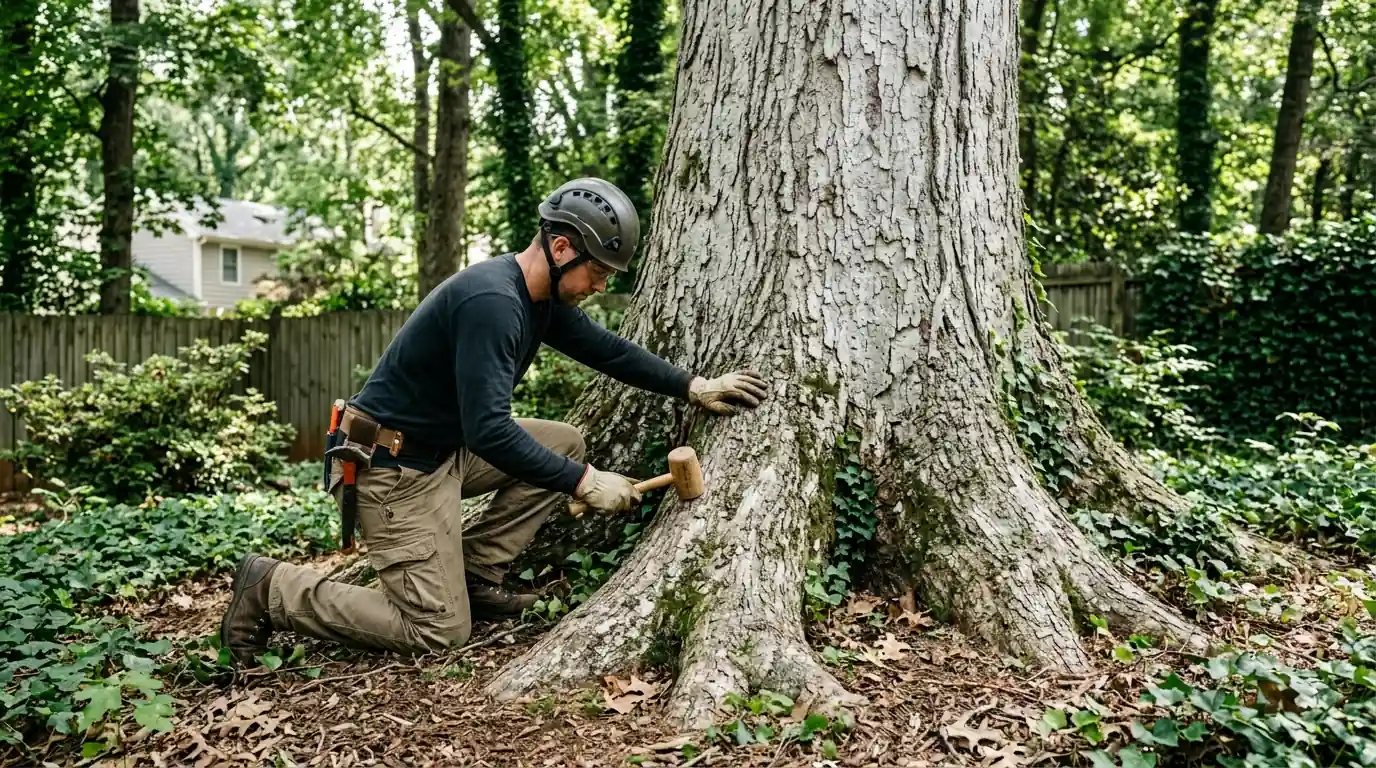
Root collar excavation removes the soil and mulch piled over a tree's root flare, the spot where the trunk widens into its main roots, using an air spade that blasts away soil without cutting roots or bark. It's needed when a flare is buried by mulch volcanoes, construction fill or planting too deep. Around Atlanta, red maples and young willow oaks set too low in builder planting holes are the trees we uncover most, often with girdling roots underneath.
Why a buried root flare causes trouble
A healthy tree widens at the base, and that flare should sit at or just above the soil line. Trunk bark is built to stay dry and take air. When soil or mulch sits against it for years, the bark stays wet, softens and lets rot fungi and insects into the trunk right at the point that carries the whole tree's weight. From the yard, all you see is a trunk that goes straight into the ground with no taper.
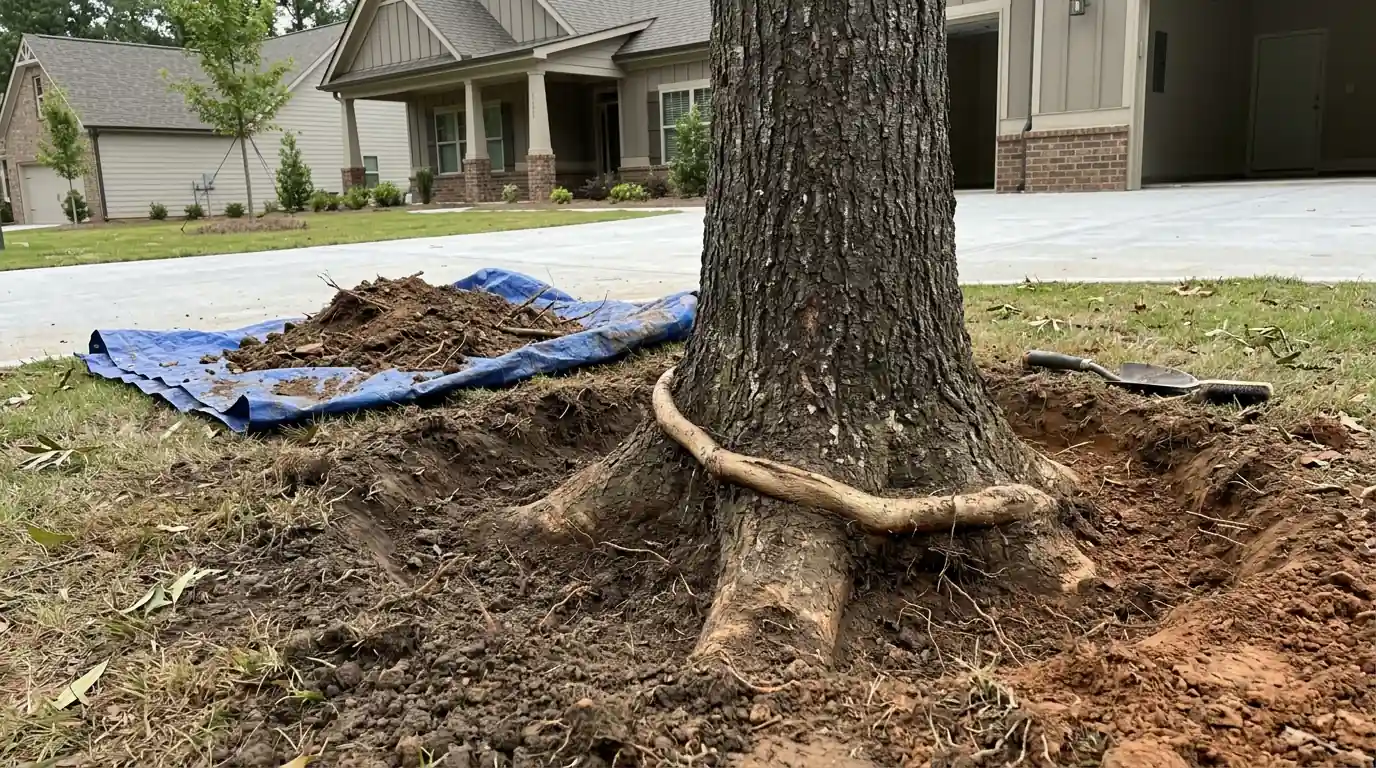
Burial also changes how the roots grow. Roots follow the moisture and the air, so when a flare is buried, new roots often grow up into the mulch or soil above the original root system. Some of those roots, along with roots that circled in a nursery pot, grow sideways across the trunk instead of out from it. As the trunk and the root both thicken, the root presses into the bark and slowly cuts off the flow of water and sugar on that side of the tree.
None of this shows quickly. A tree can look fine for ten or fifteen years while a girdling root tightens or decay works in at the base. The first signs tend to be a thinner crown, early fall color, dead branches on one side or a flat face on the trunk where it meets the ground. By the time those show up, uncovering the flare is the only way to see what's going on.
Why we use an air spade instead of a shovel
An air spade is a nozzle fed by a large air compressor. It pushes a narrow jet of air at very high speed into the soil, which breaks the soil apart and blows it out of the way. Roots, bark, pipes and cables are far denser than loose soil, so the air moves around them without cutting them. That's why it's the right tool for digging around a tree: we can expose every root down to the small ones without nicking the bark or tearing what we're trying to see.
A shovel or a trowel can't do that. Digging by hand around a buried flare tends to scrape bark, cut small roots and leave you guessing where the original flare sits. In compacted red clay, hand digging is also slow and rough on the tree. The air spade breaks up clay in minutes, and the loosened soil can be spread out, hauled away or used to regrade the area. It's loud and dusty for a short while, so we tarp nearby beds, siding and cars before we start.
When a root collar excavation is part of a risk assessment
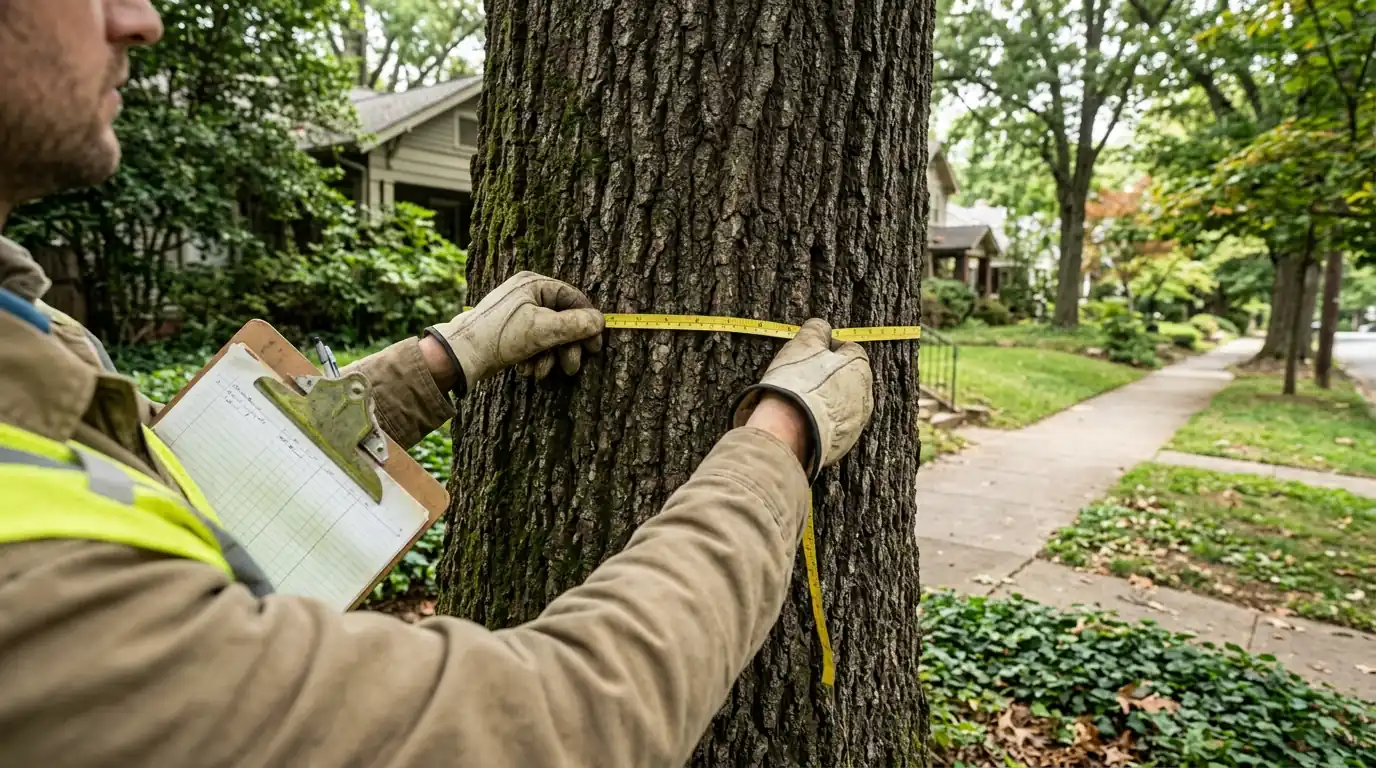
Sometimes the question isn't only how to help the tree, but whether it's safe to keep. Decay at the base of a large tree can hide under fill or mulch for years, and the root plate is what holds the whole tree upright. When a risk assessment finds a trunk with no visible flare, mushrooms at the base or a lean with no obvious cause, uncovering the root collar lets us measure how much sound wood and root is left before deciding whether to keep, monitor or remove the tree.
On a smaller tree, the answer is usually good news. Once the flare is exposed and the girdling roots are cut, the tree has a better shot at a long life. Afterward, we sometimes recommend deep root fertilization for a tree whose roots have been under stress, along with regular watering through the next couple of summers while new roots grow out from the corrected flare.
How trunk flares get buried in the first place
Almost every buried flare we uncover comes from one of these, and some trees have two or three stacked on top of each other.
Mulch volcanoes
Mulch piled in a cone against the trunk, refreshed every spring on top of last year's, can bury a flare under a foot of material within a few years.
Planted too deep
Builder trees are often set with the top of the root ball below grade, or arrive from the nursery with extra soil already piled over the flare.
Construction fill
Grading for a new house, a driveway or a patio often spreads fill dirt over existing root zones and against the trunks of trees left standing.
Landscape beds built up around trees
Raised beds, new topsoil, retaining walls or a ring of pavers stacked around the base all raise the soil level against the bark.
Erosion from above
On sloped Atlanta lots, red clay washing down from upslope slowly builds up against the uphill side of a trunk.
Turf and soil layered over time
Years of topdressing a lawn, laying new sod over old or filling low spots around a tree can bury a flare a little at a time.
What we look for once the flare is uncovered
This is where the visit earns its keep, because each finding points to a different fix.
- Roots crossing the trunk or wrapping around it, pressing into the bark.
- Roots still circling in the shape of the original nursery pot or planting hole.
- Bark that is soft, dark, sunken or peeling at the old soil line.
- Mushrooms, fungal fans or white fungal sheets on the roots or the base.
- Flat or concave sides on the trunk where a root has been pressing for years.
- Roots cut, scraped or crushed by past construction or trenching.
- A second layer of roots growing in the mulch above the original roots.
How a root collar excavation visit runs
Most single trees are a short visit, and you can see the result before we leave.
- 1
Check the tree and the lines
We look at the crown and the trunk base, ask about the planting history, and mark irrigation, lighting cable and buried lines before any soil moves.
- 2
Pull the mulch
Old mulch is raked away by hand first, which often shows how deep the burial runs before the compressor even starts.
- 3
Excavate with air
The air spade clears soil away from the trunk and out along the main roots until we reach the true flare and the first major roots.
- 4
Inspect what's exposed
We look for girdling roots, circling roots, bark damage, soft or decayed wood, fungal growth and roots damaged by old construction.
- 5
Correct the problems
Girdling roots are cut cleanly where it's safe for the tree, and damaged bark is cleaned up so it can dry and callus.
- 6
Regrade and remulch
The soil around the base is lowered and graded away from the trunk, then a flat ring of mulch two to three inches deep goes down, kept off the bark.
Buried flares across Atlanta's newer yards and teardown lots
Red maples and young willow oaks are the trees we uncover most often around Atlanta, because builders planted so many of them in new subdivisions, frequently set too deep in narrow holes dug into compacted red clay. In Johns Creek, Suwanee and Peachtree Corners, it's common to find a 15 year old maple with no visible flare and a girdling root wrapped halfway around the trunk. These are trees that can usually be saved if the problem is caught early.
Intown, the story is more often construction. Teardown rebuilds in Brookhaven, Morningside and Virginia Highland bring grading, new patios and raised beds, and the old oaks left standing often end up with fill against their trunks. Uncovering those flares pairs well with tree protection during a build. When a new tree is going in, our planting work sets the flare at grade from day one so this never has to happen.
What moves the price of root collar excavation
| Job | Typical range | Priced |
|---|---|---|
| Air-spade root collar excavation and inspection | $285 to $745 | per tree |
The depth of burial and the size of the tree set most of the price. A young maple buried under six inches of mulch is a short job, while a mature oak with two feet of construction fill against the trunk takes longer to excavate and leaves more soil to move or haul. Access for the compressor matters too, since a backyard reached only by steps or a narrow gate adds setup time.
Correcting girdling roots, regrading the soil and laying fresh mulch are part of the visit. Hauling large amounts of excess soil is priced separately, since many yards can use it elsewhere. Several trees excavated in one visit lower the cost of each. Typical ranges are on our tree care price guide.
Where we do root collar excavation around Atlanta
Crews work from our Atlanta office near the 30340 ZIP and our Duluth office. These are the places we cover most, with their main ZIP codes. See all 56 areas.
- Buckhead 30305
- Virginia-Highland 30306
- Druid Hills 30307
- Morningside 30324
- Grant Park 30312
- Kirkwood 30317
- Cascade Heights 30311
- Sandy Springs 30328
- Dunwoody 30338
- Brookhaven 30319
- Decatur 30030
- Duluth 30096
- Lawrenceville 30046
- Marietta 30060
- Smyrna 30080
- Roswell 30075
- Alpharetta 30009
- Johns Creek 30097