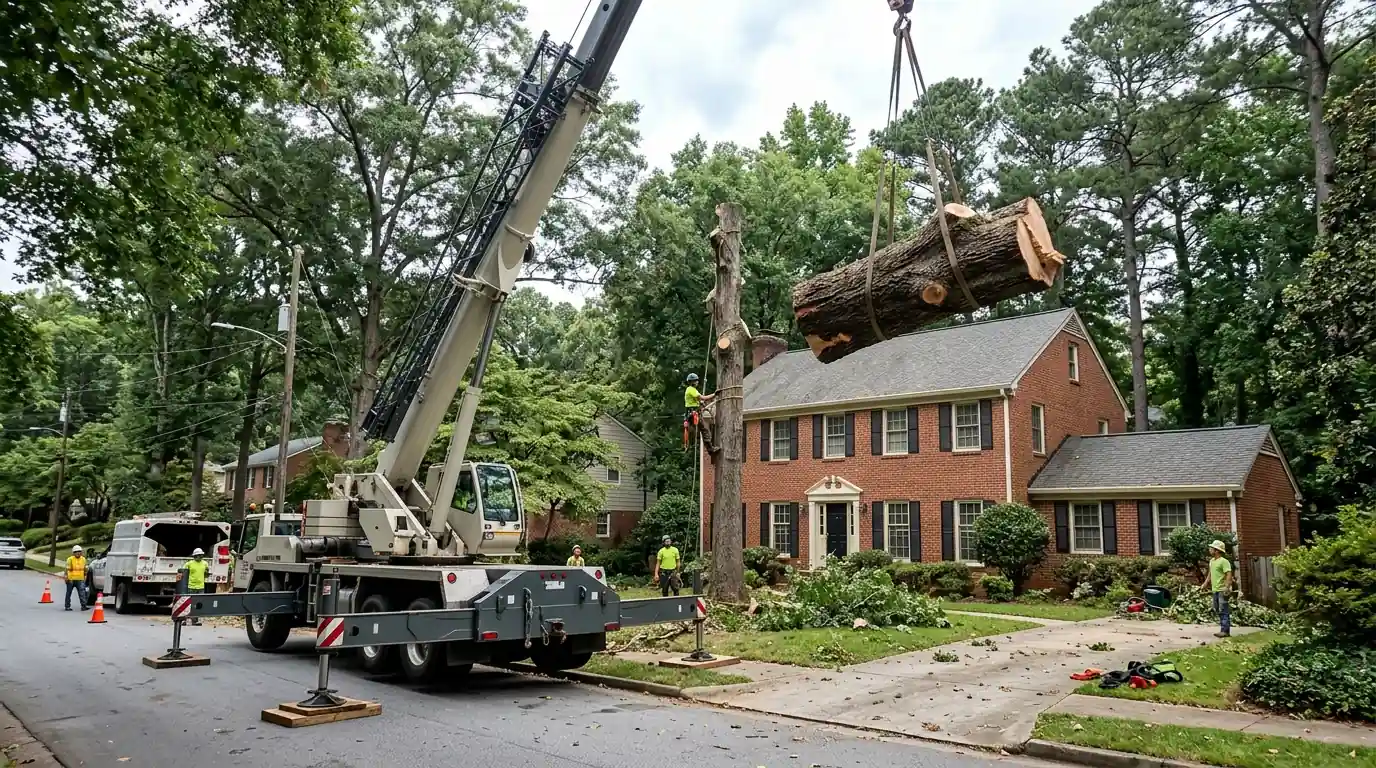
Crane tree removal uses a truck crane parked on the street or driveway to hold and lift sections of a tree as a climber or lift operator cuts them free. It makes sense for large trees over houses, decayed trees too risky to climb, and backyard trees with no drop zone. It costs more per hour than rope work, but on the right tree the speed and the protection for the house usually make up the difference.
When a crane is the right tool for the tree
Most removals don't need a crane. A good climber with a lowering system can take down a big tree in tight space, piece by piece, and that's how most standard removals are done. But rope work has limits. Every piece lowered on a rope puts a load on the tree itself, and every piece has to land somewhere on the ground. When the tree can't take the load or there's nowhere for the wood to land, a crane changes the job.
The trees we pick with a crane tend to share a few traits: very large, standing close to or over the house, and either decayed enough that climbing them is a gamble or boxed in by fences, pools and gardens with no room to drop anything. Big water oaks in older intown neighborhoods are the classic case.
A crane also shines when time on site matters. A large oak that would take a full day or more of rope work can often come down in a fraction of that, which means less time with heavy wood hanging over the house and a shorter day of noise for the neighbors.
Picks, slings and tag lines, explained without the jargon
A pick is one lift. Before each cut, the climber wraps a sling around the section and clips it to the crane's hook, and the crane operator takes up enough tension to hold the piece's weight. Only then does the climber cut. The section never drops, not even a little, because it was already hanging from the crane before it was free.
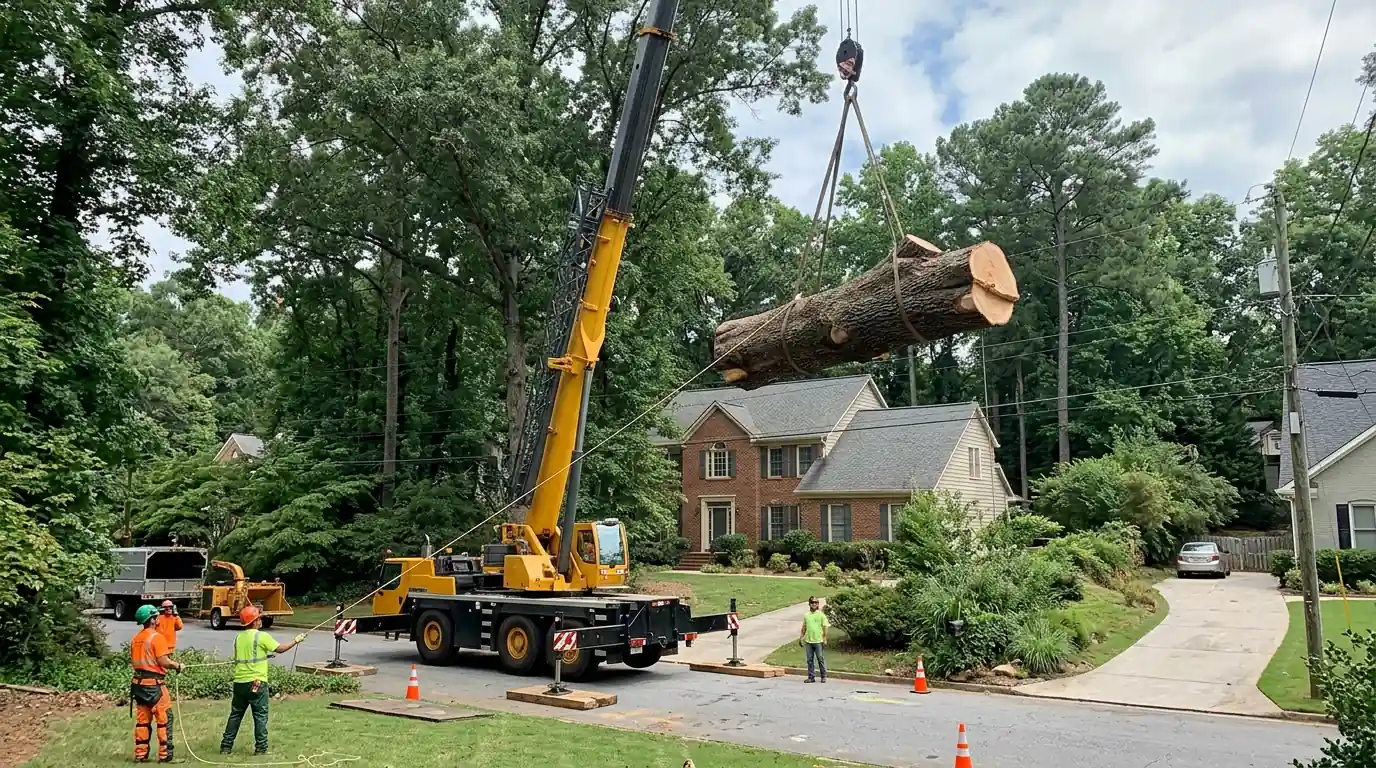
Tag lines are ropes tied to the piece and held by a ground crew member. As the section swings up and over the house, the tag line keeps it from spinning into a chimney, a gutter or the next tree. A good tag line hand is as important as the crane operator, and on a tight lot the two talk by radio through every pick.
The size of each pick is set by the crane's capacity at that reach and by the weight of the wood, which our crew estimates before each cut. Big, heavy oak sections near the base come off in shorter pieces than the lighter wood up top. If the climber isn't sure of a piece's weight, it gets cut smaller. A crane that's asked to hold more than planned is the one mistake this method can't absorb.
Situations where we bring in a crane
These are the sites where we usually recommend a crane, and the reason for each.
Big tree over the roof
When the crown spreads over the house, the crane lifts each limb up and away instead of swinging it on a rope past the gutters.
Decay too risky to climb
A hollow or cracked trunk can't hold a climber and rigging loads. On hazard trees like these, the crane carries the weight so the weak wood never has to.
No drop zone at all
Pools, patios, gardens, sheds and fences on every side leave nowhere to lower wood. The crane flies it over the house to the street.
Backyard behind the house
With no side access for equipment, the alternative is carrying every piece by hand. The crane lifts it over the roof in one move.
Tree already on a structure
After a storm, a crane can lift a trunk off a roof without dragging or rolling it across the framing, often as the daylight half of an emergency removal.
Several big trees at once
When a lot has two or three large removals, one crane day often costs less than several days of rope work.
How a crane removal day runs
The planning happens before the crane shows up, so the day itself is mostly about steady, repeated picks.
- 1
Site visit and setup spot
We look at where the crane can park, how far it has to reach, overhead wires along the street, and what the ground or driveway can carry.
- 2
Street and neighbors
We plan where the crane, chipper and trucks sit, and you let the neighbors know so street parking near the house is clear that morning.
- 3
Set up on mats
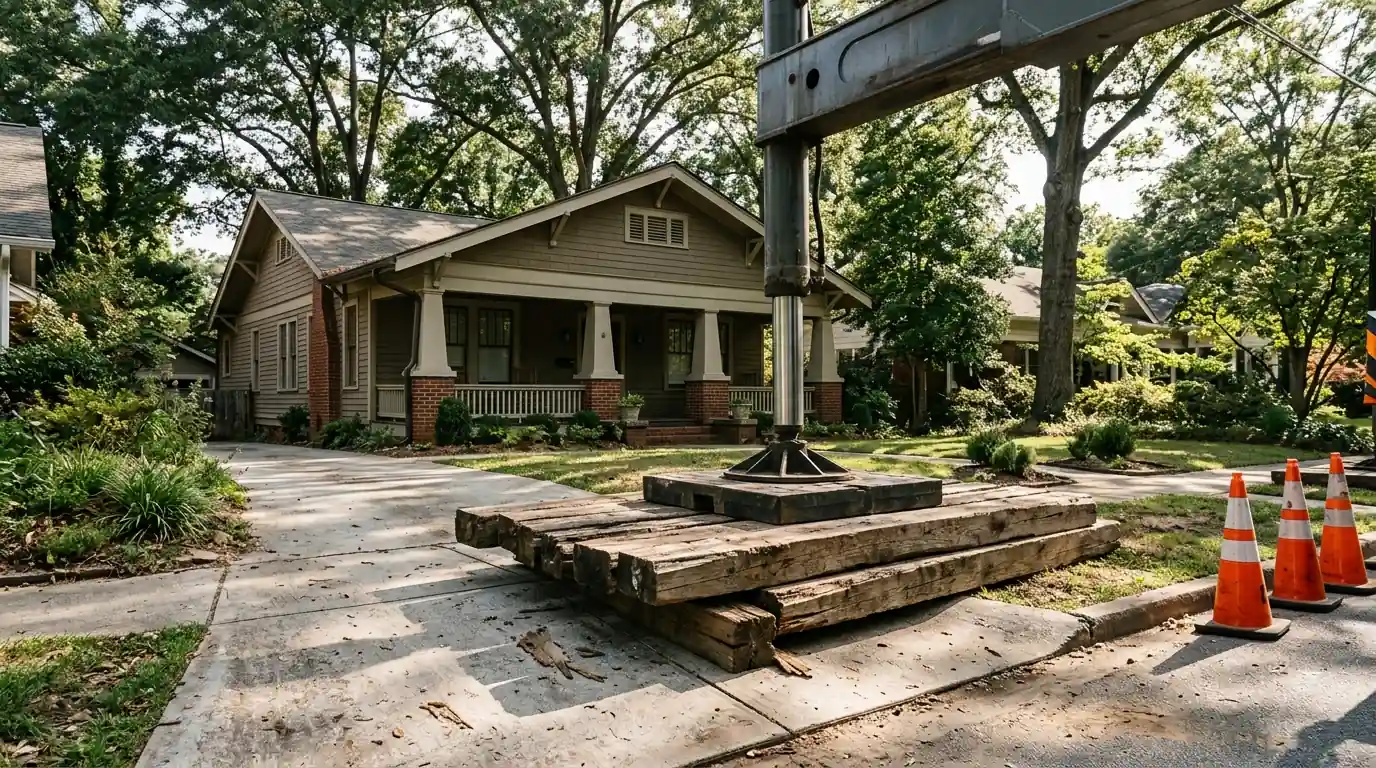
The crane parks on the street or driveway and extends its outriggers onto heavy mats that spread the load and protect the pavement.
- 4
Climber ties in and rigs
A climber goes up, or a lift operator moves into place, and sets the crane's sling around the first section, balanced so it hangs level once it's cut.
- 5
Cut and pick
The crane takes the weight first, then the section is cut free and lifted up and over the house. Ground crew use tag lines to steer it as it travels.
- 6
Land, process, repeat
Each piece is set down in the street or driveway, unhooked, chipped or bucked, and the crane swings back for the next pick until the tree is gone.
How to get ready for crane day
A crane needs space and a clear approach, and a little preparation keeps the day moving.
- Move your cars out of the driveway and off the street the night before.
- Ask neighbors to keep street parking clear in front of the house for the day.
- Tell us about septic tanks, drain lines, sprinkler mains or anything buried under the driveway or the setup spot.
- Take down hanging plants, wind chimes and outdoor decorations along the side of the house the wood will pass over.
- Bring pets inside and keep children away from the street side of the house.
- If your HOA has rules about equipment on the street, let us know the contact so we can plan around them.
- Plan for some noise from the crane, the saws and the chipper for most of the day.
Why a crane can cost less than it looks
| Job | Typical range | Priced |
|---|---|---|
| Crane-assisted removal over a house | $2,650 to $8,400 | per tree |
A crane day carries a bigger line on the invoice than rope work, and the crane is priced for the time it's on site, including setup and breakdown. Reach matters, too: the farther the tree sits from the street, the larger the crane needs to be. Street permits for blocking a lane, overhead wires and soft ground can add steps.
The other side of the ledger is speed and protection. A tree that would take a long day or more by rope can often be finished in a few hours with a crane, with fewer crew hours and less risk to the roof. For several large trees on one property, the math often favors the crane. Cleanup is included; see typical ranges for stump work and other add-ons.
Crane removals in Atlanta's older, tighter neighborhoods
Many crane jobs in Atlanta happen where the trees are oldest and the lots are tightest. In Inman Park and Virginia-Highland, large water and willow oaks tower over houses built close together, often with rear yards reached only by a narrow side path. A crane on the street lifts the wood over the roof instead of carrying it through the gate.
Out in Sandy Springs, the lots are bigger but the houses often sit below the street on sloped drives, and tall pines and oaks stand in the backyards. The crane can work from the top of the drive. Inside Atlanta city limits, the tree still needs its city permit before any crane arrives, which our permit help can prepare.
Where we do crane tree removal around Atlanta
Crews work from our Atlanta office near the 30340 ZIP and our Duluth office. These are the places we cover most, with their main ZIP codes. See all 56 areas.
- Buckhead 30305
- Virginia-Highland 30306
- Druid Hills 30307
- Morningside 30324
- Grant Park 30312
- Kirkwood 30317
- Cascade Heights 30311
- Sandy Springs 30328
- Dunwoody 30338
- Brookhaven 30319
- Decatur 30030
- Duluth 30096
- Lawrenceville 30046
- Marietta 30060
- Smyrna 30080
- Roswell 30075
- Alpharetta 30009
- Johns Creek 30097