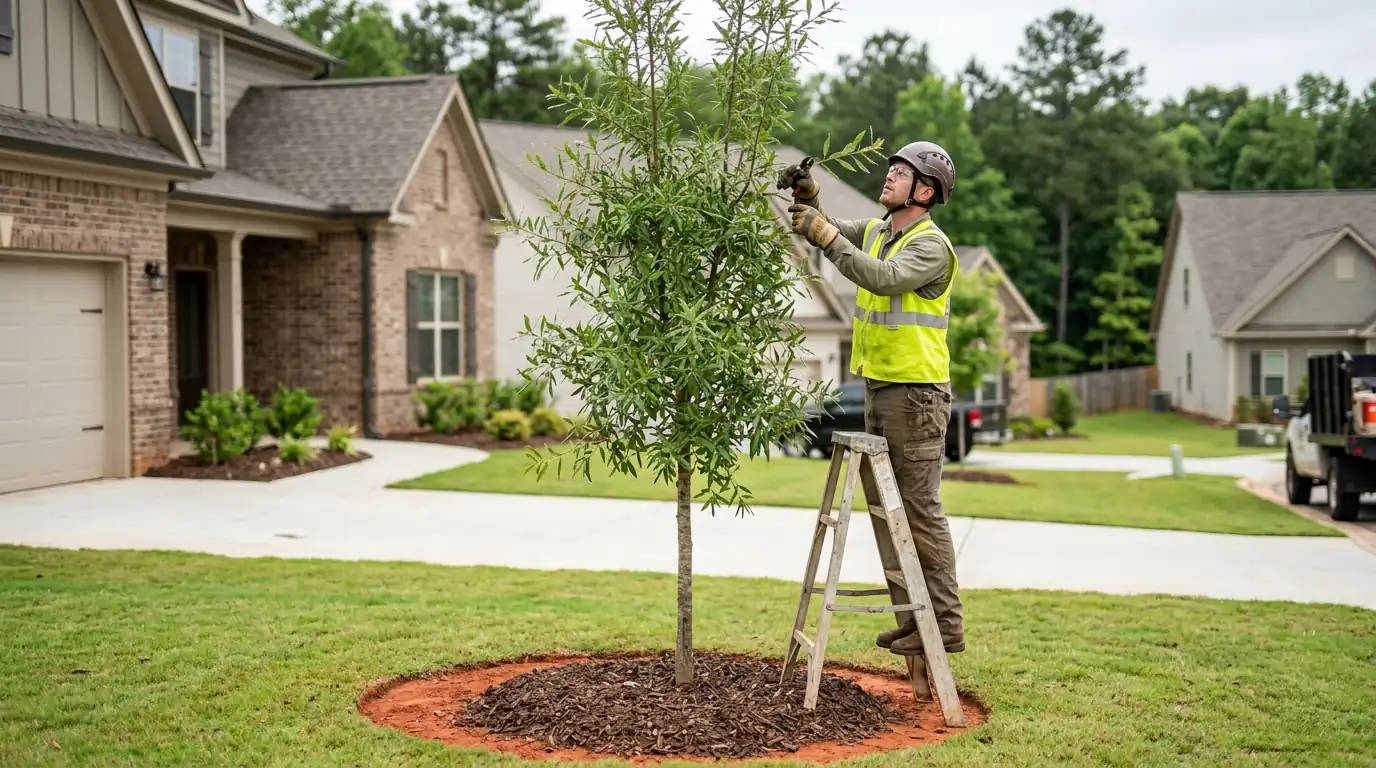
Tree pruning, in the structural sense, is corrective work on young and mid-age trees: choosing a central leader, shortening codominant stems so they fall behind it, and removing branches attached at tight V-shaped unions before they grow heavy enough to split. It follows industry pruning standards and is planned over several visits. Atlanta requires no permit to prune a private tree, but the ordinance's pruning standards still apply, which is one more reason to do it with care.
Why structural pruning matters most on younger trees
Most of the big limb failures we clean up after storms started as small defects decades earlier. Two stems grew up side by side, bark got trapped in the fork between them, and the union never knit into solid wood. By the time the tree is sixty feet tall, that fork is holding tons of wood with a seam running through it, and there's no good fix left.
Structural pruning catches those problems while they're the width of a broom handle. A cut that size closes over in a few seasons. The same correction on a mature oak means removing a limb the size of a small tree, which opens a wound that can decay for years. Early work is cheaper, easier on the tree and far more effective.
This work is different from a routine trim. Clearance trimming responds to what the tree is touching today. Structural pruning looks ahead at what the tree will become: where the main trunk will be, which limbs will become permanent scaffold branches, and which ones should be slowed down or taken out before they compete.
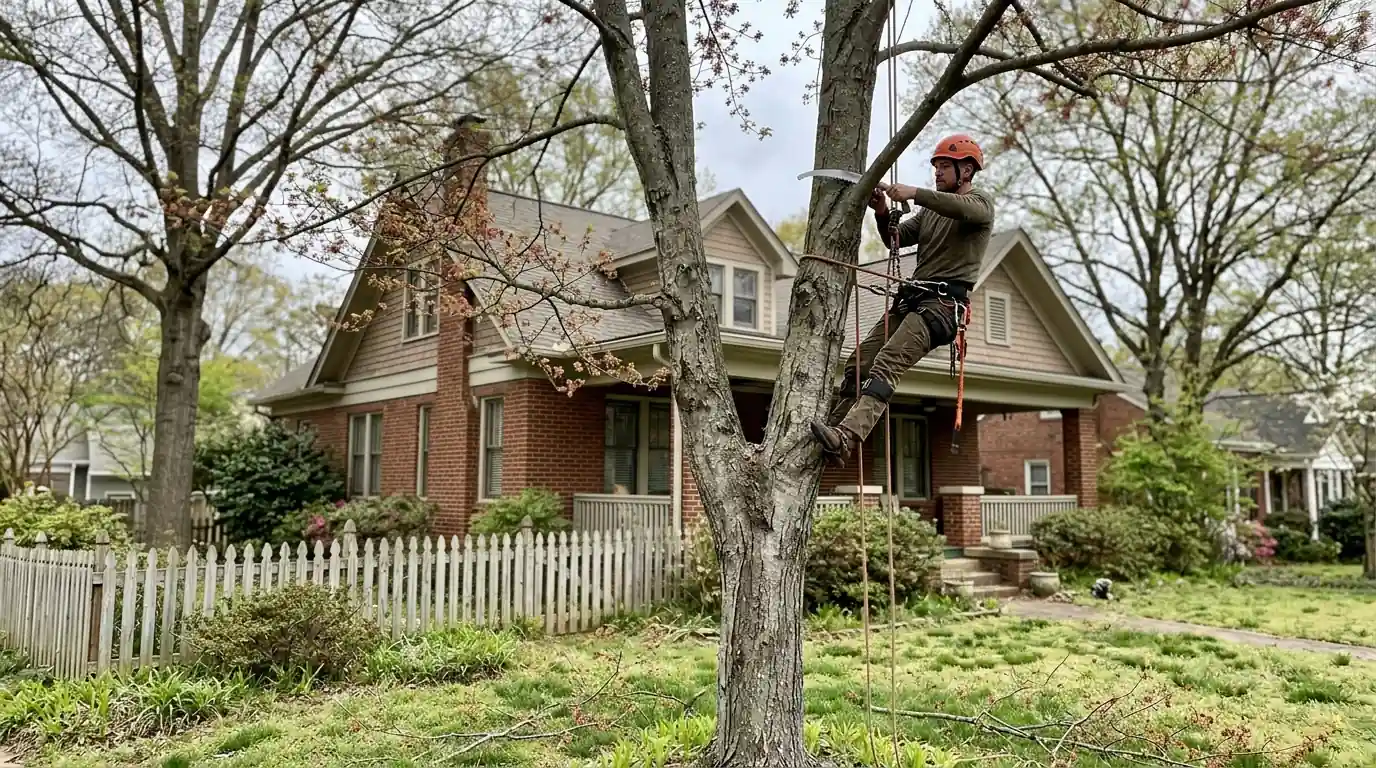
Structural defects we look for in young and mid-age trees
These are the flaws that turn into split trunks and dropped limbs if nobody touches them for twenty years.
Codominant leaders
Two or more trunks of nearly equal size racing upward from one point. Neither one is in charge, and the fork between them is the weak link.
Included bark in a V-shaped union
Bark pinched inside a narrow fork keeps the two stems from fusing. Callery pears, red maples and some oaks are known for it.
Clustered limbs
Several branches coming out of the trunk at the same height crowd each other and weaken that section of trunk as they thicken.
Crossing scaffold limbs
Two main branches growing into each other will rub through the bark and leave an open wound where decay can start.
Over-extended limbs
A long limb with all its foliage bunched at the tip carries end-weight that keeps growing every year until the limb cracks.
Low temporary branches
Lower limbs help a young trunk thicken, but the ones that will block a walk or a drive later need to be shortened on a schedule.
When to prune common Georgia trees for structure
Small structural cuts can be made most of the year, but heavier corrections go better with the timing below.
- Oaks: late fall through late winter while dormant, when the structure is easy to see and wounds sit through the cool months.
- Red maples: dormant season works, though they bleed sap in late winter, which looks alarming but does no harm. Early summer is another option.
- Tulip poplar and sweetgum: dormant season, before the spring growth flush starts.
- Flowering dogwood, redbud and cherry: right after they finish blooming in spring, so you don't cut off next year's flowers.
- Crape myrtle: late winter before new growth, and our crape myrtle service has its own approach.
- Loblolly and shortleaf pine: the cooler months, when fresh resin is less likely to draw bark beetles to the tree.
- Southern magnolia: light cuts after the spring flush, since heavy cuts sprout a mess of new shoots.
How we prune a tree for structure, one visit at a time
Structural work is spread over several visits so the tree never loses more foliage than it can spare.
- 1
Choose the leader
On shade trees like oaks, maples and elms we pick the straightest, strongest stem to be the trunk for the life of the tree.
- 2
Subordinate the competitors
Competing stems are shortened back to a side branch so they grow slower and the chosen leader pulls ahead, rather than being cut off whole.
- 3
Correct weak unions
Branches attached at tight V-shaped forks with included bark are reduced or removed while the wound is still small.
- 4
Space the scaffold limbs
We keep permanent branches spaced up and around the trunk so no single spot carries too much load.
- 5
Manage the lower branches
Temporary low limbs are shortened rather than stripped, which keeps the trunk tapering while clearance develops over time.
- 6
Stop at a sensible limit
We take only what the tree can afford this year, write down what is left to correct, and plan the next visit in two to four years.
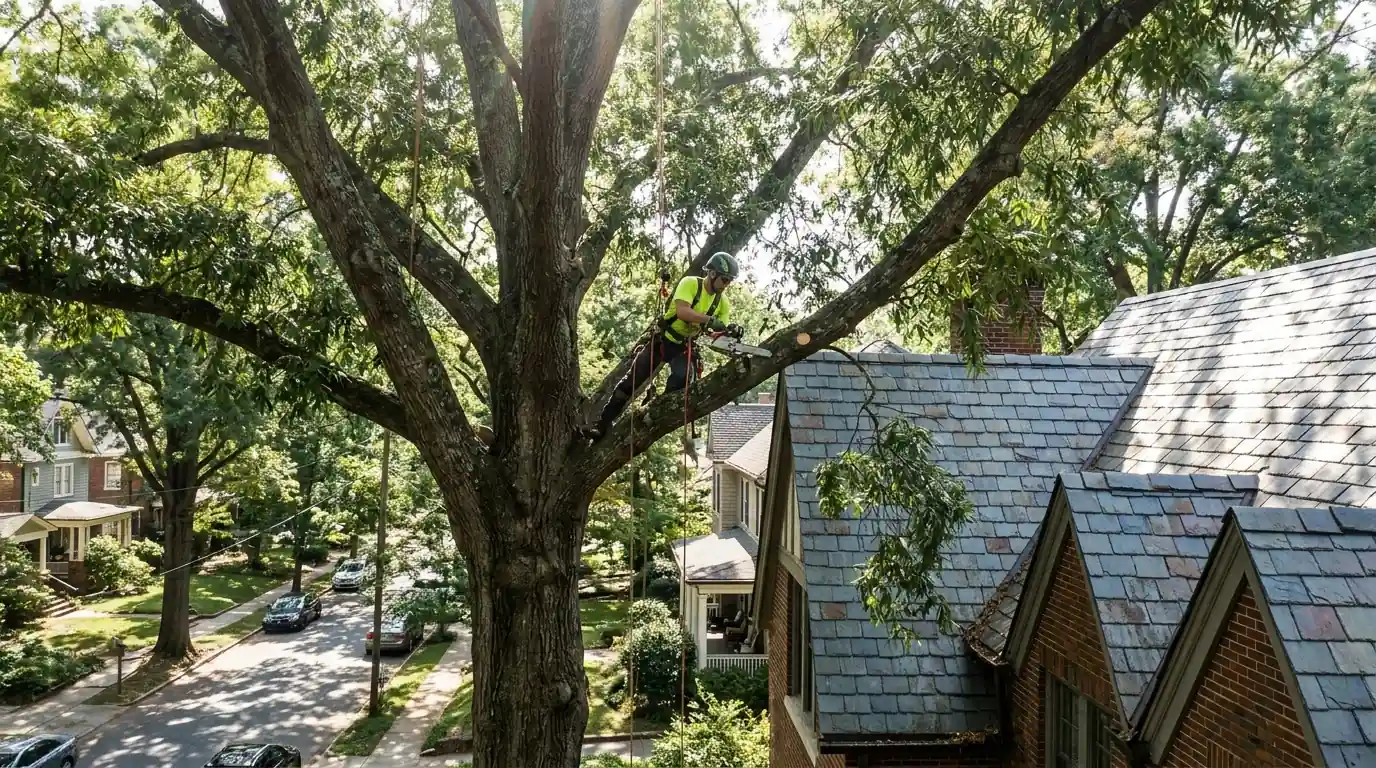
Pruning young trees under Atlanta's rules and in its newer yards
Atlanta leaves pruning on private land free of permits, yet the tree ordinance still sets pruning standards for the work. That matters because most of the city's remaining trees, about 72 percent, grow on lots zoned for single-family homes, so the canopy's future depends heavily on how homeowners care for yard trees. On the older streets of Inman Park, structural work often means a mid-age oak planted to replace a lost giant.
Further out, the newer subdivisions of Johns Creek and Suwanee are full of young willow oaks, red maples and Callery pears planted by builders in compacted red clay. Many have never been pruned, and some already show two leaders and tight forks. A light structural visit now does more for those trees than anything else. Our guide on pruning season in Georgia covers timing in more detail.
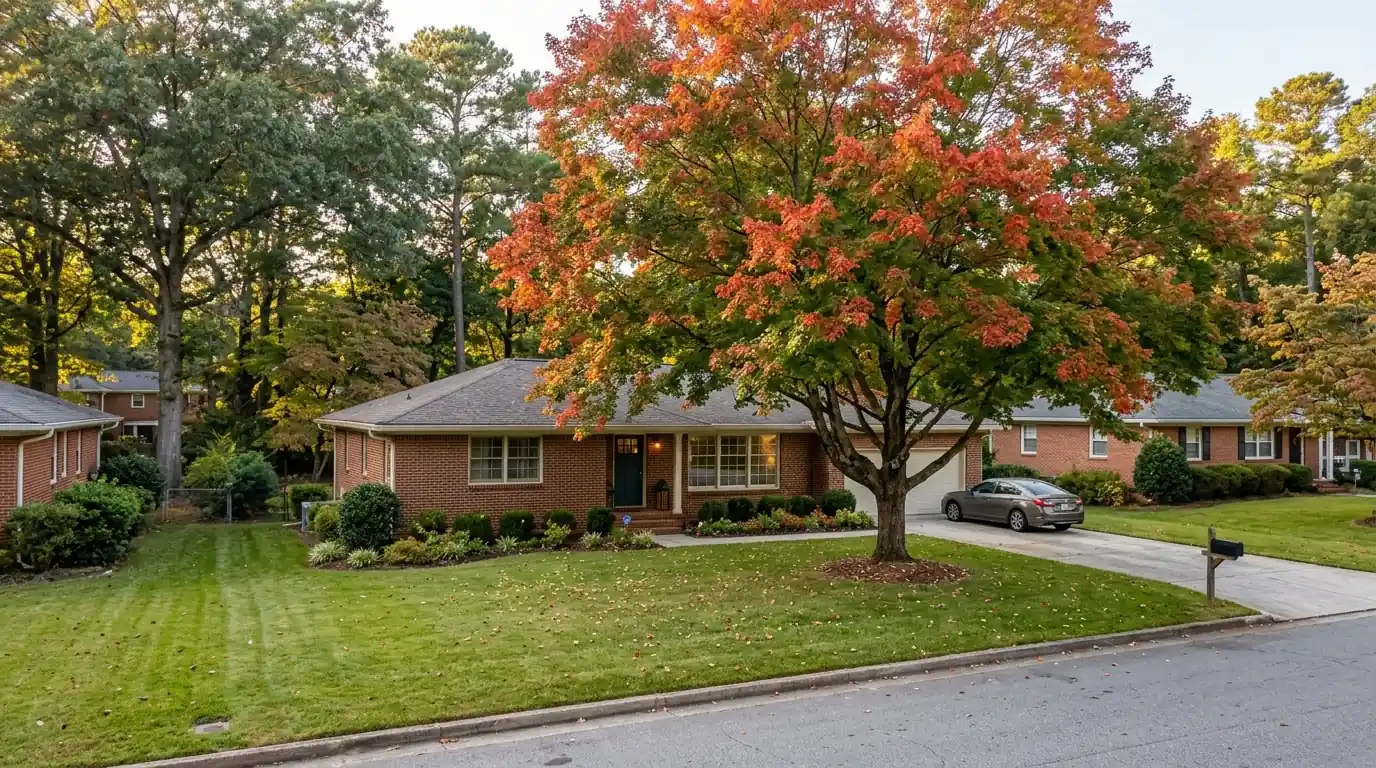
What structural pruning can fix at different ages
The same defect gets harder to correct every year the tree grows, which is why timing matters so much.
| Young tree, under 15 years | Mid-age tree | Mature tree | |
|---|---|---|---|
| Typical cut size | Finger to wrist thick | Wrist to forearm thick | Limbs as big as a small tree |
| How fast cuts close | A few growing seasons | Several years | Often never fully |
| What can be fixed | Almost any defect | Most leaders and forks, over time | Load reduction and support only |
| Usual approach | Pruning alone | Pruning over two or three visits | Reduction, cabling or a removal conversation |
What decides the cost of structural pruning
| Job | Typical range | Priced |
|---|---|---|
| Structural pruning | $235 to $1,180 | per tree |
Young trees are the least expensive to prune for structure. A ten-year-old oak can often be done from a ladder or with a pole saw in a short visit, while a mid-age tree needs a climber in the crown working limb by limb. Size, the number of defects, and how many trees we can handle in one trip move the price more than anything else.
Because structural work is planned over several visits, each one is smaller than a single heavy pruning would be. Brush chipping and cleanup are included, and adding a second or third young tree to the same visit costs far less than a separate trip. The range below covers one tree, and our price guide lays out how pruning compares with trimming and the rest of our services.
Where we do tree pruning around Atlanta
Crews work from our Atlanta office near the 30340 ZIP and our Duluth office. These are the places we cover most, with their main ZIP codes. See all 56 areas.
- Buckhead 30305
- Virginia-Highland 30306
- Druid Hills 30307
- Morningside 30324
- Grant Park 30312
- Kirkwood 30317
- Cascade Heights 30311
- Sandy Springs 30328
- Dunwoody 30338
- Brookhaven 30319
- Decatur 30030
- Duluth 30096
- Lawrenceville 30046
- Marietta 30060
- Smyrna 30080
- Roswell 30075
- Alpharetta 30009
- Johns Creek 30097