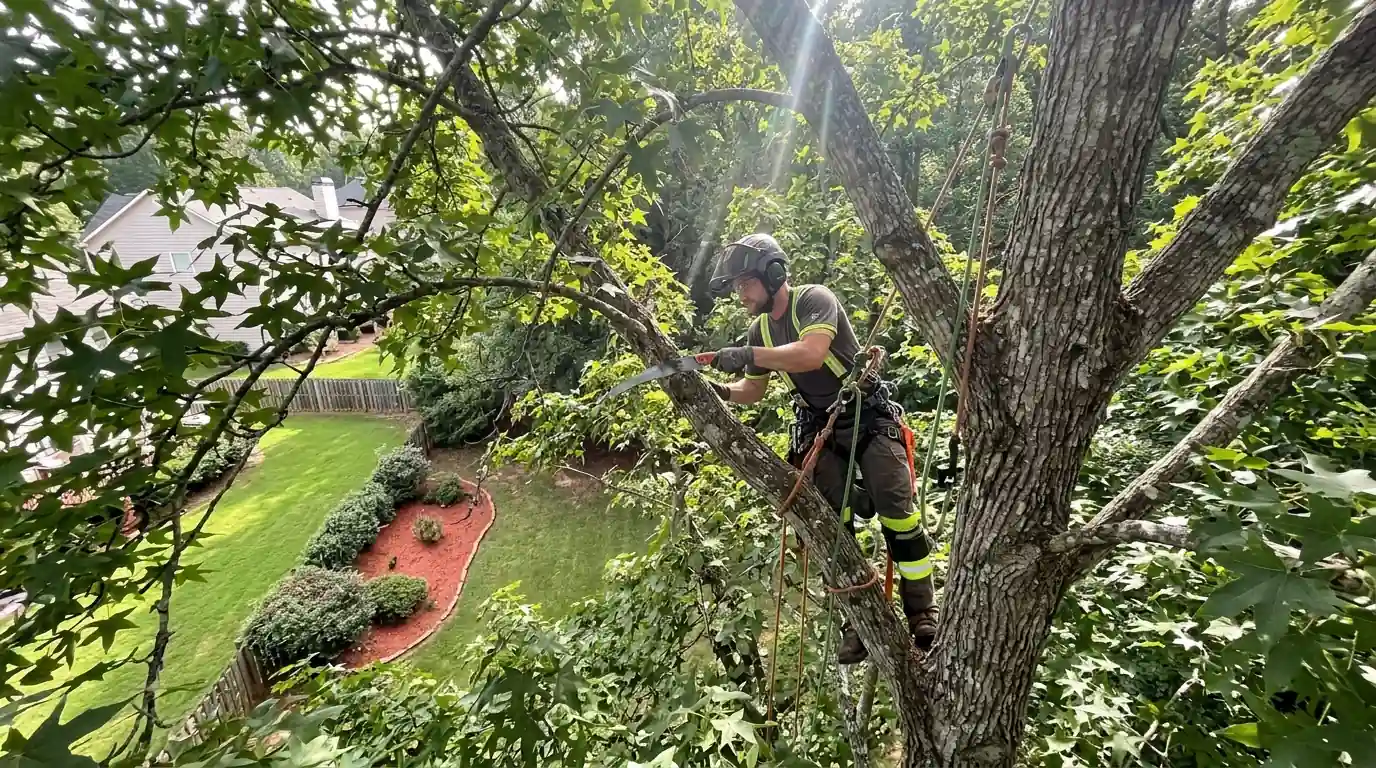
Crown thinning is the selective removal of interior branches, especially ones that cross, rub or crowd each other, spread evenly through the canopy. It lowers wind resistance, lets light reach the grass and beds below, and improves airflow through the leaves. Done properly, it takes only a modest share of live foliage per visit. In Atlanta yards, the usual candidates are dense oaks, sweetgums and red maples that have grown thick over a lawn or patio.
What crown thinning does for a dense tree
Some trees grow thick enough that you can't see sky through them. That density comes at a cost. Branches inside the crown cross and rub each other raw, interior twigs die from lack of light, and the whole canopy holds wind instead of letting it pass. During a summer thunderstorm, that wind load pulls hard on every limb and on the roots holding the tree in soft clay.
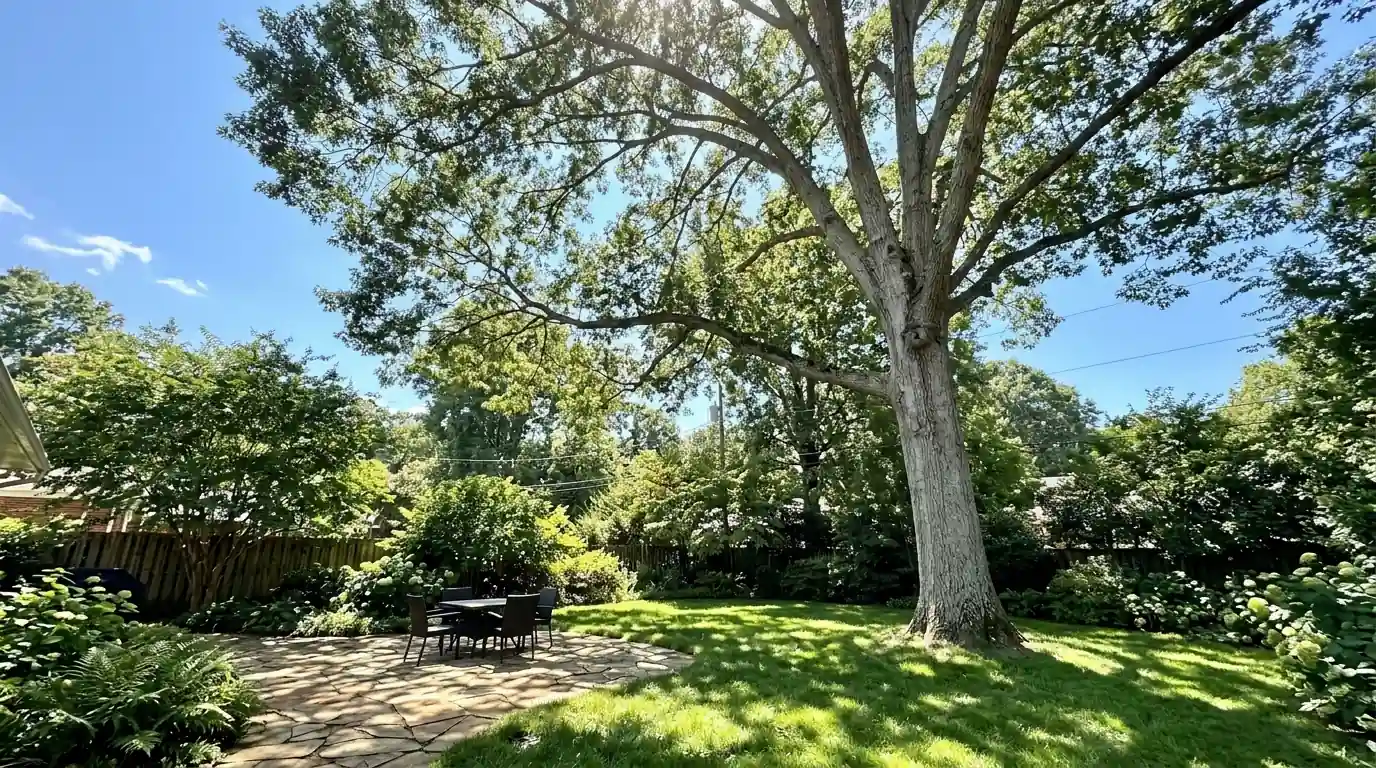
Thinning addresses this by removing selected branches back to their point of origin, spread evenly from the inside of the crown to the outside. The tree keeps its height and spread. What changes is how much air and light passes through it. After a good thinning, you see patches of sky through the canopy and dappled light on the ground instead of solid shade.
Thinning is often confused with reducing a crown's size, but the two do different jobs. Reduction makes the tree smaller. Thinning leaves the outline alone and opens up the interior, which is why it suits healthy trees that fit their space but have grown too thick. Many trees need only one of the two, and some need neither, which we'll tell you on the walk-around.
Why we never lion-tail a tree
Lion-tailing is what happens when a crew strips out all the inner branches and keeps foliage only at the tips, like a tuft on the end of a lion's tail. It looks open and tidy from the ground, which is why it's common. It's also one of the most damaging things that can be done to a tree in the name of thinning.
A lion-tailed limb carries all its weight at the end, the worst place for it, and bends more in wind because the inner branches that damped its movement are gone. Bark that was shaded suddenly sits in full sun and can scald. The tree also responds by pushing out water sprouts along the stripped limbs, which crowd the crown all over again within a few years. Real thinning removes branches throughout the crown and keeps foliage along the whole length of every limb.
Branches we remove when we thin a crown
Each cut in a thinning has a reason, and these are the branches that usually go first.
Crossing branches
Two limbs growing across each other will eventually wear through the bark where they touch. We remove the weaker one.
Rubbing branches
Branches that move against each other in wind leave open wounds that let decay in. Separating them stops the damage.
Interior branches heading inward
Limbs that grow toward the center of the crown crowd the space and shade out healthier growth, so we cut them back to their origin.
Clusters of competing shoots
Where several branches sprout from one spot, we keep the one or two that are well spaced and strongly attached, and remove the rest.
Weak or poorly attached limbs
Branches with tight forks or included bark come out during thinning while they're still small enough to remove cleanly.
Small dead twigs
Dead interior wood is removed as we go, and heavier dead limbs are handled through deadwood removal if the tree has a lot of it.
Signs a crown has grown too dense and needs thinning
You can spot most of these from the yard without climbing anything.
- Grass under the tree has thinned to moss or bare red clay even though the rest of the lawn is healthy.
- You can't see patches of sky when you stand under the crown and look straight up.
- Branches in the interior have bare, dead twigs where light no longer reaches.
- Two limbs touch or cross, with polished or torn bark where they rub in wind.
- The whole crown sways as one heavy mass in a summer storm instead of letting gusts pass through.
- Leaves stay wet on the patio or deck long after a rain because the canopy blocks sun and air.
- Clusters of sprouts have filled in where old pruning cuts were made.
How a crown thinning visit is done
Thinning is slow, careful work from inside the crown, and every cut is weighed against the tree's overall balance.
- 1
Look up from several angles
We walk around the tree and study the crown from the ground to see where it's densest and which limbs are the problems.
- 2
Set the amount to remove
We decide on a modest share of foliage to take, rarely more than about a quarter of the live crown, and less on older or stressed trees.
- 3
Climb and work from the inside out
The climber works through the crown, removing branches at their point of origin and spreading cuts evenly around the tree.
- 4
Keep inner foliage in place
We leave healthy small branches along the inner parts of the limbs, since those leaves help feed the tree and dampen limb movement in wind.
- 5
Check balance as we go
The ground person watches the outline and calls out any side that's getting too open or too heavy.
- 6
Chip, rake and walk the yard
All brush is chipped, the lawn and beds are raked clean, and we walk the yard with you before we leave.
Thinning oaks, sweetgums and maples in Atlanta yards
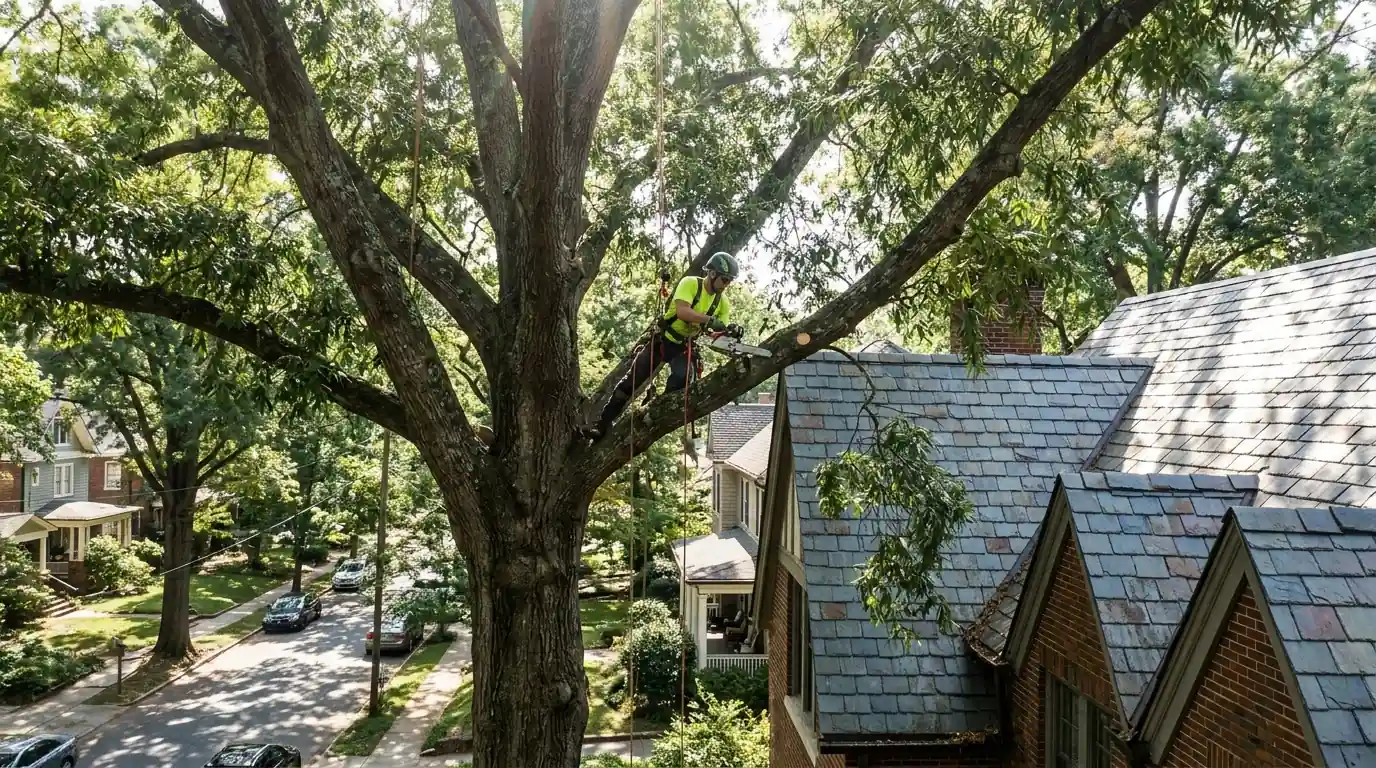
The trees we thin most in metro Atlanta are white and willow oaks, sweetgums and red maples. Oaks grow dense crowns that shade lawns down to bare clay, especially in older neighborhoods like Brookhaven where mature trees stand over most of the lot. Sweetgums grow thick and fast, and thinning cuts down on the gumballs that rain onto patios and pool decks.
Summer thunderstorms are the other reason people call. A dense crown takes the full force of a sudden gust, and the wet red clay under many Atlanta yards can't always hold the roots. In Dunwoody and Chamblee, where tall hardwoods stand close to homes, thinning before storm season is a practical way to reduce that load. If you also want clearance underneath, our crown raising work pairs well with a thinning visit.
Thinning, reduction or raising: which cut fits the problem
These three crown jobs are often mixed up, so here is what each one changes and when it fits.
| Crown thinning | Crown reduction | Crown raising | |
|---|---|---|---|
| What changes | Density inside the canopy | Overall height or spread | Height of the lowest limbs |
| Outline afterward | Same size and shape, more open | Smaller, same general shape | Same top, more trunk showing |
| Typical reason | Wind load, shade, rubbing limbs | Tree has outgrown its space | Clearance over walks, drives and roofs |
| Where the cuts are | Spread evenly through the interior | At the ends of the longest limbs | On the lower trunk and lower scaffold limbs |
| Effect on the lawn | More dappled light on the grass | More light, mainly at the edges | Easier mowing and foot traffic |
What sets the price of crown thinning
| Job | Typical range | Priced |
|---|---|---|
| Crown thinning | $465 to $1,690 | per tree |
Thinning is priced by the size of the tree and the density of the crown. A big oak with decades of crossing limbs takes a climber much longer than a younger sweetgum that just needs light cleanup. How easy it is to reach the tree, what's beneath it, and how much brush has to be carried out also matter.
All brush chipping and cleanup are included in the price. If the tree also needs height reduced, deadwood removed or limbs lifted off a roof, we can usually combine that into the same climb for a better total than separate visits. See our cost guide for typical ranges across our services.
Where we do crown thinning around Atlanta
Crews work from our Atlanta office near the 30340 ZIP and our Duluth office. These are the places we cover most, with their main ZIP codes. See all 56 areas.
- Buckhead 30305
- Virginia-Highland 30306
- Druid Hills 30307
- Morningside 30324
- Grant Park 30312
- Kirkwood 30317
- Cascade Heights 30311
- Sandy Springs 30328
- Dunwoody 30338
- Brookhaven 30319
- Decatur 30030
- Duluth 30096
- Lawrenceville 30046
- Marietta 30060
- Smyrna 30080
- Roswell 30075
- Alpharetta 30009
- Johns Creek 30097