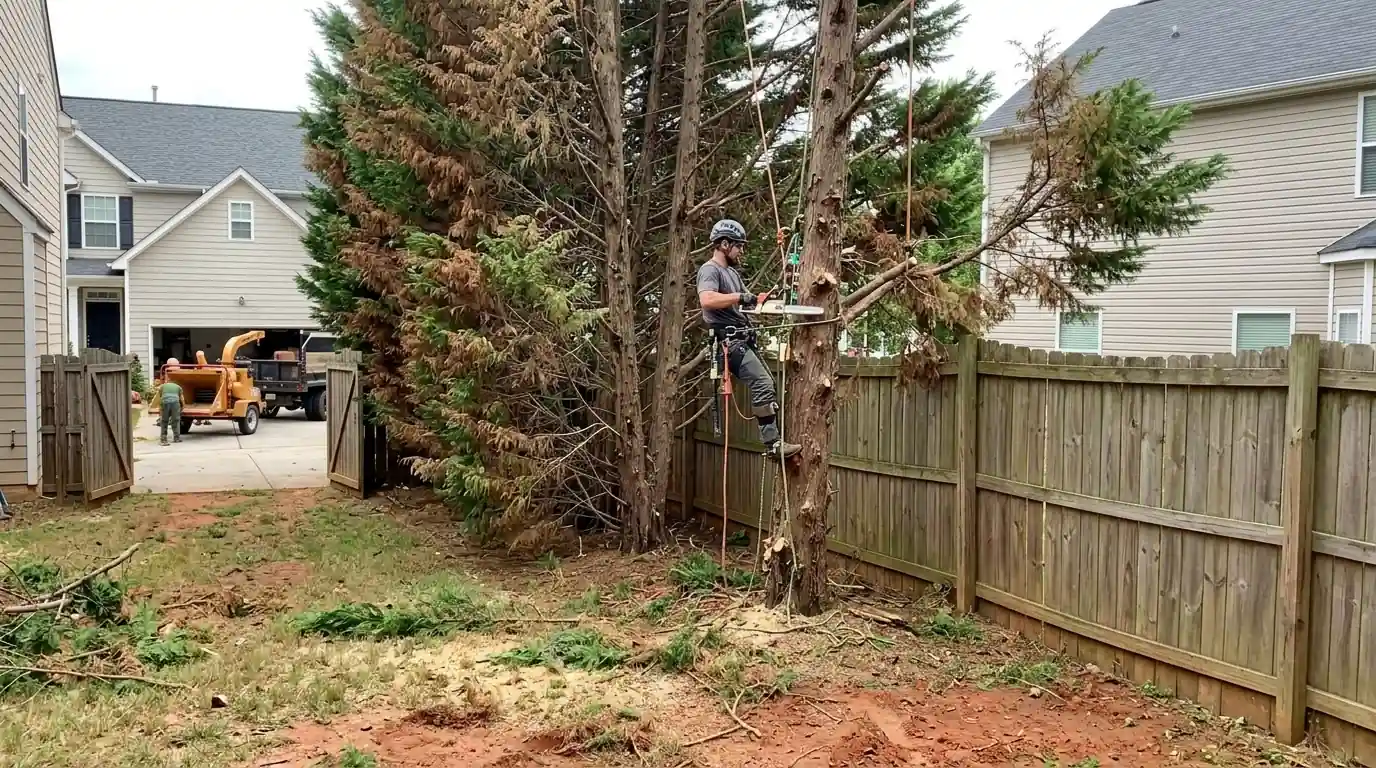
Leyland cypress removal means cutting out dead, cankered or leaning Leylands, either one tree from a gap in a screen or an entire row, then chipping the brush and grinding the stumps so the strip can be replanted. You need it when brown sections keep spreading, cankers ooze resin or the trees tip after rain. Inside Atlanta city limits, a Leyland 6 inches across at 4.5 feet needs a city permit, even a dead one, though dead trees carry no application fee.
Why Leyland screens fail in Atlanta yards
Leyland cypress grows fast enough to turn a bare back fence into a green wall in a few seasons. That speed is why it went in so heavily across metro Atlanta in the 1990s and 2000s. But Georgia asks a lot of it: humid summers, red clay that stays wet in winter and bakes hard in August, and dry spells that stress its shallow roots.
Stressed Leylands invite two canker fungi. Seiridium canker kills branches in patches and leaves sunken, resin-streaked wounds on the bark. Botryosphaeria canker tends to follow drought and shows up as scattered brown limbs throughout the tree. Neither one can be cured once it reaches the trunk. Pruning out infected limbs can slow it on one tree, but in a tight row, spores spread from tree to tree in rain splash and on tools.
Spacing finishes the job. Many screens were set a few feet apart for an instant hedge, far closer than a mature Leyland needs. The trees shade out each other's lower limbs, fight over the same water and grow top-heavy on small root plates. Bagworms pile on in late summer. By the time a row is 25 or 30 years old, it's often more dead wood than green.
What to plant where the Leylands stood
The lesson from failing Leyland rows is not to replace them with another single-species row. A mixed, staggered screen holds up better, because a disease or drought that hits one species leaves the others standing. Spacing matters as much as the plant list. Give each tree room for its mature width, even if the screen looks thin for the first few years.
For sun along a back fence, Green Giant arborvitae and Cryptomeria both grow quickly and handle Georgia heat better than Leylands do. Hollies, from American holly to the larger hybrid hollies, give a dense screen and tolerate clay and partial shade. Native wax myrtle fills in fast on wet or sandy ground and suits a looser, more natural edge. Our planting work can lay out a staggered mix and set each tree at the right depth.
If you lost only one or two trees from a screen you want to keep, a holly or a Cryptomeria in the gap looks patchy at first but gives the row a backup species. Keep the surviving Leylands with light yearly cuts, since they leave brown holes wherever they're cut into bare wood. Our hedge trimming visits cover that upkeep, and we point out any new canker we spot while we're up there.
Signs your Leyland cypress should come out
A few brown tips can be trimmed away, but these are the signs we see before a Leyland, or a whole screen, is past keeping.
Brown sections that keep spreading
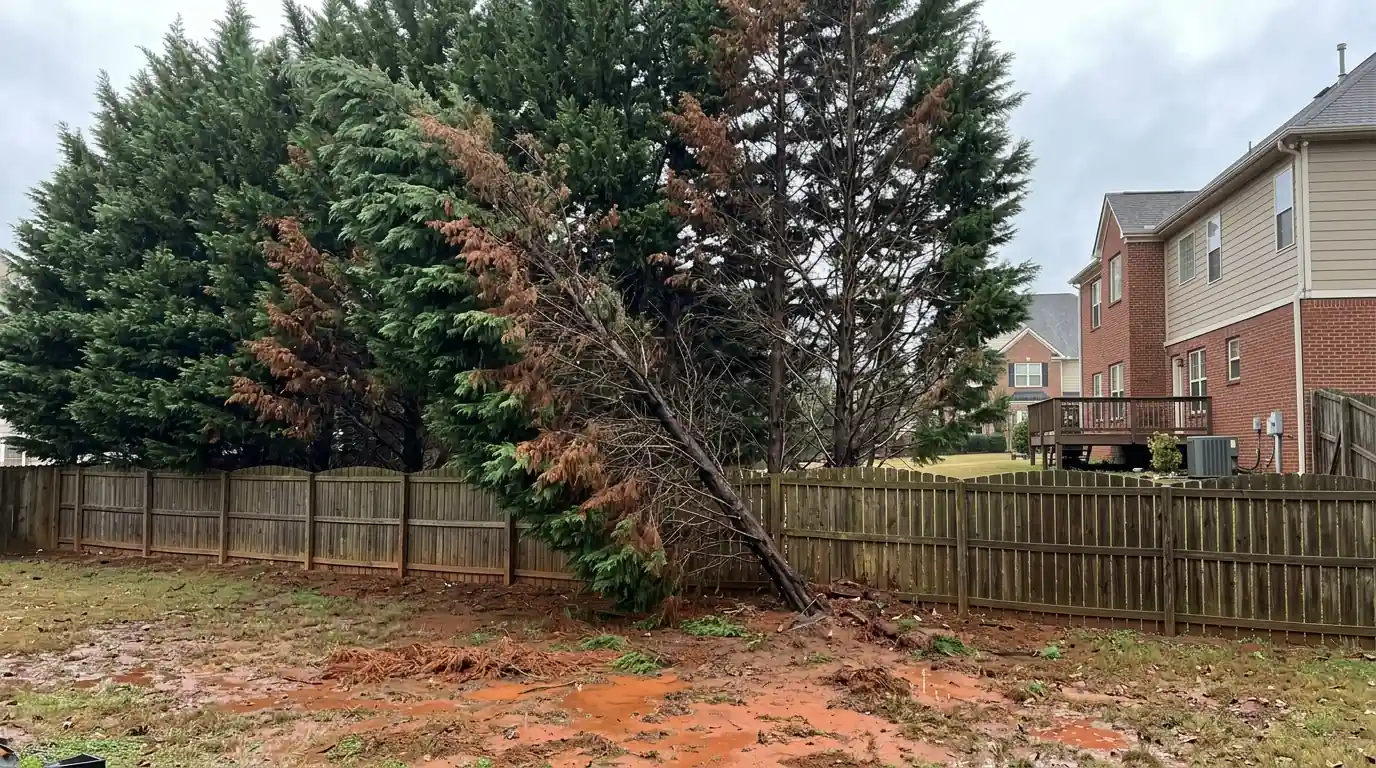
Rust-colored patches that start on one limb and widen each season usually mean Seiridium or Botryosphaeria canker working through the tree.
Oozing cankers on the trunk
Sticky amber resin running from a sunken, darker patch of bark is a canker on the main stem, and that one doesn't prune out.
Sudden collapse
A tree that looked green in spring and went entirely brown by August has usually been girdled by canker or lost its roots to drought.
Leaning after a heavy rain
Tall Leylands on wet clay tip over on their shallow root plates. Lifted soil or a gap opening at the base means the tree is on its way down.
Bare from the ground to head height
Crowded trees shade out their lower limbs, and Leylands don't regrow from bare wood, so the screen no longer screens anything.
Bagworm bags hanging everywhere
Hundreds of small cone-shaped bags and stripped brown tips mean a heavy bagworm load on a tree that may already be weak.
How we take down a Leyland screen without wrecking the fence
Leylands come down quickly, but a tight row against a fence takes some order.
- 1
Walk the row and check the rules
We look at every tree, mark what's dead, leaning or cankered, measure trunk diameters and check whether a city or county permit applies at your address.
- 2
Plan the drop
With a clear lane, a Leyland can be felled whole. Near a fence or house, a climber takes it apart from the top.
- 3
Limb and lower
Branches come off from the top down and are lowered or dropped into the yard side, away from the fence and the neighbor's lot.
- 4
Cut the trunks in rounds
Trunks come down in short sections, and each round is carried out rather than dropped onto a fence rail or a flower bed.
- 5
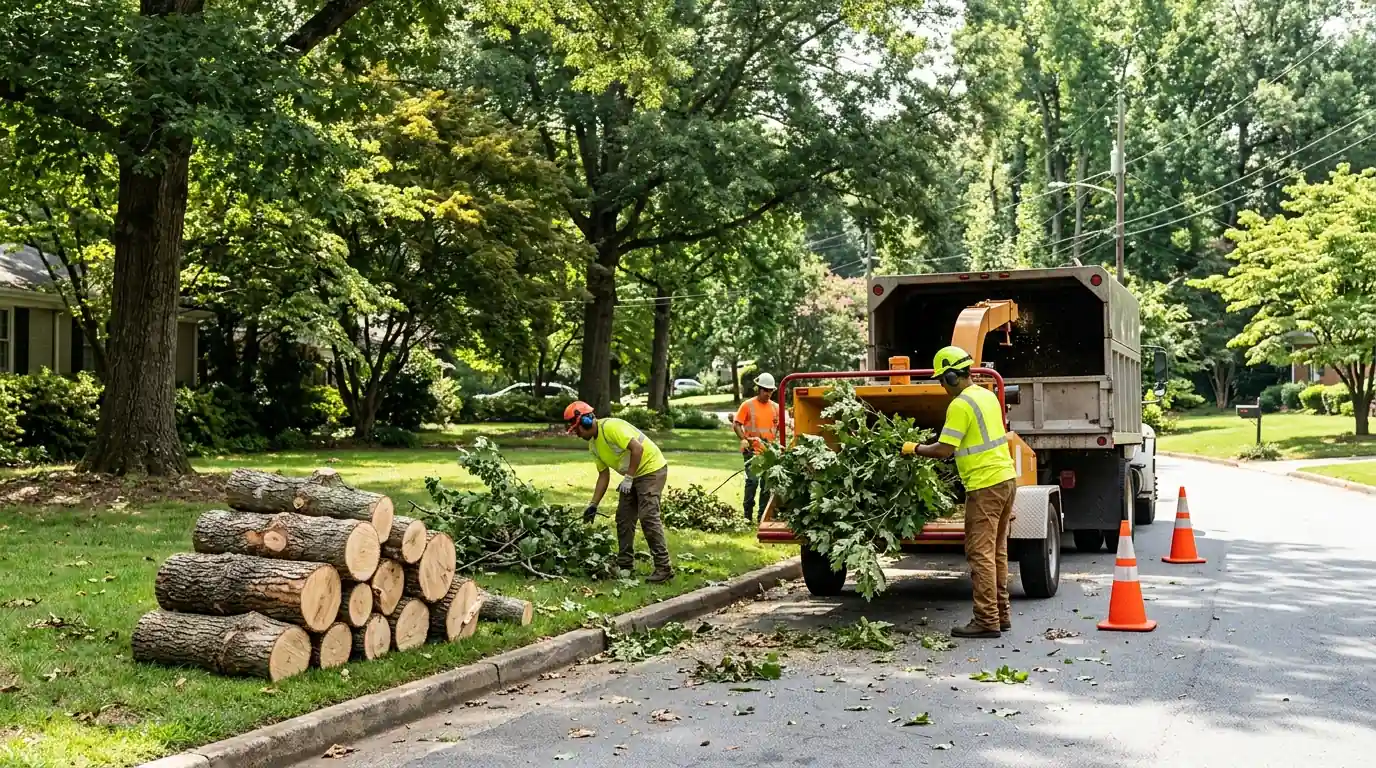
Chip the brush
Leyland brush is bulky and soft, so it feeds through the chipper fast. Chips are hauled, or left for mulch if you want them.
- 6
Grind the row of stumps
After a Georgia 811 locate, we grind each stump below grade so the strip can be replanted without old stump wood in the way.
Before a Leyland row comes down
Taking out a full screen changes your yard and your neighbor's view, so a little planning helps.
- Talk to the neighbor first, since the screen probably blocks their view as much as yours.
- Confirm whether the row sits on your side of the line, right on it, or on theirs.
- Check whether your address is inside Atlanta, Brookhaven, Decatur or an unincorporated county area, since each has its own rule.
- Mark irrigation lines, pet fence wire and landscape lighting that run along the fence.
- Decide whether you want the chips hauled or spread as mulch along the new planting strip.
- Pick replacement plants before removal day so the strip doesn't sit bare through a season.
What moves the price of Leyland cypress removal
| Job | Typical range | Priced |
|---|---|---|
| Single Leyland cypress | $265 to $1,180 | per tree |
| Screen of five or more, felled and chipped | $1,450 to $4,850 | per row |
Access and height decide most of it. A single 30 foot Leyland in an open backyard is a short job, while a 50 foot tree wedged between a fence, a deck and a neighbor's garage has to be climbed and lowered in pieces. Rows are priced by the job, and the cost per tree drops as the work moves down the line.
Chipping and hauling the bulky Leyland brush are included, even on a long row. Stump grinding is quoted as its own line, since some people grind right away and others wait to replant. Typical ranges for a single tree and for a full row are on our tree service price guide.
Removing one Leyland or taking out the whole row
The choice comes down to how much of the screen is still healthy and how fast the canker is moving.
| Remove single trees | Remove the whole row | |
|---|---|---|
| Makes sense when | One or two trees are dead and the rest are dense and green | Brown sections run through most of the row or several trees lean |
| What you're left with | A gap that won't fill in from the trees on either side | A clean strip ready for a new, mixed screen |
| Canker risk | The trees left standing may still carry the infection | The source comes out along with the trees |
| Privacy | Mostly kept for now | Lost until the new plantings grow in |
| Cost per tree | Higher, since each tree is cut out of a tight row | Lower, since the work moves steadily down the line |
Leyland rows and tree rules across metro Atlanta
Inside Atlanta city limits, removing a private tree 6 inches across or larger at 4.5 feet needs a permit from the Arborist Division, and that includes dead and dying Leylands. A dead or hazardous tree carries no application fee, and once the city verifies its condition there is no recompense. Brookhaven sets its line at 4 inches, dead trees included. In unincorporated DeKalb County, up to five healthy, non-specimen trees per single-family lot can come out in a calendar year with no notice, so a long healthy row may need a Notice of Tree Removal.
In unincorporated Gwinnett County, homeowners on a developed single-family lot generally need no permit unless the row sits in a zoning buffer, stream buffer or other protected area, but at least two live trees must stay on the lot. That rule matters when a back fence of Leylands is most of what's growing there. Cities such as Snellville sit outside that unincorporated county rule, so we check the address before quoting. For the longer story on why these screens decline, read our piece on dying Leyland cypress.
Where we do leyland cypress removal around Atlanta
Crews work from our Atlanta office near the 30340 ZIP and our Duluth office. These are the places we cover most, with their main ZIP codes. See all 56 areas.
- Buckhead 30305
- Virginia-Highland 30306
- Druid Hills 30307
- Morningside 30324
- Grant Park 30312
- Kirkwood 30317
- Cascade Heights 30311
- Sandy Springs 30328
- Dunwoody 30338
- Brookhaven 30319
- Decatur 30030
- Duluth 30096
- Lawrenceville 30046
- Marietta 30060
- Smyrna 30080
- Roswell 30075
- Alpharetta 30009
- Johns Creek 30097