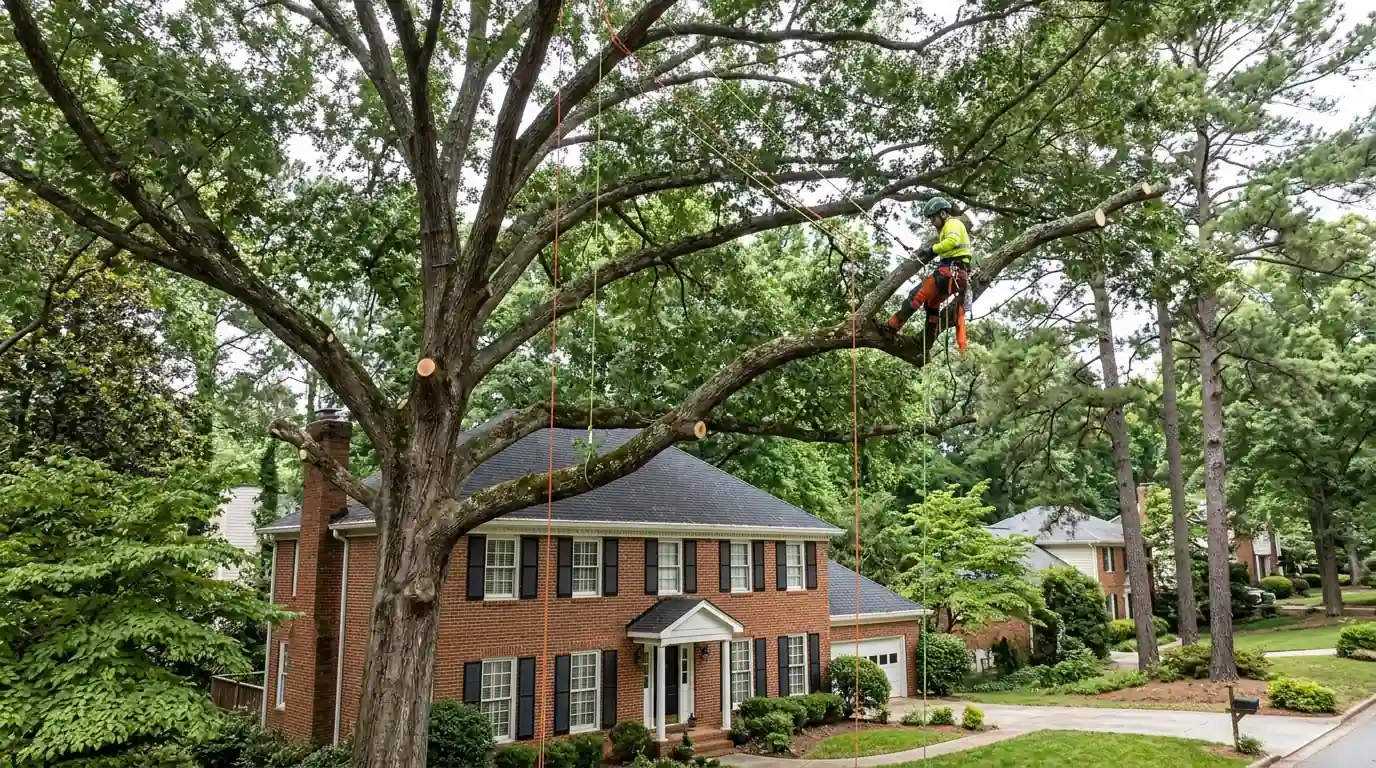
Crown reduction makes a tree shorter or narrower by cutting branches back to lateral limbs that can carry on growing, rather than chopping them off mid-stem. It's used when a tree crowds a house, when long limbs carry too much end-weight, or when a cracked leader can be kept by lightening it. In Atlanta, where big oaks often stand a few feet from older homes, reduction can keep a healthy tree that would otherwise come down.
How crown reduction shortens a tree the right way
Every limb in a crown ends in a growing tip, and below that tip are side branches of various sizes. A reduction cut removes the end of a limb just above one of those side branches, which becomes the new leader for that part of the crown. The rule of thumb is that the branch you cut back to should be at least a third the diameter of the piece being removed, so it's strong enough to take over.
Done that way across the canopy, the whole tree drops in height or narrows in spread while keeping the same overall outline. The cuts are spread around the crown rather than concentrated on one side, and the tree keeps enough leaves to feed itself. From the street, a well-reduced tree looks like a smaller version of itself, not a shorn one.
Reduction takes more skill and more time than most pruning. The climber has to work out to the ends of long limbs, often on a second tie-in point, and judge every cut against what it leaves behind. When only a couple of limbs are the problem, taking off a single limb may be all you need.
How much a crown can be reduced, and when it can't
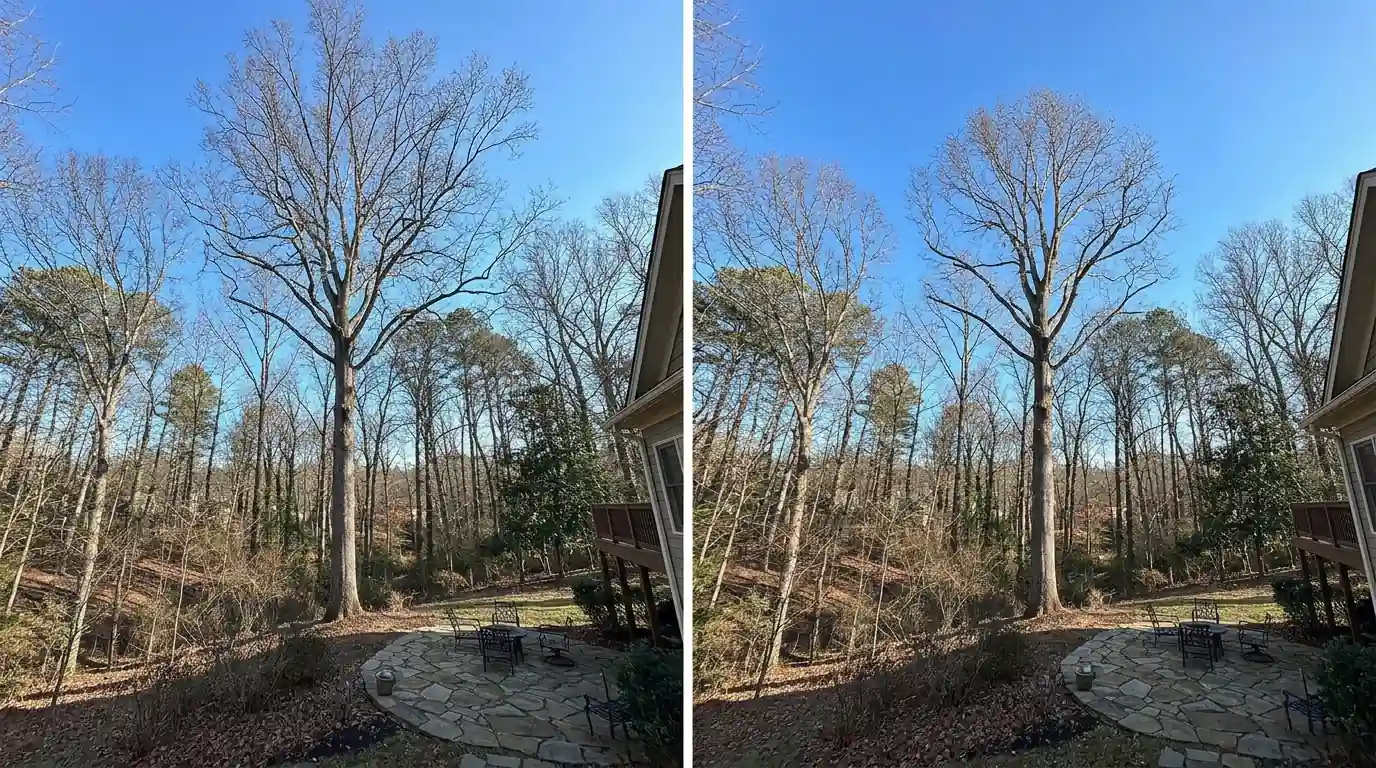
Reduction has limits. A healthy, vigorous hardwood can usually lose a modest amount of its height or spread in one visit, and more over several visits spaced a few years apart. Take too much at once and the tree is left with too few leaves to feed itself, more exposed bark to sunburn, and a flush of stressed sprouts. If the size you need would take more than the tree can give, we'll tell you plainly.
Species matters too. Oaks, maples and elms generally respond well. Pines don't, since they rarely sprout from older wood, and cutting a pine's leader back usually leaves a dead top. Trees with advanced decay or a declining crown are also poor candidates, and for those a risk assessment comes before any pruning decision.
When crown reduction is the right call for your tree
We suggest reduction when keeping the tree is reasonable but leaving it alone is not.
The tree outgrew its spot
An oak planted close to a house or a tulip poplar shading out the whole yard can be brought back into scale without losing it.
Long limbs with heavy ends
Limbs that reach far out with all their foliage at the tip act like levers. Shortening them takes weight off the attachment point.
A cracked leader worth keeping
When a stem has a crack but the tree is otherwise sound, reducing that stem lightens the load and gives the wood a chance to hold, sometimes with a cable for support.
Lopsided after storm damage
If a storm took out one side of a crown, reducing the heavy side can bring the tree back into balance.
Crowding a roof on all sides
When a tree overhangs a roof from several directions, a reduction can give clearance everywhere at once instead of a patchwork of single cuts.
Solar or garden light
Reducing a crown's height can let more sun reach a vegetable bed, a lawn or a south-facing roof without removing the shade entirely.
How we plan and carry out a crown reduction
Reduction is planned from the ground before anyone climbs, so the cuts add up to the shape we agreed on.
- 1
Check the tree is a candidate
We look at the species, its health and the trunk for decay. A tree in decline may not respond well to reduction, and we'll say so.
- 2
Set the target size
We agree with you on how much height or spread to take off and mark reference points on the house or the yard.
- 3
Map the cut points
From the ground, the climber identifies which side branches will become the new tips on each limb.
- 4
Climb and reduce
Working from the top and outer edges inward, the climber cuts each limb back to its chosen lateral and lowers heavy pieces on a rope.
- 5
Balance the crown
We step back regularly and check the outline from several angles, evening it out so no side is heavier than the others.
- 6
Clean up and plan follow-up
Brush is chipped and the yard cleaned, and we tell you when a light follow-up visit will help keep the new size.
Reducing big Atlanta oaks and poplars on tight lots
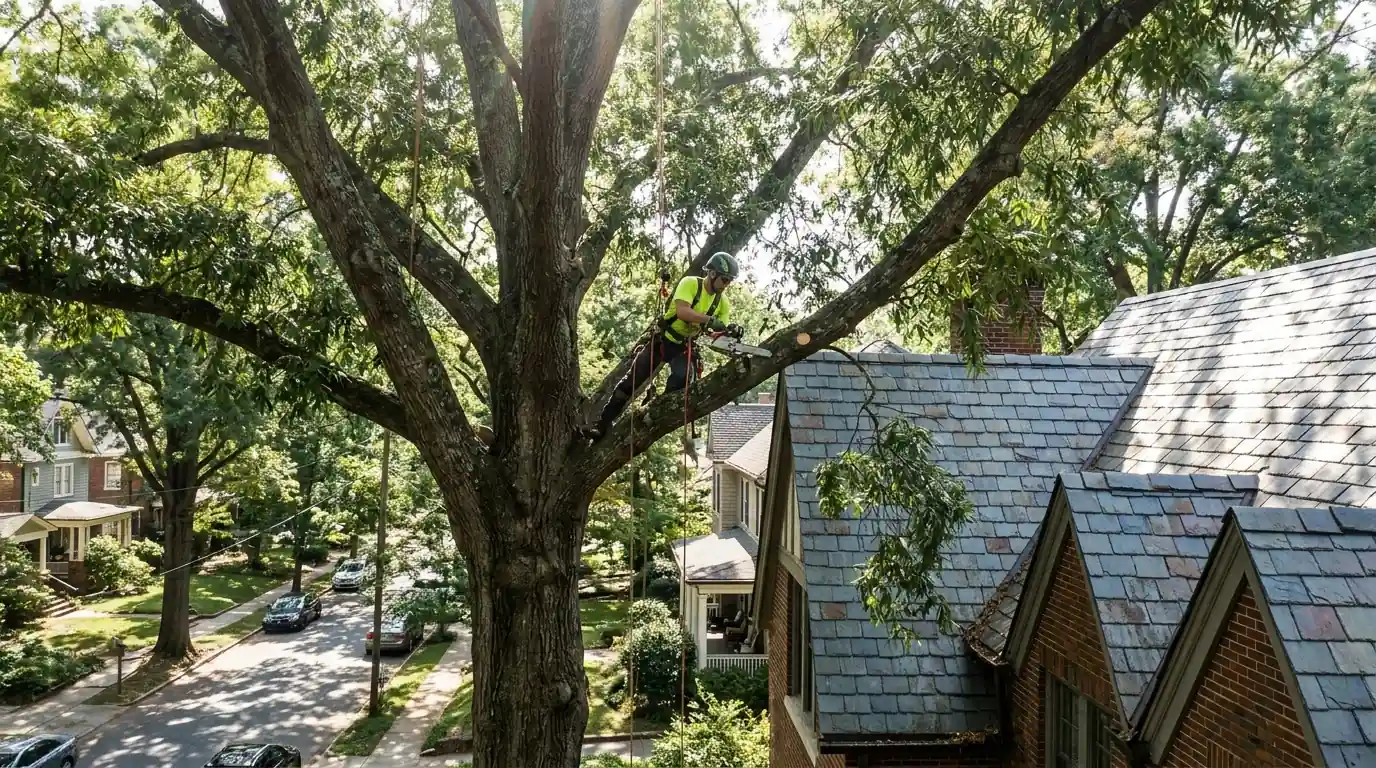
A lot of the reduction we do is on oaks and tulip poplars planted or left standing far too close to the house. In Ansley Park and Virginia-Highland, it's common to find a southern red or willow oak with limbs reaching across the roof of a two-story home, where reduction lets the owners keep a tree they love. Pruning needs no permit inside the city, but the ordinance's pruning standards still apply, and topping is not how industry pruning standards shorten a tree.
Up in Sandy Springs, tall tulip poplars on wooded lots are the usual candidates. Their limbs are brittle and they grow fast, so reducing the longest, heaviest ends before storm season makes sense. Water oaks are another story: many are old, short-lived and prone to heart rot, and reducing a hollow one rarely helps. Our water oak guide covers what to look for.
Crown reduction versus topping, cut by cut
Both make a tree smaller today, but they end up as very different trees five years from now.
| Crown reduction | Topping | |
|---|---|---|
| Where the cut goes | Just above a living side branch big enough to take over | Wherever the limb hits a chosen height, often mid-stem |
| What the tree does next | The side branch keeps growing as the new tip | Dozens of fast, weakly attached sprouts burst from the stub |
| Decay | Small cuts that close over | Large stubs that die back and rot into the limb |
| Shape afterward | Natural outline, just smaller | Flat or knuckled top that looks butchered |
| Long-term safety | Lighter limbs with less end-weight | Heavy sprouts on rotting stubs that break in storms |
What affects the cost of crown reduction
| Job | Typical range | Priced |
|---|---|---|
| Crown reduction | $585 to $2,160 | per tree |
Crown reduction usually costs more than a routine trim on the same tree because there are more cuts, each made far out on the limbs, and the climber has to reposition many times. The size of the tree, how much it needs to come down, what sits underneath and whether heavy pieces must be lowered on ropes all affect the price.
Cleanup and hauling of all the brush and wood are part of the job. Some trees need a follow-up visit a few years later to hold the new size, and we price that separately when the time comes. Our tree service cost guide shows how reduction compares with thinning, trimming and removal.
Where we do crown reduction around Atlanta
Crews work from our Atlanta office near the 30340 ZIP and our Duluth office. These are the places we cover most, with their main ZIP codes. See all 56 areas.
- Buckhead 30305
- Virginia-Highland 30306
- Druid Hills 30307
- Morningside 30324
- Grant Park 30312
- Kirkwood 30317
- Cascade Heights 30311
- Sandy Springs 30328
- Dunwoody 30338
- Brookhaven 30319
- Decatur 30030
- Duluth 30096
- Lawrenceville 30046
- Marietta 30060
- Smyrna 30080
- Roswell 30075
- Alpharetta 30009
- Johns Creek 30097