We remove and thin pines, clear brush and clean up wooded lots across Adams Park in southwest Atlanta, around the park and its golf course. Tall loblolly pines dominate the big lots behind mid-century brick homes, with oaks and sweetgums mixed in. Adams Park is inside Atlanta city limits, so each pine 12 inches or more at 4.5 feet, and other trees from 6 inches, needs a city permit to remove. Our line is answered 24/7.
Pine stands that grew too crowded
Adams Park was built out in the middle of the last century, with brick ranch homes set on generous lots around the park and its golf course. Many builders left the pines standing, and those trees have now grown tall and thin, packed close together at the back of the lot. Crowded pines compete for light and water, and the weaker ones fall behind: thin crowns, lean trunks and a lot of dead lower branches.
Thinning helps. We take out the weakest, leaning or damaged pines and leave the strongest ones with room to grow. That cuts the chance of one tree falling into another, lets more light reach the ground and makes the stand less inviting to bark beetles, which favor stressed trees. On many lots, thinning a dozen pines solves more than removing the one nearest the house.
Pines close to the house and the roof
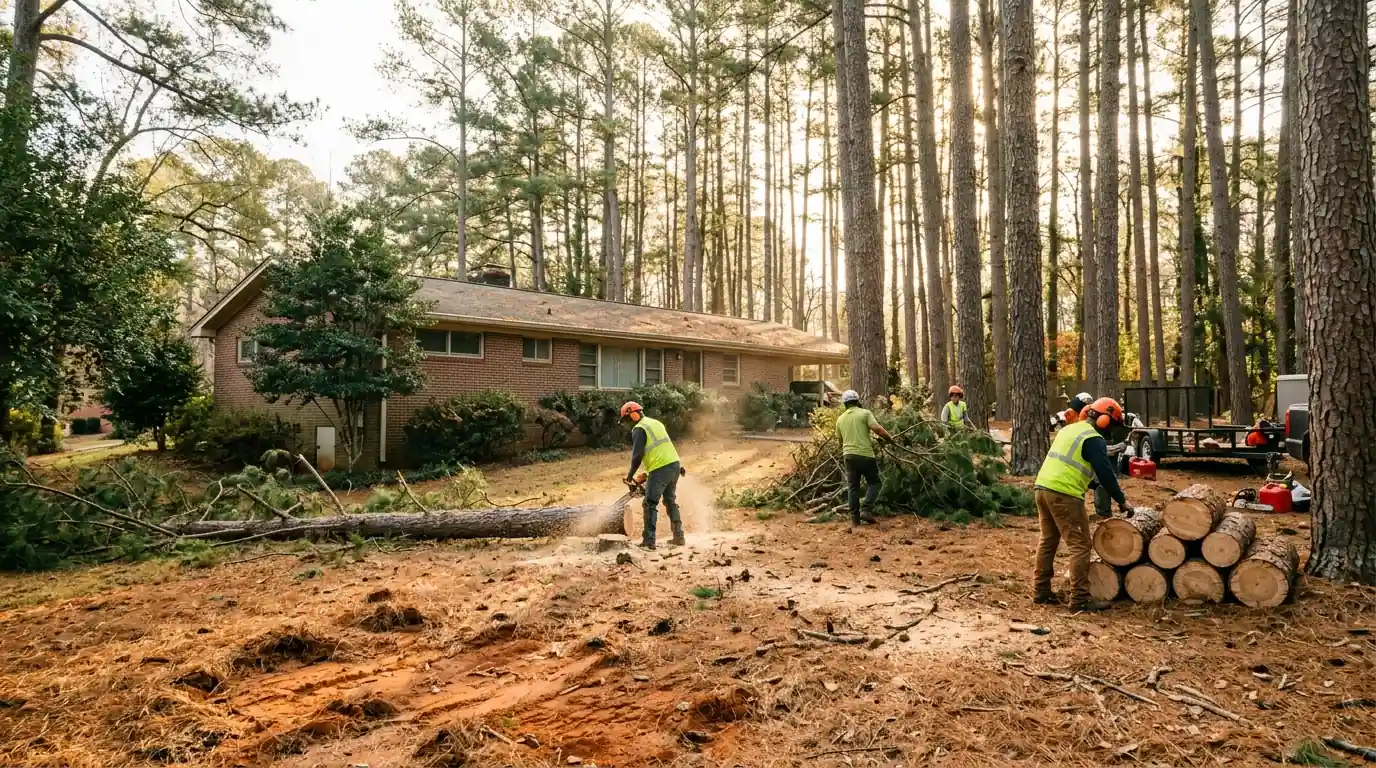
Some pines stand too close to the house for comfort. A pine that was a small tree beside a new ranch in the 1950s or 1960s may now stand eighty feet tall, its roots under the driveway and its needles filling the gutters every fall. When a tall pine leans toward the roof, has damage at the base or shows beetle signs such as pitch tubes or sawdust, we recommend taking it down.
Near the house, we don't fell pines whole. A climber goes up, removes the limbs and lowers the top in sections, then the trunk comes down in short rounds. Pine wood is soft and resinous, so we cut each piece small enough for the rigging to stop. Our pine removal service covers this work, and the article on tall pines near the house explains when a pine is worth worrying about.
Cleaning up a wooded lot that got away
A lot of Adams Park properties have a back section full of years of growth: fallen pine limbs, old brush piles, privet, ivy on the trunks and saplings filling every gap. Owners want that space back for a garden, a play area or simply a clear view to the fence. We cut the undergrowth, haul the old debris, pull ivy off the trunks and remove the small trees that crowd the keepers.
Pine stumps add work at the end. A thinned stand can leave several stumps, and pine roots spread wide and shallow in the clay. We grind the stumps below grade after a Georgia 811 locate and rake the chips into the beds or haul them off. Pine wood makes poor firewood for an indoor fireplace, so most owners here have us haul it, though we leave rounds for anyone who wants them for an outdoor fire pit.
Permits when you thin a pine stand
Adams Park sits inside Atlanta city limits in Fulton County. Each pine 12 inches or more at 4.5 feet needs a city permit to remove, other trees from 6 inches, so a thinning job can list several trees on one application. Small saplings and brush need no permit. Dead or beetle-killed pines go through the Arborist Division with no application fee once the city confirms them. Neighbors in Cascade Heights and West End work under the same rule, and our permit help covers the paperwork.