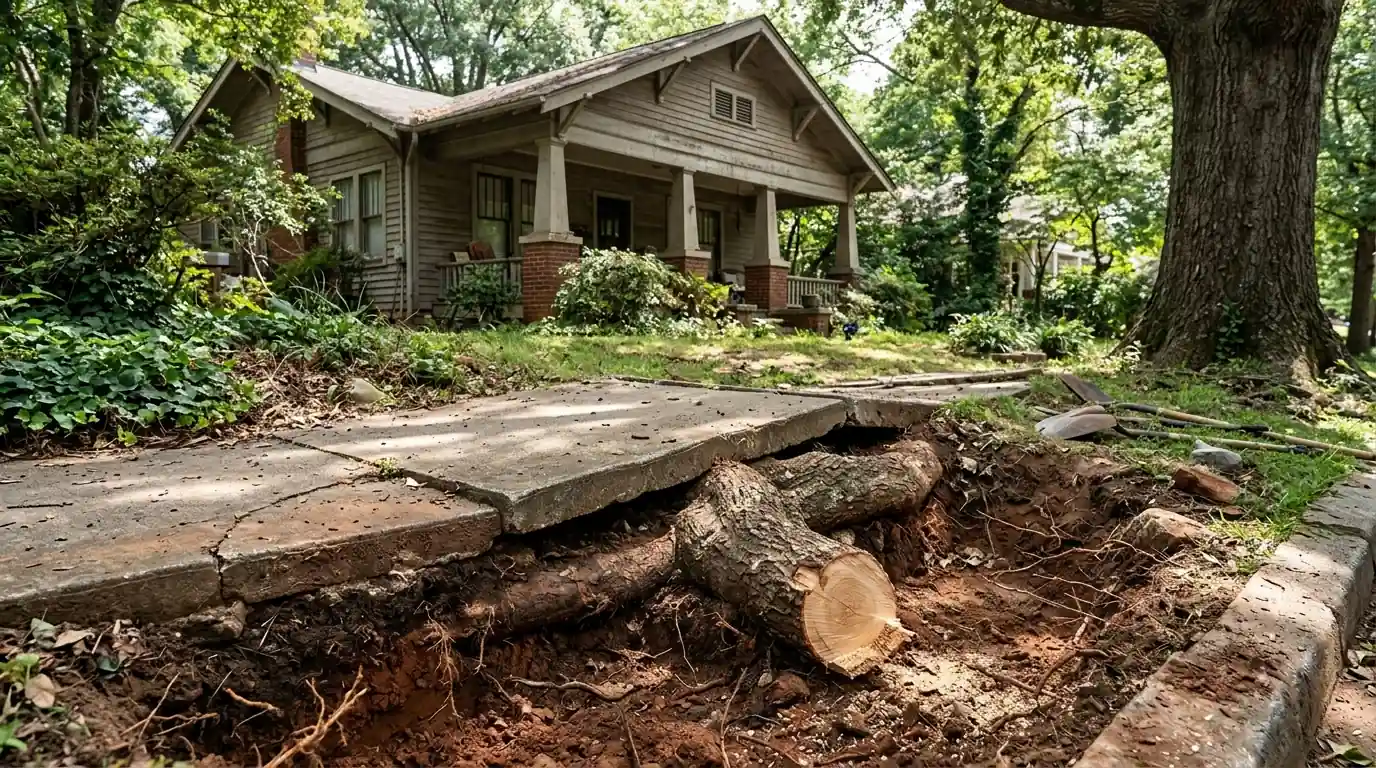
Tree root removal means cutting and pulling roots that lift sidewalks, crack driveways, trip mowers or crowd a foundation or sewer line. On a live tree it is really root pruning, and how much can be cut depends on the root's size and its distance from the trunk. In Atlanta, shallow roots in compacted red clay cause most of these problems, and we file a Georgia 811 locate before cutting.
Root pruning a live tree versus clearing roots from a dead one
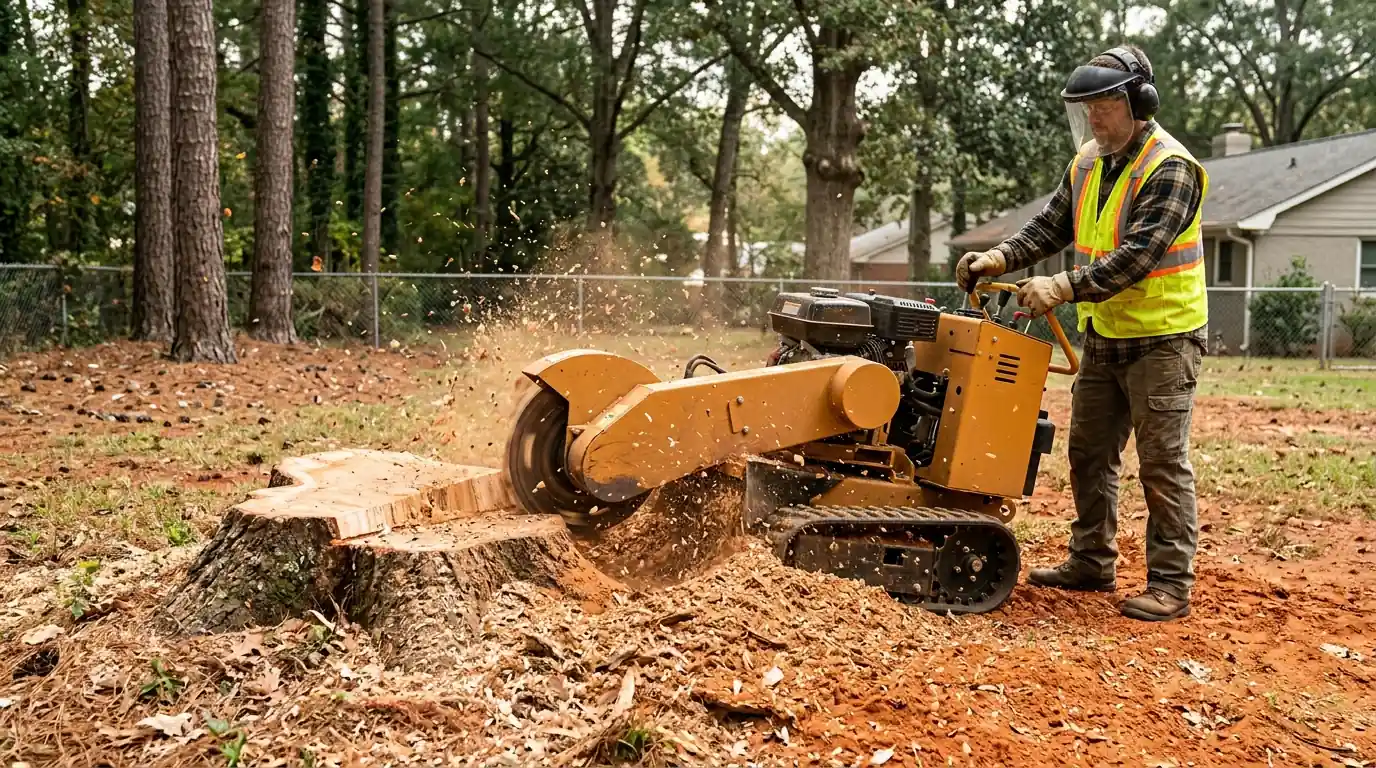
These are two different jobs that sound alike. When the tree is gone, its roots are just wood in the ground. We can grind them, dig them out or chase them across the lawn as far as you like, because there's nothing left to keep standing. That is mostly a cleanup question, and it often follows grinding the stump.
When the tree is alive, every root you cut is part of what feeds it and holds it up. Small roots far from the trunk can usually go with little effect on a healthy tree. A thick root close to the trunk is a structural root, and cutting it can starve one side of the crown or leave the tree prone to tipping in the next saturated storm.
So the first question on any live-tree root job isn't how to remove the root. It's whether this root can be removed at all, and if not, what can change instead: the walk, the driveway edge, the mowing line or the grade around it. Often the answer is a mix of a few small cuts and one change to the hardscape.
How much of a live tree's roots can be cut
There is no single safe number, and anyone who quotes one without seeing the tree is guessing. What matters is the root's diameter, how close it sits to the trunk, how much of the root zone has already been lost to driveways, trenches or past construction, and the tree's species, age and health. A young, vigorous red maple tolerates root loss far better than a stressed, aging water oak.
The general rule is cautious: the larger the root and the closer to the trunk, the more risk the cut carries. We keep cuts several trunk diameters away from the trunk wherever the job allows, avoid cutting roots on more than one side in the same season, and use a clean saw cut instead of tearing with a machine.
When a root is too important to remove, we say so plainly. Sometimes the better fix is bridging a walk over the root, curving a path, raising a slab on a gravel base or accepting a section of mulch instead of grass. If the tree is already in decline, a risk assessment may be the more useful first step.
Root problems we're called about most
Most root trouble in Atlanta comes from shallow roots looking for air and water near the surface.
Sidewalks and walks lifted
A root swelling under a concrete slab lifts one edge into a trip hazard. The slab can usually be reset once the root is dealt with.
Driveway edges cracking
Asphalt and thin concrete aprons buckle where roots run beneath them, especially near the street where the soil is driest.
Surface roots in the lawn
Sweetgum, water oak, red maple and willow oak raise knuckles of root that scalp the mower and leave bare, hard patches.
Roots against the foundation
Roots seldom break a sound foundation, but they do crowd footings, lift stoops and steal moisture from clay near the house.
Roots in the sewer lateral
Older clay sewer pipe has joints that leak a little moisture, and fine roots follow it inside until the line backs up.
Roots left after a removal
A cut tree's roots still run under the lawn and beds, and they get in the way of planting, edging and new hardscape.
How a root removal job runs
Root work is slow, careful digging more than heavy cutting.
- 1
Locate and look
We file a Georgia 811 locate, then look at the tree, the roots and the damage to decide which roots can safely go.
- 2
Expose the root
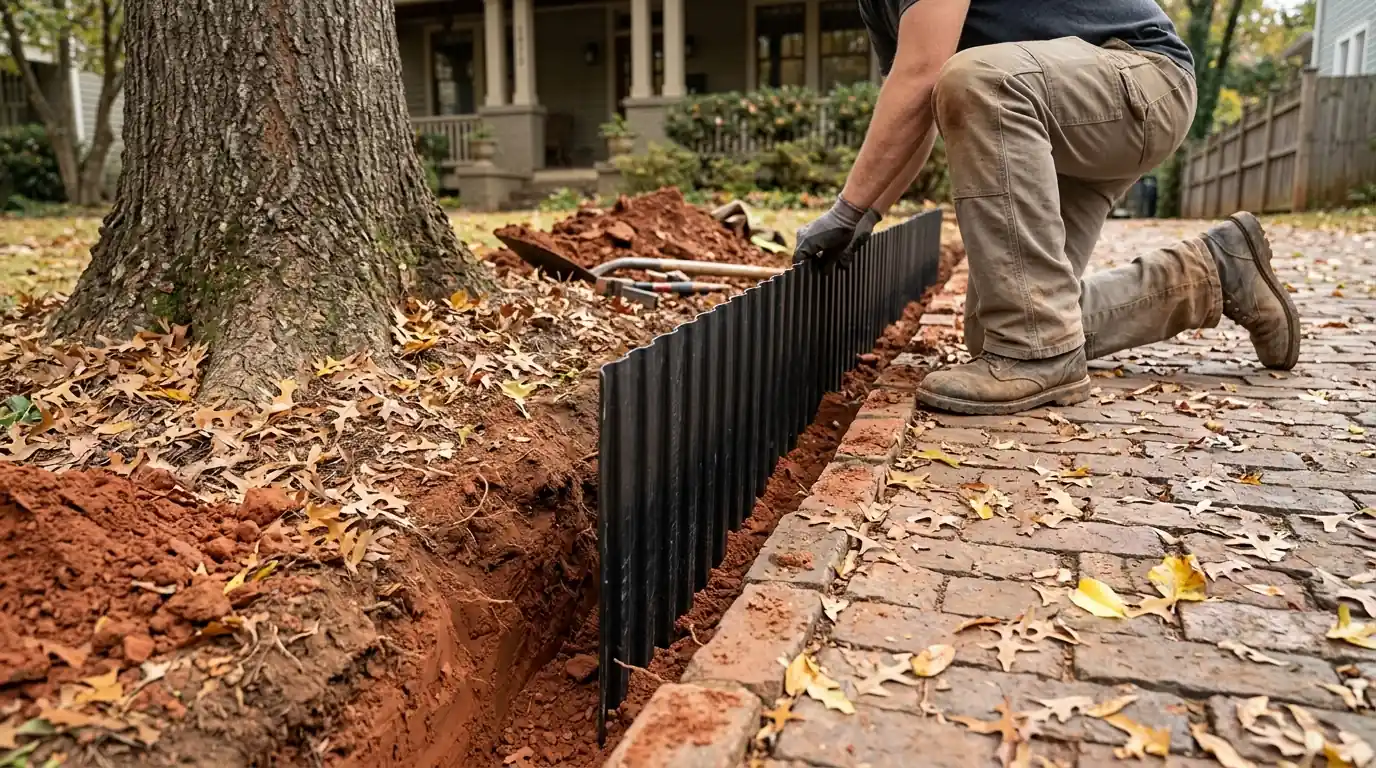
We dig by hand or with an air tool along the walk, drive or lawn so we can see each root before it's cut.
- 3
Cut cleanly
Roots are severed with a saw at a clean face, which seals over far better than a root torn by a bucket or a grinder.
- 4
Remove the section
The cut section is pulled or ground out from under the slab or lawn, and the trench is cleaned of loose wood.
- 5
Set a barrier if needed
Along walks, drives and foundations, a vertical root barrier goes into the trench before it is closed.
- 6
Backfill and settle
The trench is filled and firmed, and the slab, pavers or lawn are ready for your concrete crew or for seed.
Signs roots are behind the problem you're seeing
Roots get blamed for a lot of things. These signs make it likely they really are the cause.
- A sidewalk slab tilted upward on the side facing the nearest tree.
- A ridge in the driveway running in a line toward a trunk.
- Bare, hard ground with roots showing in a ring around a tree.
- A sewer line that backs up slowly and keeps clearing, then backing up again.
- Stoops or walks near a large tree that have risen while the rest of the walk has not.
- Mulch or soil that keeps washing off a root you used to be able to cover.
- Fresh cracks in a slab after a dry summer next to a large oak or maple.
What tree root removal costs in Atlanta
| Job | Typical range | Priced |
|---|---|---|
| Root cutting or removal near hardscape | $425 to $2,150 | per job |
Root jobs are priced by the work of reaching the roots, not by the root itself. A single surface root in an open lawn is quick. Roots tangled under a slab, wrapped around a water service or running beside a foundation take slow hand digging, and a root barrier adds trenching and material along its whole length.
Removing and resetting concrete is not part of our price, since that belongs to your concrete or paving contractor, but we coordinate timing with them. Root removal after a tree is gone usually costs less than root pruning on a live tree, because there's no need to work around its health. Our price guide shows typical ranges.
Atlanta clay, old sewer lines and shallow roots
Georgia red clay compacts hard and holds water after long rains, so tree roots in the Piedmont tend to stay shallow, where there's air. That is why surface roots are so common in metro lawns and why walks and driveways lift so often. It also means a tree with big roots cut on one side has less anchorage than the same tree in deep, loose soil.
In older intown neighborhoods like Virginia-Highland and Ormewood Park, many homes still run their sewer laterals in old clay pipe, and roots from street-side oaks find the joints. Out in Lilburn and Tucker, the usual call is sweetgum or water oak roots lifting a driveway. Where a new project is coming, our construction tree protection work can root prune ahead of the excavator.
Where we do tree root removal around Atlanta
Crews work from our Atlanta office near the 30340 ZIP and our Duluth office. These are the places we cover most, with their main ZIP codes. See all 56 areas.
- Buckhead 30305
- Virginia-Highland 30306
- Druid Hills 30307
- Morningside 30324
- Grant Park 30312
- Kirkwood 30317
- Cascade Heights 30311
- Sandy Springs 30328
- Dunwoody 30338
- Brookhaven 30319
- Decatur 30030
- Duluth 30096
- Lawrenceville 30046
- Marietta 30060
- Smyrna 30080
- Roswell 30075
- Alpharetta 30009
- Johns Creek 30097