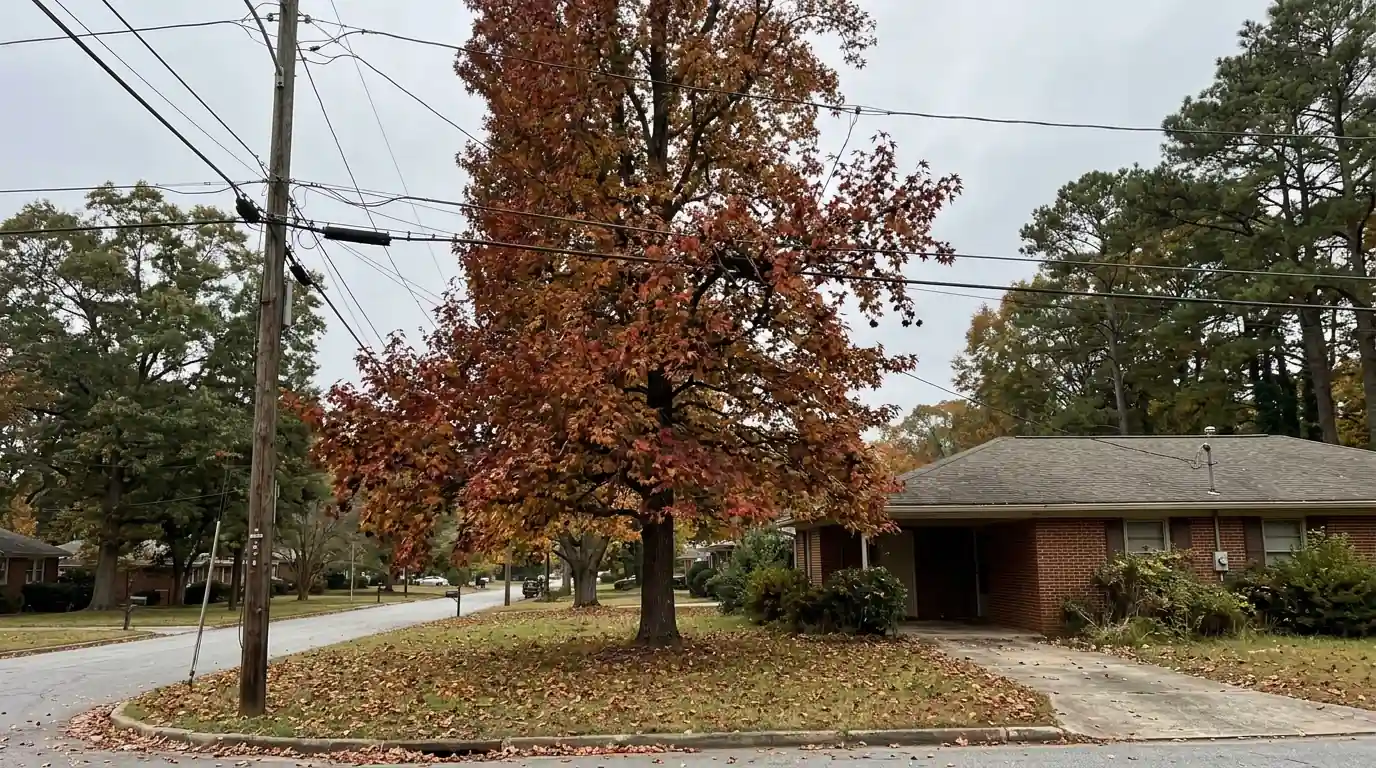
Tree removal near power lines means taking down or cutting back a tree that touches or hangs over electrical wires, done only after the line is made safe. The key is knowing which line you're dealing with: the service drop running to your house, or the utility's primary lines along the street. Georgia Power maintains trees that threaten its lines on its own schedule. Trees near your service drop, and storm debris, usually fall to the owner.
Service drop or primary line: why the difference matters
Two kinds of wire run past most Atlanta homes. Along the street, high on the poles, are the utility's primary distribution lines, which carry far higher voltage and belong entirely to Georgia Power. From a pole near your house, a single cable runs down to the side of your house: that's your service drop, the line that feeds your meter and your home.
The line involved changes who can do what. Work around primary lines is for the utility and the specially trained line-clearance crews it uses. A tree growing into your service drop is a common homeowner problem, and it's one we can help with, but only after the utility has made the line safe, usually by disconnecting the service at the pole for the duration of the work.
If you can't tell which line a tree is touching, assume the worst, stay back and call us. We'll look from the ground and tell you which line is involved and who needs to act first. Cable and phone lines often share the same poles a little lower down, and a tree tangled in those is a separate call to that provider.
What Georgia Power does and what falls to you
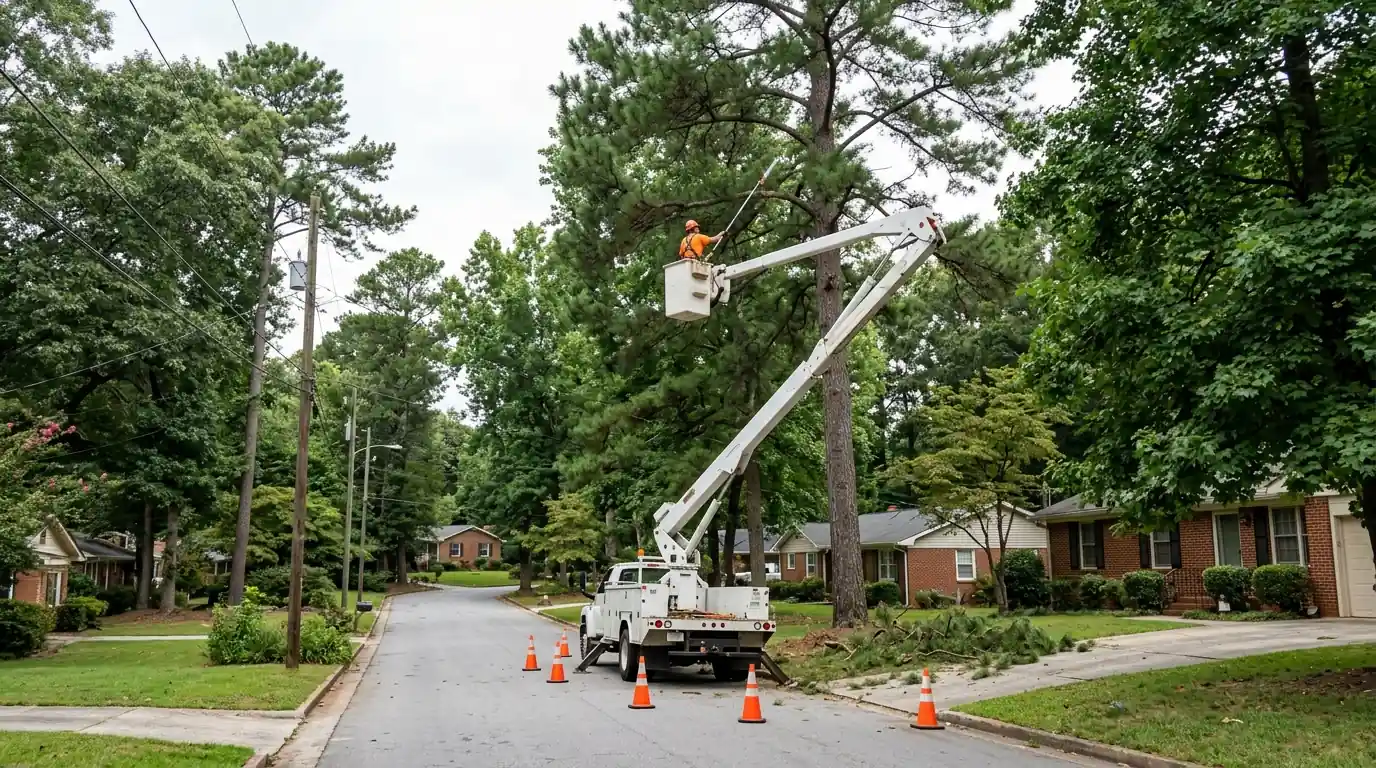
Georgia Power prunes trees that threaten its lines on its own maintenance cycle. That work focuses on keeping primary lines clear, and the trimming follows the utility's schedule, not yours. If a tree is touching a primary line now, report it to Georgia Power. Don't try to cut it or hire anyone to cut it around the energized line.
Storm debris is a different story. When a storm brings down limbs or trees on your property, cleanup is the property owner's job, even if the utility had to cut a tree off a line to restore power. Crews often leave cut wood where it lands. That's where our storm cleanup picks up.
Trees near your service drop are usually yours to maintain. The utility may disconnect or protect the line so the work can be done safely, but the tree work itself is up to you and the crew you hire. Sometimes the simplest fix is taking off the limbs over the drop rather than the whole tree, and that still needs the line made safe first.
Tree and wire situations we see most
These are the most common ways trees and wires cross paths in Atlanta yards, and what usually happens next.
Limbs rubbing the service drop
Branches swaying against the wire to your house can wear the insulation. We plan the work with the utility so the line is safe first.
Tree growing through the drop
Sweetgums, pines and maples sometimes grow right around the wire. Nothing gets cut until the service is disconnected or protected.
Tree leaning toward street lines
A tree threatening the primary lines is the utility's concern. Report it to Georgia Power, and we can remove the rest of the tree once they clear the line.
Wire down after a storm
Any downed wire is treated as energized. Stay well away, keep others back and report it to Georgia Power before anyone goes near the tree.
Limb hung on a line
A broken limb draped over a wire is a hanger with live voltage under it. That one belongs to the utility to clear before we touch the tree.
Tree near the meter or weatherhead
A trunk close to where the drop enters the house can damage the mast in a storm. We often take these down once the service is made safe.
How we remove a tree tangled with your service line
The order never changes, because skipping a step around a live wire isn't an option.
- 1
Identify the line
We look from the ground to see whether the tree touches your service drop, a primary line or a cable or phone line, and where each one runs.
- 2
Report and schedule with the utility
For your service drop, we help you arrange with Georgia Power to disconnect or protect the line for the work. Primary lines are left to the utility.
- 3
Confirm the line is safe
Our crew doesn't start until the utility has made the line safe. Until then, we treat every wire as live, even one that looks dead.
- 4
Work with insulated tools
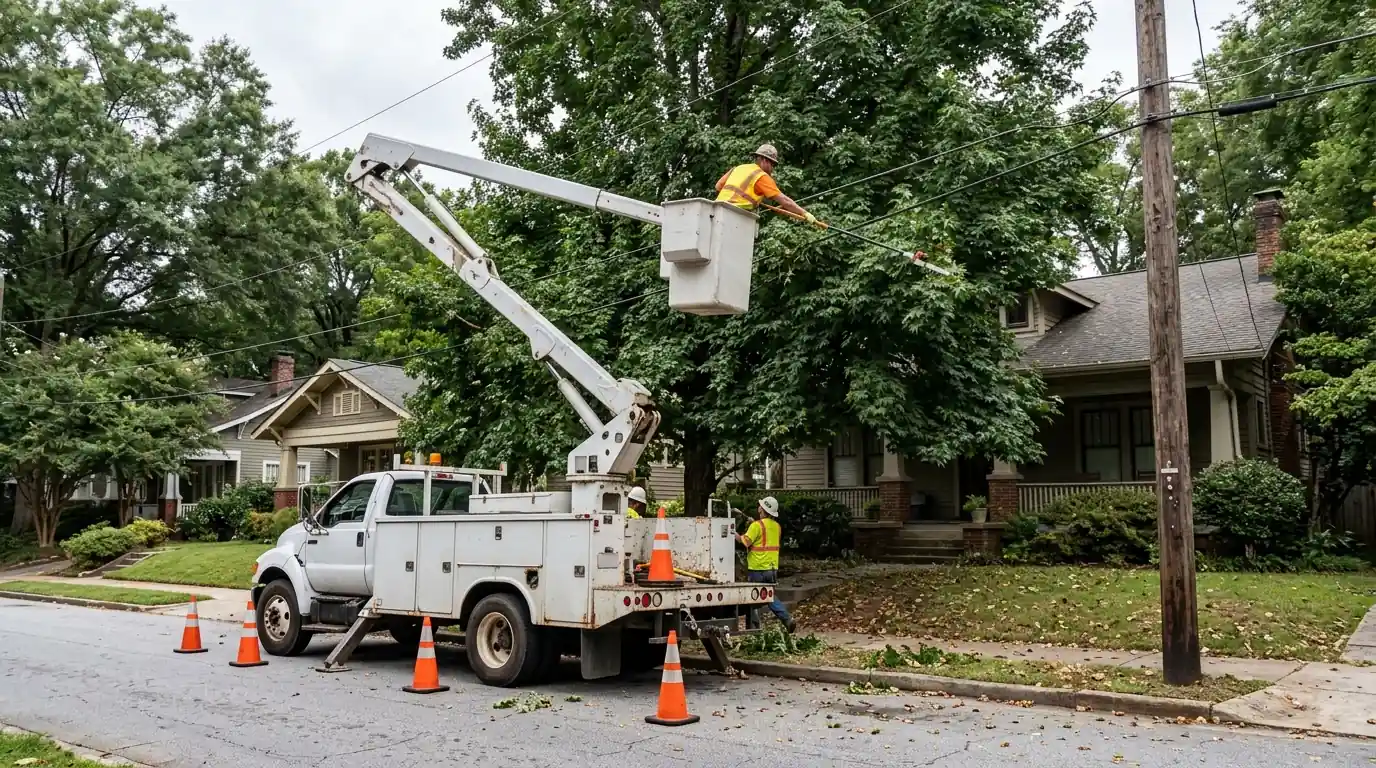
Near any wire, our climbers use insulated poles and tools, keep their bodies and saws well clear, and control every limb with a rope so nothing swings into a line.
- 5
Take the tree down in sections
Limbs near the wire come off first, lowered away from it. Then the rest of the tree comes down the normal way.
- 6
Restore and clean up
Once our work is done, the utility reconnects the service. We chip the brush, haul the wood and leave the area clear.
Safety rules for any tree near a wire
These apply whether we're on the job yet or not.
- Treat every downed or sagging wire as energized, no matter how it looks.
- Stay well back from any tree, fence or puddle that a wire touches.
- Report a tree touching a line, or a wire down, to Georgia Power first.
- Never prune or cut near a line yourself, even with a pole saw from the ground.
- Keep ladders, pool skimmers and other long tools away from overhead wires.
- Don't try to move a limb off a wire with a rope or a stick.
- Keep children and pets indoors until the line has been made safe.
What affects the cost of removal near a line
| Job | Typical range | Priced |
|---|---|---|
| Tree tangled with the service drop | $720 to $3,950 | per tree |
Trees near lines take more time than the same tree in an open yard. The crew works around the utility's schedule, moves more slowly near the wire, uses insulated tools and lowers more pieces on a rope instead of dropping them. A tree growing right through the service drop needs more careful cuts than one that just hangs over it.
The range below covers trees tangled with the service drop in metro Atlanta. Any work by the utility to disconnect or protect the line is on their side and not part of our price. Cleanup is included, and our price guide covers stump grinding and the rest.
Trees and wires in Atlanta neighborhoods
Many older Atlanta neighborhoods run overhead lines along back lot lines or through side yards, with tall trees growing right up into them. In East Atlanta and Ormewood Park, it's common to find a service drop strung through a sweetgum or a pine. In Chamblee and Doraville, older ranch-house lots often have mature oaks and pines arching over the drop.
Tall loblolly pines and tulip poplars are the trees most likely to reach lines here, because they grow fast and tall, and poplar limbs are brittle enough to snap onto a wire in an ordinary summer storm. When a tree near a line also needs a city permit inside Atlanta city limits, we can help with the permit paperwork while the utility schedules its part.
Where we do tree removal near power lines around Atlanta
Crews work from our Atlanta office near the 30340 ZIP and our Duluth office. These are the places we cover most, with their main ZIP codes. See all 56 areas.
- Buckhead 30305
- Virginia-Highland 30306
- Druid Hills 30307
- Morningside 30324
- Grant Park 30312
- Kirkwood 30317
- Cascade Heights 30311
- Sandy Springs 30328
- Dunwoody 30338
- Brookhaven 30319
- Decatur 30030
- Duluth 30096
- Lawrenceville 30046
- Marietta 30060
- Smyrna 30080
- Roswell 30075
- Alpharetta 30009
- Johns Creek 30097