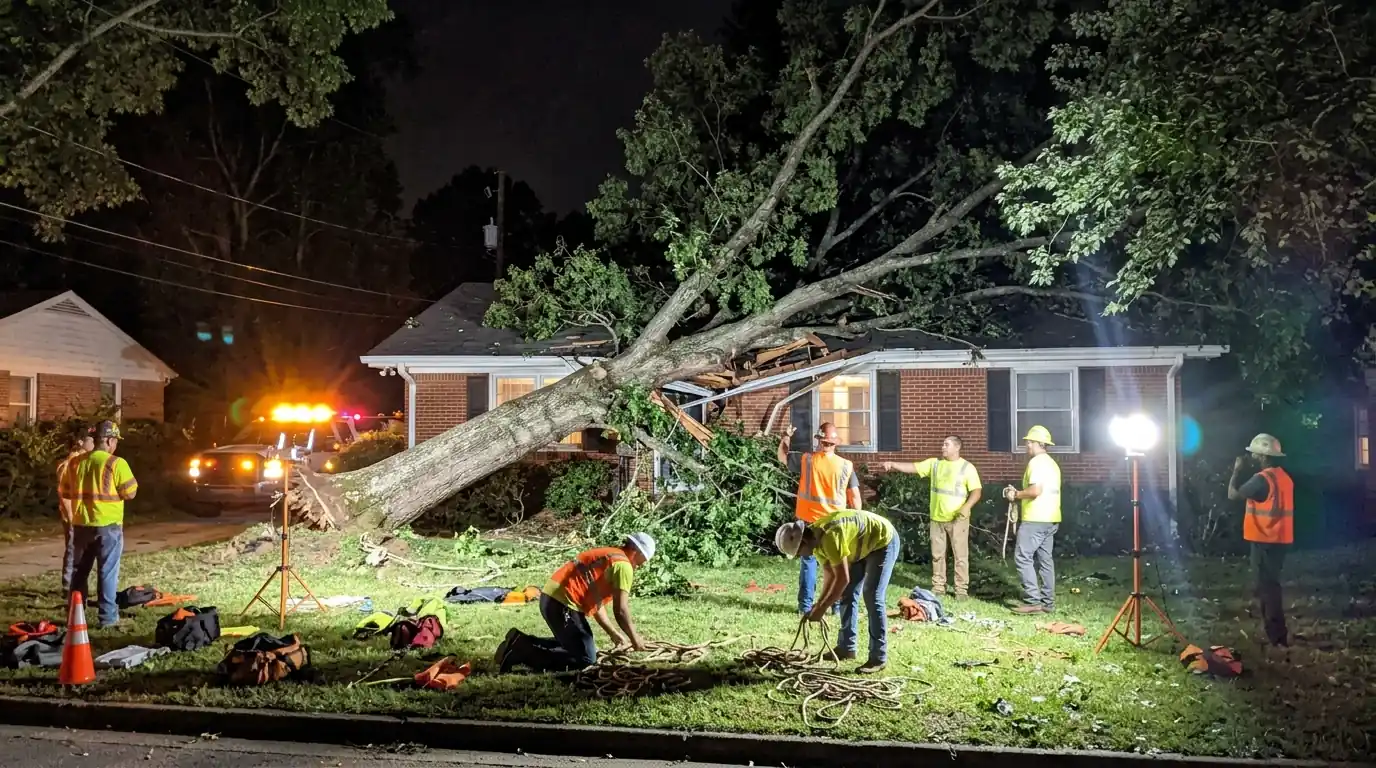
Emergency tree removal is getting a fallen or hung-up tree off a roof, a car or the only way out of the driveway, often at night or in the middle of a storm. The order matters more than the speed: people out of danger, every wire treated as live, photos for insurance, then the lightest reachable limbs first. Inside Atlanta, a fallen tree resting on a structure needs no permit, though the city wants photos and notice.
Emergency scenes we work, and the first move for each
Almost every after-hours call is one of a handful of scenes, and each one has its own starting point.
Tree through the roof
We stabilize what's left on the roof, take the weight off in stages and leave the opening clear for the roofer's tarp.
Trunk on a parked car
The car is freed last, after the tree above it is lightened, so the frame doesn't take a second hit when the trunk shifts.
Driveway blocked
When the tree is only on the ground, we cut a lane first so you can get a car out, then finish the rest in daylight.
Tree on the power drop
If a wire is involved, nothing gets cut until the utility makes the line safe. Here's how we handle trees caught in service lines.
Tree on a fence or shed
Unless it blocks an exit or threatens the house, we often secure it at night and come back at first light to finish.
Leaning but not down
A tree that tipped and caught on another tree or the gutter is one of the most dangerous scenes. We rig it before anyone works beneath it.
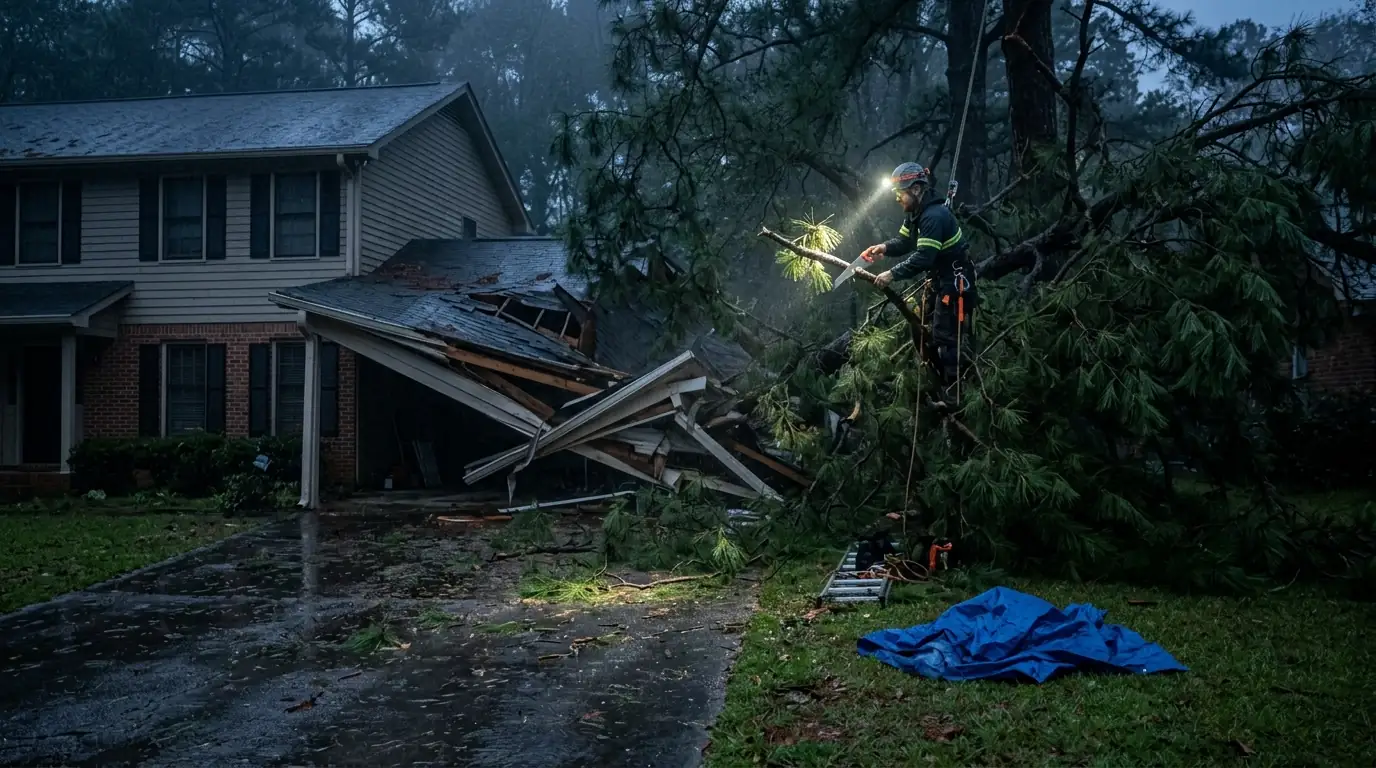
What happens the night a tree hits the house
This is the sequence we follow on almost every after-dark call, and the first three steps are yours.
- 1
Get everyone out of those rooms
Close the doors to any room under the tree and keep people and pets on the far side of the house. A roof carrying a trunk can shift again without warning.
- 2
Treat every wire as live
If a line is down, sagging or touching the tree, stay well back and report it to Georgia Power. Don't touch the tree, a wet fence or a gutter it rests on.
- 3
Photograph before anything moves
Shoot the tree, the roof, the car and any ceiling damage from several angles, plus a few wide shots of the whole scene. Those photos are what an adjuster sees first.
- 4
Call and describe the scene
Tell us where the tree sits, what it's resting on, whether a wire is involved and whether water is coming in. We answer 24/7 and plan the order of work from that.
- 5
Take the load off in stages
The crew lights the scene, removes the lightest reachable limbs first and works toward the trunk, cutting nothing that still bears on the house until it's rigged or supported.
- 6
Clear the deck for the roofer
Once the tree is off, a roofer tarps or dries in the opening. We leave the roof surface clear and the debris pulled aside so they can get straight to work.
- 7
Document and finish cleanup
We photograph the roof again after the tree is off, then chip the brush and cut the wood, either that night or on a return visit in daylight.
Why we never start by cutting the trunk
A tree lying on a roof is a loaded spring. The trunk might rest on the ridge, a wall and a broken rafter at once, while the root plate is still partly anchored in the yard. Cut the trunk in the wrong place and the top section can drop straight through the ceiling, or the butt end can jump sideways toward whoever is holding the saw.
So the first cuts are small. Our climber ties into a sound neighboring tree or works from a lift when there's room, takes off the lightest limbs within reach and lowers each one on a rope. Every piece removed lightens the load on the framing. We watch how the trunk settles after each cut, because that tells us where it's still bearing.
Only when the limbs are off and the trunk is held, either by a rigging line to another tree or by a crane, do we cut the trunk itself. On a big oak across a two-story house, that can mean making the house safe tonight and booking a crane pick for daylight, which is gentler on the framing than any amount of rope work in the dark.
Photos and paperwork that make the insurance claim easier
Your insurer decides what's covered, not us, but the records we hand you make that decision easier to reach. Before we cut, we photograph the tree where it fell, every point where it touches the house and any damage visible from the ground. After the load is off, we photograph the roof and framing again so the adjuster can see exactly what the tree did.
The invoice spells out the work in plain lines: removing the tree from the structure, rigging or crane time, cleanup and hauling. Policies often treat a tree on the house differently from a tree in the yard, so keeping those lines apart saves a round of questions later. Our article on the first hour after a tree falls on a house has a fuller checklist.
We also plan around the roofer, whether that's a company your insurer sends or one you already trust. Our last cuts are timed so the opening is clear when they arrive, and we pile the wood away from the side of the house where they'll set ladders. If the tarping is done by others, we tell them which rafters took the hit.
Atlanta storms, soaked clay and the trees that come down
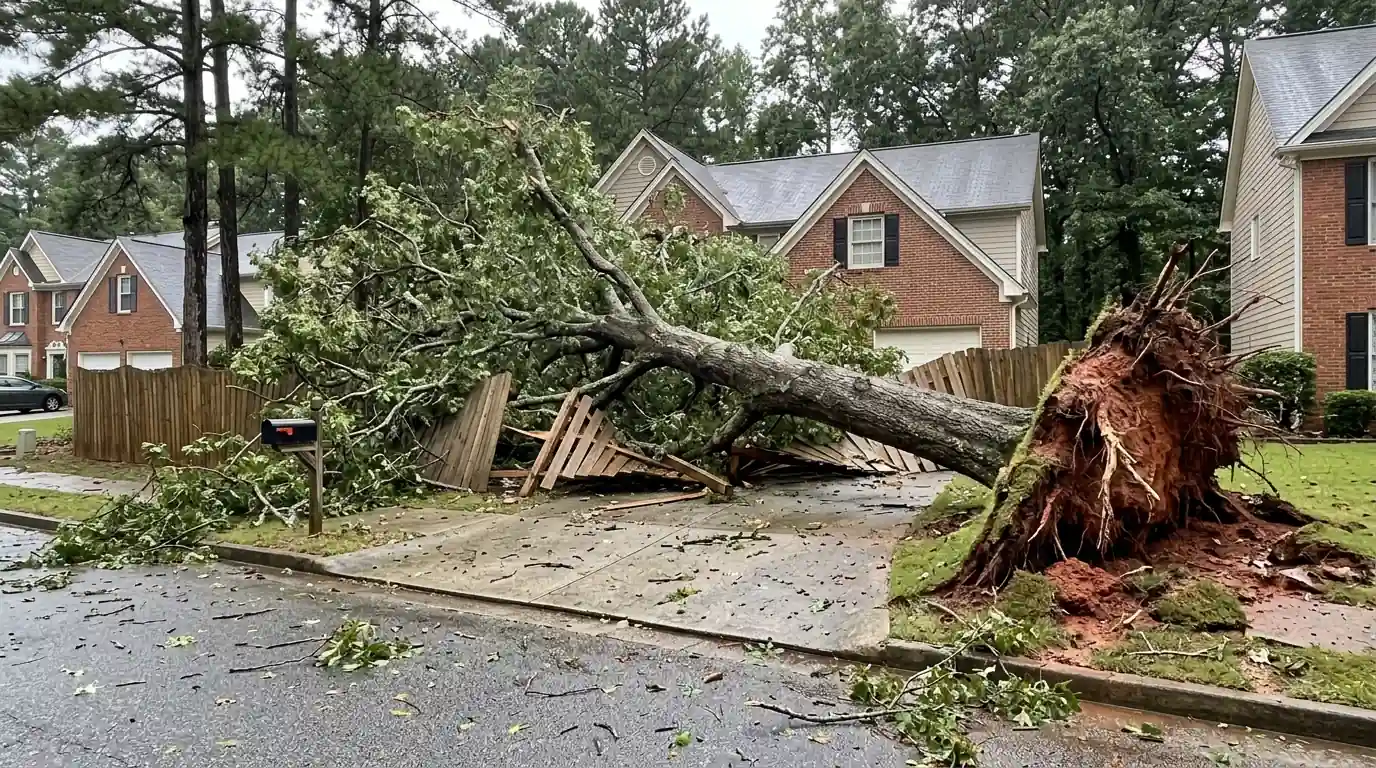
On September 27, 2024, Tropical Storm Helene soaked the ground and uprooted trees onto homes across metro Atlanta. Many of those trees didn't snap. Whole root plates lifted out of saturated red clay, which holds water after long rains and keeps roots shallow, so a tree that had stood through a dozen dry storms went over in one wet one.
The usual culprits are aging water oaks and tall loblolly pines left standing when subdivisions went in. In Grant Park, the call is often an old oak on a Victorian roof with no rear access. In Tucker and Dunwoody, it's more often a pine across a driveway or a ranch house. Inside Atlanta, a fallen tree resting on a structure needs no removal permit, but photograph it and notify the city's Arborist Division.
What moves the price of an emergency removal
| Job | Typical range | Priced |
|---|---|---|
| Tree on a roof or car, first visit and removal | $1,150 to $5,900 | per tree |
An after-hours removal costs more than the same tree on a planned day because the work is slower and riskier. Night lighting, a trunk still bearing on framing, rain, and a wire that has to be cleared by the utility all add time. A tree on a roof also means more rigging and smaller pieces than one lying across the lawn.
Often the night visit only makes the house safe, and the rest is finished in daylight, which can lower the total. Cleanup and hauling are part of the job. Stump grinding is separate, and our price list for every service shows typical ranges. For yards full of broken limbs but nothing on the house, storm cleanup is usually the better fit.
Where we do emergency tree removal around Atlanta
Crews work from our Atlanta office near the 30340 ZIP and our Duluth office. These are the places we cover most, with their main ZIP codes. See all 56 areas.
- Buckhead 30305
- Virginia-Highland 30306
- Druid Hills 30307
- Morningside 30324
- Grant Park 30312
- Kirkwood 30317
- Cascade Heights 30311
- Sandy Springs 30328
- Dunwoody 30338
- Brookhaven 30319
- Decatur 30030
- Duluth 30096
- Lawrenceville 30046
- Marietta 30060
- Smyrna 30080
- Roswell 30075
- Alpharetta 30009
- Johns Creek 30097