Pick where the tree stands, what kind it is, how big the trunk is and what shape it is in. The checker applies the published rules for Atlanta, Brookhaven, Decatur and unincorporated DeKalb and Gwinnett.
Rules by addressAtlanta, Brookhaven, Decatur, DeKalb and Gwinnett all handle tree removal differently.
In short
Inside Atlanta city limits, most private trees 6 inches across or larger need a permit before removal, and pines start at 12 inches. Brookhaven starts at 4 inches, including dead trees. Decatur regulates diseased, hazard and healthy trees closely. Unincorporated DeKalb allows up to five healthy, non-specimen trees per lot each year, and unincorporated Gwinnett mostly regulates buffers.
How it works
Four questions, one straight answer
The answer updates as you change anything. Nothing you type leaves this page.
The checker
Does your tree need a permit?
Not sure? Unincorporated means the address is outside any city limits.
Or enter the diameter in the next box if you know it.
Add the trunk size
Measure around the trunk 4.5 feet above the ground and enter it above.
Measuring
How to measure a trunk for any of these rules
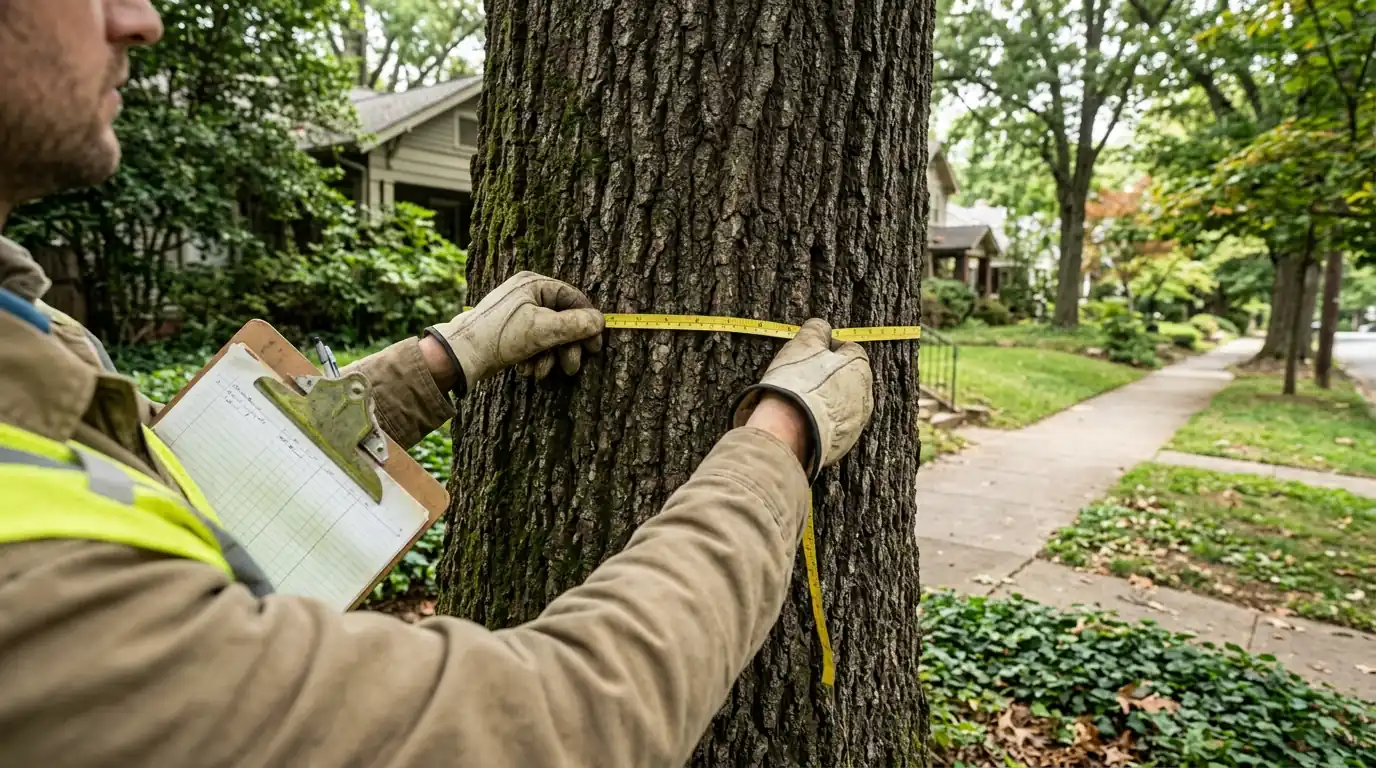
Every rule here measures the trunk at 4.5 feet above the ground, which foresters call diameter at breast height. On a slope, measure from the uphill side. Wrap a cloth tape around the trunk at that height and divide the circumference by 3.14 to get the diameter, or type the circumference into the checker and it does the math.
Measure below a fork if the trunk splits under 4.5 feet, and measure each stem if a tree comes out of the ground as several trunks. When in doubt, take a photo with the tape in place; it is the same photo most applications ask for.
Measure the trunk at 4.5 feet, above any root flare or fork.
Permit for private trees 6 inches and up, pines 12 inches and up. Dead, dying and hazardous trees still need a permit from the Arborist Division, with no application fee and no replacement charge once verified. Pruning needs no permit. A fallen tree resting on the ground, another tree or a structure needs no permit; photograph it and notify the Arborist Division.
Brookhaven
Permit for any tree 4 inches and up, including dead, dying and hazardous trees, subject to city arborist approval. Applications go through the online Project Portal with photos and a site plan.
Decatur
Permit for untreatably diseased or infested trees and for hazard trees rated moderate or higher risk in a certified arborist's report. Dead trees need an emailed dead tree affirmation with photos. The 2022 ordinance tightened healthy-tree removals.
Unincorporated DeKalb
No notice under 5 inches. Up to five healthy, non-specimen trees per single-family lot per year without notice. More than five, or a specimen tree (oak, poplar or pine 30 inches and up, dogwood or redbud 10 inches and up), needs a Notice of Tree Removal.
Unincorporated Gwinnett
Usually no permit on a developed single-family lot. Trees in buffers, Tree Save Areas, conservation space, the Chattahoochee River Corridor, or street trees are the exception. Keep at least two live trees on the lot.
Everywhere else
Sandy Springs, Dunwoody, Roswell, Alpharetta, Marietta and the other cities around Atlanta run their own ordinances. We check the address before we quote.
Questions
Questions about the permit checker
Does the tree permit checker replace an Atlanta permit decision?
No. It applies the published rules to your answers so you know what to expect. The city or county makes the actual decision, and rules change, so we confirm the current requirement for your address before any work starts.
Who files the tree permit after the checker says one is needed?
We prepare the measurements, photos and site sketch, fill in the application and either walk you through submitting it or file it with your authorization. Approval is up to the city or county.
Why does the permit checker ask whether the tree is a pine?
Atlanta measures pines differently: a pine needs a permit from 12 inches across, while most other trees start at 6. In unincorporated DeKalb, tree type also decides whether a large tree counts as a specimen.