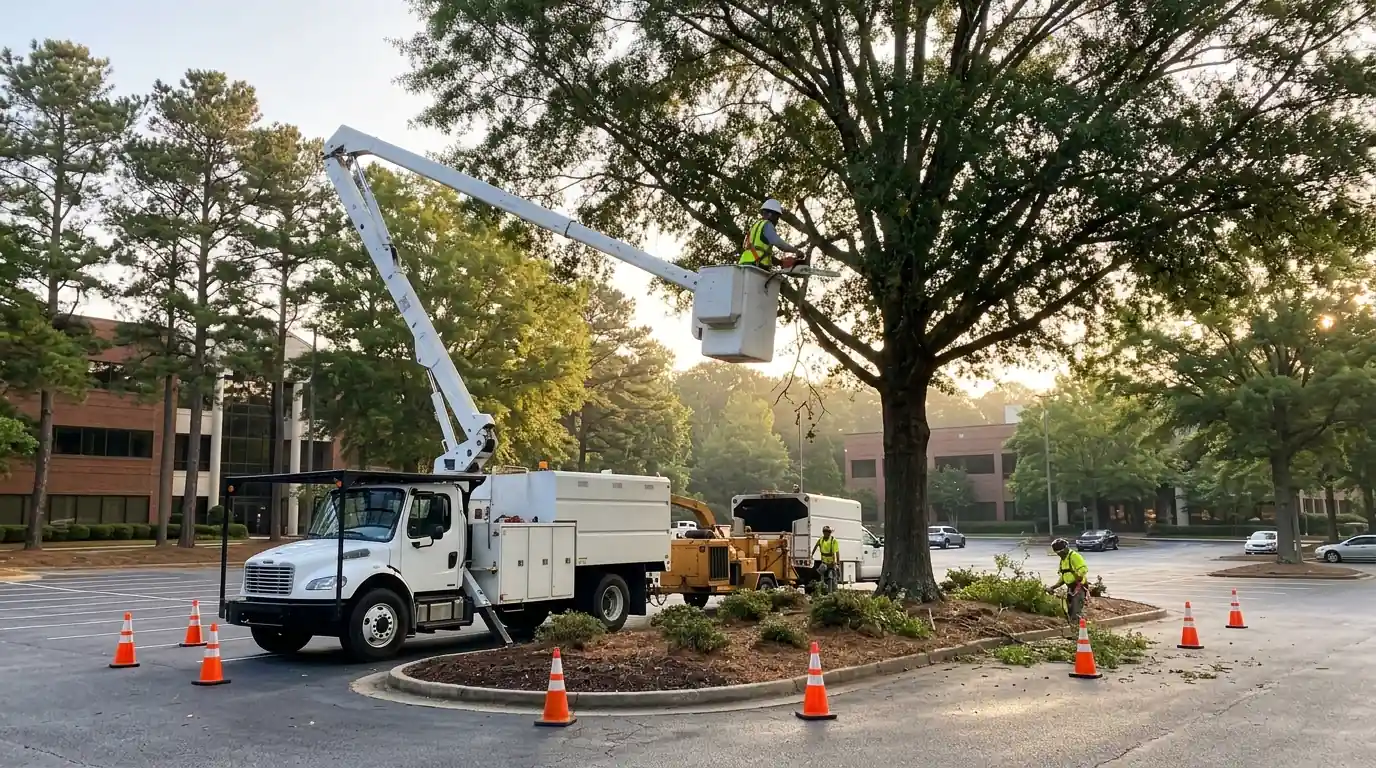
Commercial tree service covers tree work on HOA common areas, apartment communities, office parks, churches, schools and other shared property. That includes pruning entrance plantings and common-area trees, clearing parking lot islands, keeping sidewalks and sight lines open, removing hazard trees and handling storm response across several properties. Around Atlanta, the work is scheduled around tenants, school hours and traffic, and each job starts with a written scope a board or manager can read and approve.
What commercial tree work looks like on shared property
On a homeowner's lot, one person decides and one yard is affected. On an HOA's common area or an apartment property, the trees sit beside parking spaces, playgrounds, pool decks, mailbox clusters and walkways that dozens or hundreds of people use every day. A limb over a parked car or a root heaving a sidewalk is a liability the board or the manager has to answer for.
So the work is planned differently. We walk the property with the manager or a board member, note every tree that needs attention, and sort the list by risk and visibility. The scope spells out which trees get pruned, which come down, what clearances we're cutting to and how the work zone will be controlled. Then we schedule around the people who live and work there, not the other way around.
Most properties need a mix of steady maintenance and the occasional urgent job. Raising crowns over sidewalks and parking spaces, keeping sight lines clear at exits and pruning entrance plantings are routine. Hazard trees, storm damage and roots lifting pavement come up between cycles, and a property we already know is faster to sort out. Keeping a running list of every tree we've worked on, and what we did to it, helps a new manager or a new board pick up where the last one left off.
Storm response across one property or many
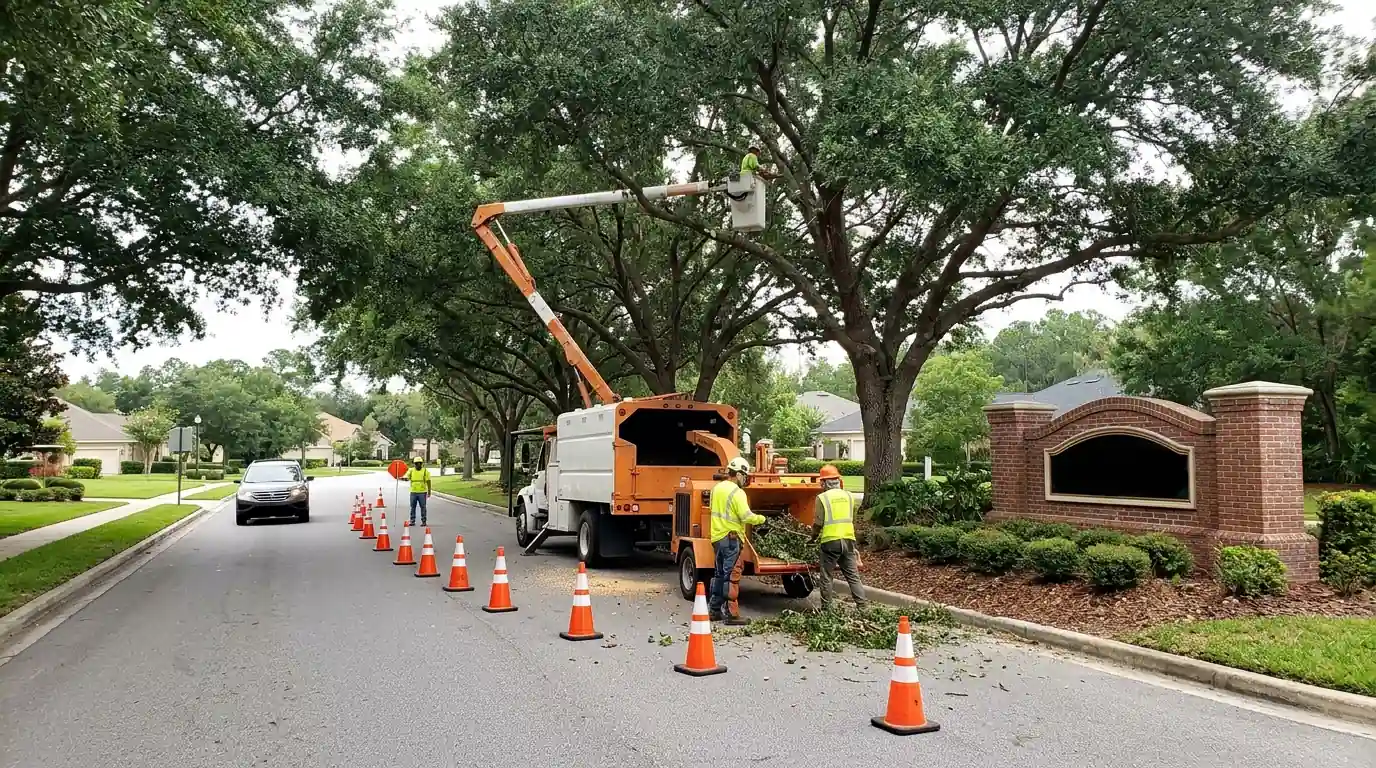
After a major storm, a manager with several apartment communities or a big HOA can face dozens of downed limbs and trees at once. The first job is sorting: trees on buildings, trees across drives or blocking access, and limbs hanging over walkways come first. Debris in open common areas can wait a day or two. We work through properties in that order so the urgent problems get handled before the cosmetic ones.
Because the phone is answered around the clock, you can call as soon as the storm passes. Properties we already know move faster, since we've mapped the trees and know where the access points are. Where a tree has come down on a line, the utility goes first, and we work around them. Our storm cleanup and emergency removal services cover the details.
Properties and areas we work on
These are the commercial and community settings where most of our shared-property work happens.
HOA common areas
Entrance plantings, buffer woods, trails, detention pond edges, playgrounds and the trees along shared roads.
Apartment communities
Trees over parking, beside buildings, around pools and dog parks, and along walkways residents use daily.
Office parks and retail
Parking lot islands, perimeter trees, and plantings that frame signs and entrances without blocking them.
Churches
Old shade trees on church grounds, cemetery trees, and trees over parking used heavily one or two days a week.
Schools
Trees around playgrounds, bus loops, athletic fields and walkways, with work scheduled for breaks and weekends.
Multiple properties
Managers with several communities across the metro get one schedule and one storm response plan covering them all.
How a commercial tree job runs from walk-through to cleanup
The order keeps boards, managers and residents informed at every stage.
- 1
Walk the property
We tour the site with the manager or board contact, noting each tree's condition, location and what it stands over.
- 2
Write the scope
You get a written scope listing each tree, the work and the reason, organized so a board can discuss it and vote.
- 3
Set the schedule
Work is booked around tenant routines, school hours, church services and the busiest traffic times.
- 4
Give notice
We tell you what notices residents or tenants need, such as which parking spaces must be empty and when.
- 5
Control the work zone
Cones, signs and spotters keep cars and people out of the drop zone, with paths kept open where possible.
- 6
Clean up and report
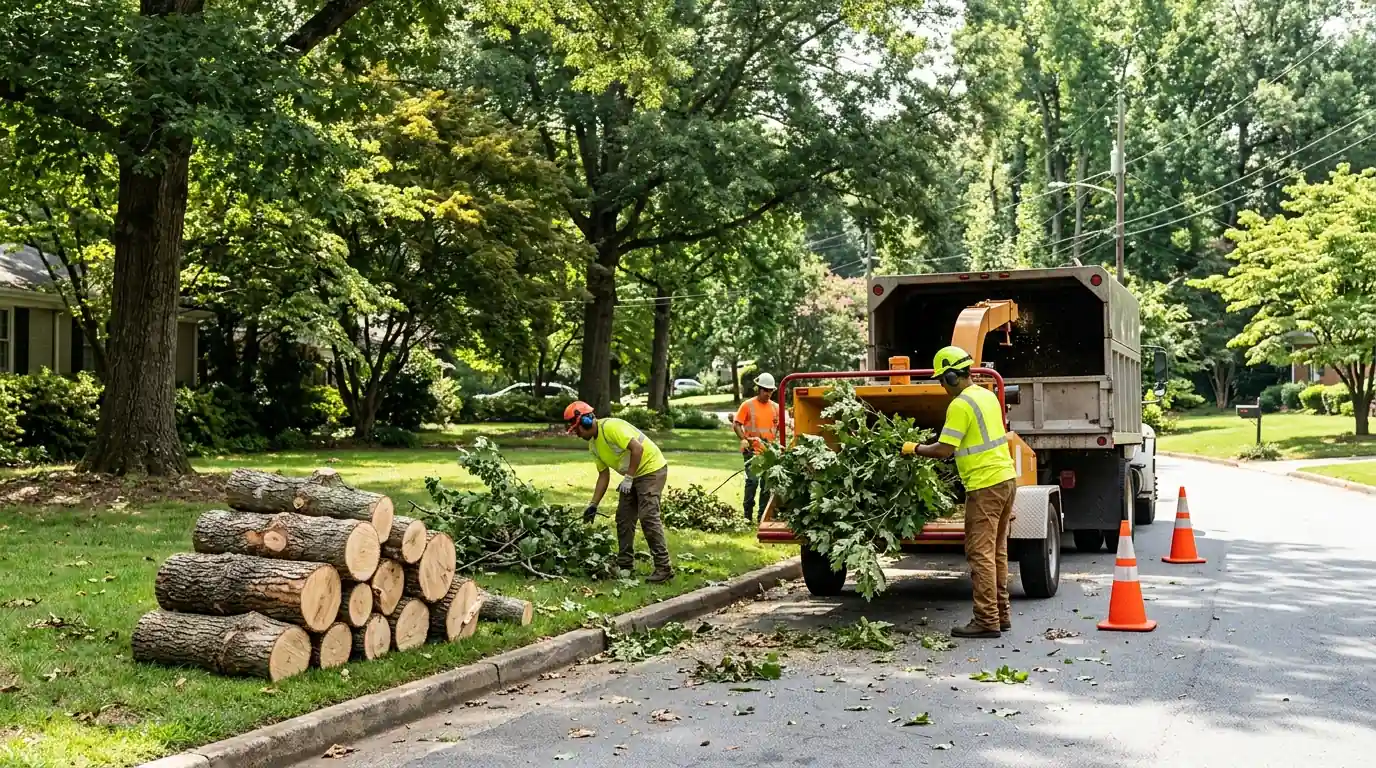
Brush is chipped, wood is hauled, pavement is blown clean, and you get a short note on what was finished.
Routine work that keeps shared property safe and tidy
Most commercial properties need these tasks on a regular cycle.
- Raising crowns over sidewalks, walkways and parking spaces for clear passage.
- Clearing limbs away from building walls, roofs, gutters and balconies.
- Keeping sight lines open at exits, intersections and signs.
- Pruning entrance trees so trucks, buses and moving vans clear them.
- Removing deadwood from trees over high-use areas like playgrounds and pool decks.
- Treating or removing declining trees before they become hazards.
- Clearing storm debris across common areas after a major storm.
- Pulling vines and invasive growth out of buffer woods and along fences.
What moves the price of commercial tree service
| Job | Typical range | Priced |
|---|---|---|
| HOA or commercial property visit | $1,450 to $7,800 | per visit |
The number of trees, their size and how hard they are to reach drive most of the cost. Parking lot islands with cars parked all around, trees beside occupied buildings and work that must happen at night or on weekends take more time and traffic control than open common areas. Scheduling everything on one visit usually costs less than several trips.
Every job is quoted from the written scope, so a board can see the work tree by tree and fund it over more than one budget year if needed. Stump grinding in lawns and islands, large removals and storm cleanup can be listed separately or bundled into the scope. Properties on a yearly care schedule get routine work priced ahead of time. Typical commercial visit ranges are on our price guide.
Shared trees across the Atlanta metro
Many HOA neighborhoods in Gwinnett County, Johns Creek and Peachtree Corners were built around stands of loblolly pine and mixed hardwoods that are now forty or fifty years old. Pines left in common areas and buffers are tall, wind-exposed and prone to beetles after drought. Water oaks planted along entrance drives are reaching the age where heart rot and dead tops show up. Parking lots at older office parks often have willow oaks whose roots lift pavement and curbs.
Rules differ by location. Inside Atlanta city limits, removing trees on private property generally needs a city permit, while pruning doesn't. Unincorporated Gwinnett has rules for trees in zoning buffers, stream buffers and Tree Save Areas, which are common on HOA land. Brookhaven and Decatur run their own programs. We check the rules for each property before we cut, and our permit help covers the paperwork.
Where we do commercial and HOA tree service around Atlanta
Crews work from our Atlanta office near the 30340 ZIP and our Duluth office. These are the places we cover most, with their main ZIP codes. See all 56 areas.
- Buckhead 30305
- Virginia-Highland 30306
- Druid Hills 30307
- Morningside 30324
- Grant Park 30312
- Kirkwood 30317
- Cascade Heights 30311
- Sandy Springs 30328
- Dunwoody 30338
- Brookhaven 30319
- Decatur 30030
- Duluth 30096
- Lawrenceville 30046
- Marietta 30060
- Smyrna 30080
- Roswell 30075
- Alpharetta 30009
- Johns Creek 30097