Four ways vines harm a tree
Vines don't usually kill a tree outright the way a disease or beetle can. They wear it down and set it up to fail. Here's how.
Weight
A mature English ivy or wisteria vine can grow as thick as a wrist or more, and a tree covered in vines carries a lot of extra weight, especially when the leaves are wet. That load sits on limbs and unions that grew without it. Kudzu draped over the top of a crown can pull limbs down and break them.
Shade
Once ivy or kudzu climbs into the crown, its leaves compete with the tree's own for light. A tree with half its crown covered in vines makes less food, grows less and declines faster. Kudzu can cover a tree completely within a few seasons.
Hiding defects
Thick ivy hides the trunk. Cracks, cavities, fungal growth, bark loss and decay at the base are all invisible under a mat of vines. We've taken ivy off trees that looked fine from the yard and found trunks that were hollow at the base. If you can't see the trunk, you can't judge the tree.
Wind sail
A crown full of evergreen ivy catches wind like a sail, even in winter when the tree itself would be bare. That extra surface area adds load during storms, and it's one reason vine-covered trees are often among the first to come down.
Telling the common vines apart
Knowing which vine you have changes how you deal with it. These are the ones we find on trees most often around Atlanta. Native vines such as Virginia creeper and crossvine climb trees too, and while they're lighter, they can still hide the trunk and are worth keeping off the crown.
- English ivy: evergreen, dark glossy leaves with three to five lobes, climbing with small root hairs that stick to the bark.
- Kudzu: leaves in groups of three, large and slightly fuzzy, dying back in winter and covering whole trees and edges by late summer.
- Chinese wisteria: compound leaves with many leaflets, thick twisting woody stems, hanging purple flowers in spring.
- Poison ivy: leaves in groups of three, often shiny, with a hairy-looking vine on older trunks.
- Virginia creeper: native, five leaflets radiating from one point, turning red in fall.
The life saver cut
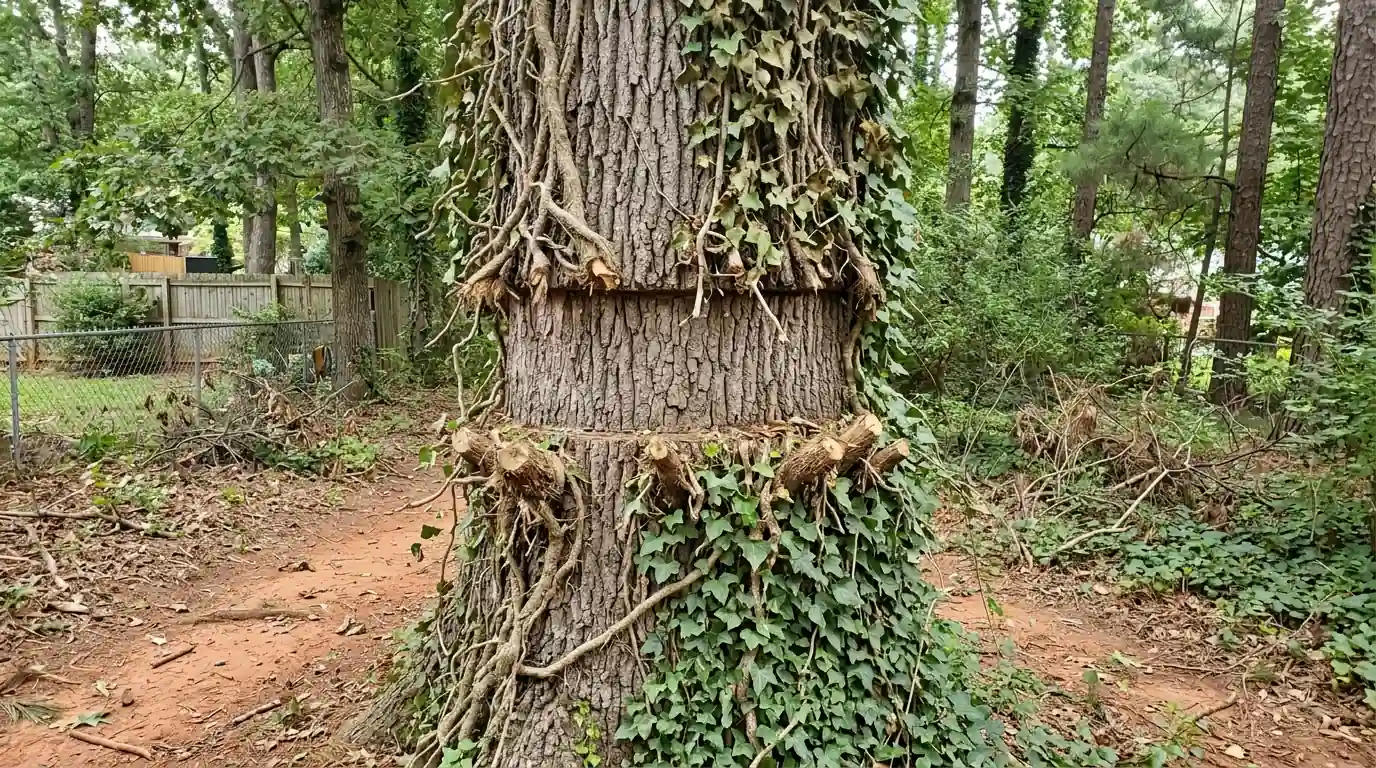
The most effective first step against English ivy on a tree is a simple technique often called the life saver cut. It gets the vines out of the crown without trying to rip them off the trunk, which can damage the bark.
With pruning shears or a pruning saw, cut every vine around the trunk at about chest height. Then cut each vine again at the ground, so you have a band of cut vines. Peel the vines off the trunk in that band, from roughly knee height up to shoulder height. Leave the vines above the band in place. Cut off from their roots, they'll die and dry out over the next few months and eventually fall away.
Then clear the ivy off the ground in a ring around the base, at least 3 feet out from the trunk, so new runners can't climb right back up. Cut carefully and keep the saw shallow, since slicing into the bark creates wounds that can let decay in.
- Cut every vine at about chest height, all the way around the trunk.
- Cut each vine again near the ground.
- Peel the vines off the bark between the two cuts.
- Leave the upper vines to die and fall off on their own.
- Clear a ring of ivy at least 3 feet out from the trunk.
Follow-up keeps the vines from coming back
The cut is only the start. English ivy roots readily from runners on the ground, so the ring around each tree will fill back in unless you keep at it. Walk the trees a few times a year and pull new runners before they reach the trunk. Over time, pulling the ivy out of larger areas of the yard reduces how much comes back.
Kudzu is harder. It grows from large root crowns in the ground, and cutting the vines alone won't stop it. Mowing or cutting repeatedly over several seasons weakens the root crowns, and digging them out where you can reach them is the surest fix. On a bigger infestation, clearing the brush and debris at the edge of the yard is often part of the job.
Cautions with wisteria and poison ivy
Not every vine on an Atlanta tree is ivy. Two others need extra care.
Chinese wisteria
Chinese wisteria grows into very thick, woody vines that wrap around trunks and limbs and can girdle them as they tighten. Large wisteria vines are heavy and can hold real tension where they wrap and climb into the crown. Cutting one under tension can make it spring back or let a load shift in the crown. Big wisteria vines should be cut at the base and allowed to die, then the dead vines removed carefully, rather than pulled down from the tree.
Poison ivy
Poison ivy climbs trees too, with hairy-looking aerial roots on the vine and leaves in groups of three. All parts of the plant, including the bare winter vines, carry the oil that causes the rash. Wear long sleeves, gloves and eye protection, and wash clothes and tools afterward. Never burn poison ivy, since the smoke carries the oil.
When a vine-choked tree should come down instead
Some trees are too far gone by the time the vines come off. Once the dead ivy falls away, the trunk may show decay, cavities or bark loss that the vines had been hiding. A crown that has been shaded out for years may be mostly dead. If the tree stands where it could hit the house, the driveway or a neighbor's yard, removal is often the safer choice.
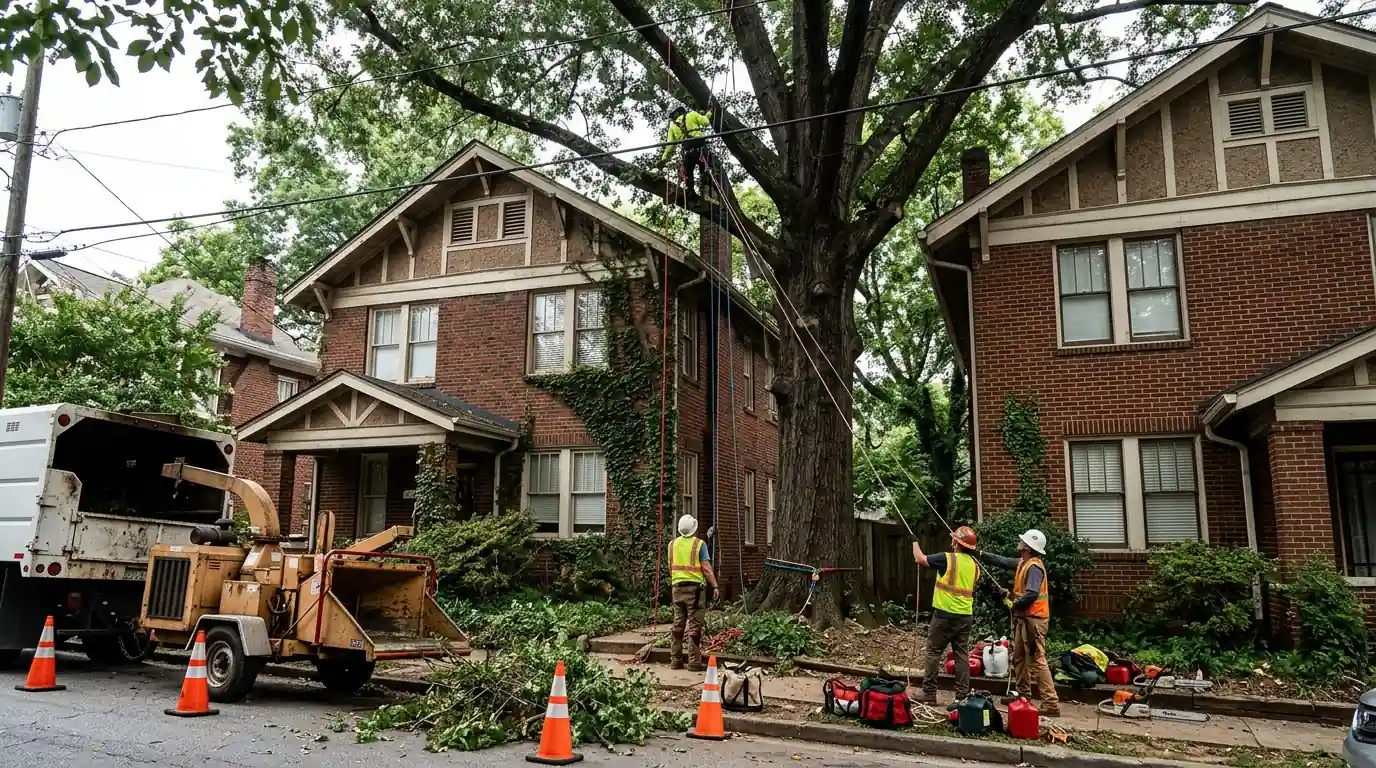
Vine-covered trees also tend to be harder and riskier to work. Climbers have a harder time reading the wood, rigging points can hide under vines, and dead vines tangle ropes. When we remove a vine-choked tree, we usually cut the vines first and give them time to die back if the tree is stable enough to wait. If it isn't, the removal goes ahead with extra care. A risk check after the vines come off tells you which way to go, and our post on the signs a tree is dying lists what to look for on the newly exposed trunk.
Where we see the worst of it
Vines are worst at wooded edges, along creeks and on lots where part of the yard was left wild for years. In older intown neighborhoods like Kirkwood, English ivy often runs from yard to yard along shady back fence lines. On larger lots in Snellville and Lawrenceville, kudzu and wisteria take over the edges where woods meet lawn.
Our ivy and vine removal covers the life saver cut, clearing the ground ring and pulling back the worst of the vines. Running bamboo is a related problem at many of the same wooded edges, and bamboo removal handles that separately.
Key takeaways
- Climbing vines harm trees through added weight, shade, hidden defects and extra wind load.
- The life saver cut severs every vine at chest height and near the ground, then leaves the upper vines to die.
- Clear a ring of ivy at least 3 feet around each trunk and pull new runners a few times a year.
- Large wisteria vines can hold tension, and poison ivy oil is on every part of the plant, including bare vines.
- Once the vines are off, check the trunk for decay, since some vine-choked trees need to come down.