Where the borer is now in metro Atlanta
Emerald ash borer was first found in Georgia in July 2013, in DeKalb and Fulton counties. By 2023 it had been confirmed in all ten core metro counties (Cherokee, Clayton, Cobb, DeKalb, Douglas, Fayette, Fulton, Gwinnett, Henry and Rockdale) and in Forsyth. In practical terms, there's no part of the metro where an ash tree can be assumed safe.
The adult beetle is small, metallic green and rarely noticed. The damage comes from its larvae, which tunnel through the thin living layer just under the bark that carries water up and sugar down. Once enough of that layer is cut, the tree starves from the top down. Ash isn't as common in Atlanta yards as oak or pine, which is part of the problem: many owners don't know they have one until the crown is half bare. Green ash grows along creeks and low ground, and white ash turns up on drier slopes and in older yards across DeKalb County and Fulton County.
How to tell if a tree is an ash
Before worrying about the borer, make sure the tree really is an ash. Three features together usually settle it, and you can check all of them from the ground.
Opposite branching
Ash branches and buds grow in pairs, directly across from each other on the twig. Maples, dogwoods and buckeyes are the other common ones, and none of them has ash leaves. Look at the lower twigs in summer, or at the paired leaf scars in winter, and check that the pairs line up.
Compound leaves
Each ash leaf is made of several leaflets, usually 5 to 9, set in pairs along a central stem with one at the tip. A whole leaf can run close to a foot long. Hickory and pecan also have compound leaves, but their branches alternate. The one common lookalike is boxelder, a maple with three to five ragged leaflets, so count the leaflets and look at their edges.
Diamond bark on mature trees
On a mature ash, the bark has tight, interlacing ridges that make a diamond pattern, a bit like a woven net pulled over the trunk. Young ash bark is smoother and grayer, so on a small tree rely on the branching and the leaves instead.
Signs your ash has the borer
Early infestations are hard to spot because the larvae work under the bark, often high in the crown first. By the time signs show at eye level, the tree has usually been infested for a few years. Any one sign can have another cause, since drought also thins crowns and woodpeckers work many trees, but two or three together on an ash almost always mean the borer. These are the signs we look for, roughly in the order they appear.
- Thinning from the top: the upper crown leafs out sparse and small, with bare twigs above lower limbs that still look healthy.
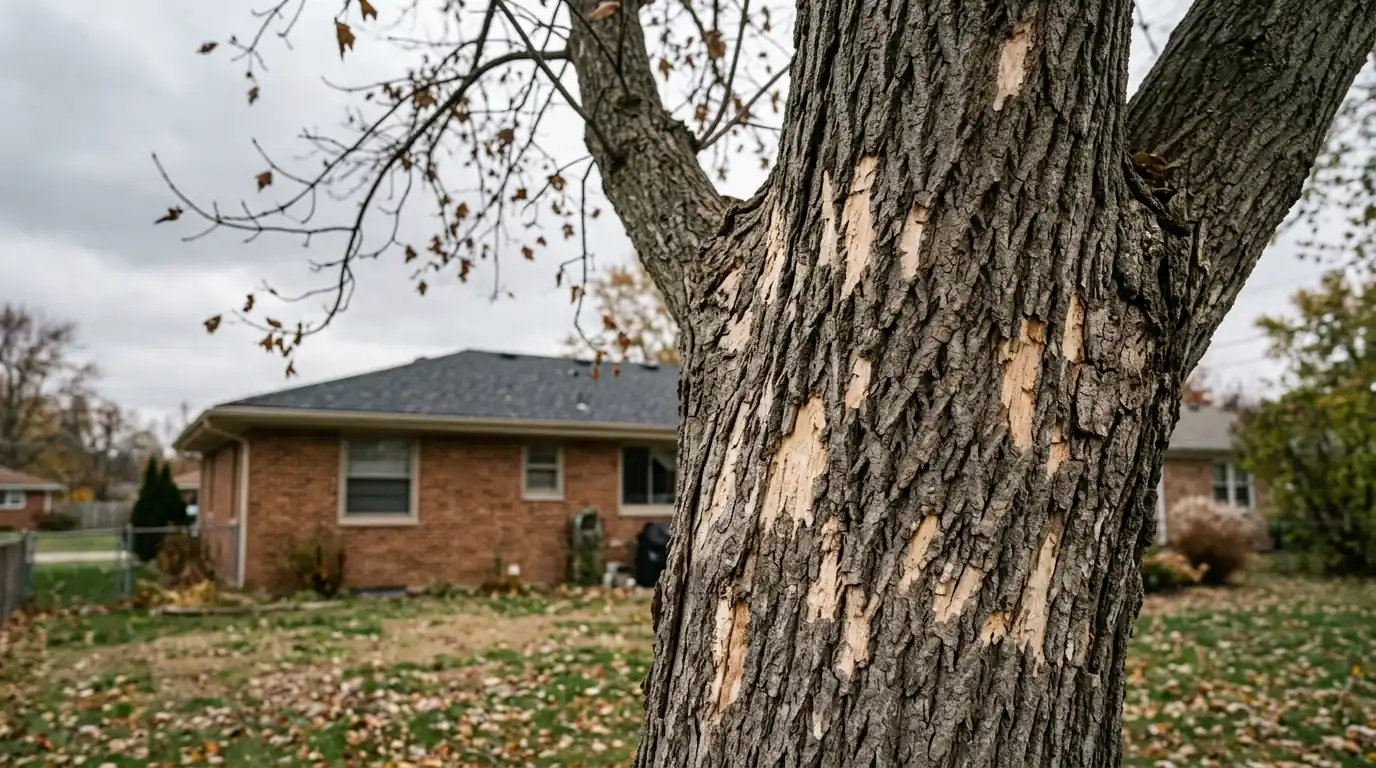
- Woodpecker flecking: birds chasing the larvae chip off the outer bark and leave pale tan patches on the trunk and limbs.
- D-shaped exit holes: small holes about an eighth of an inch across, flat on one side, where adult beetles chewed their way out.
- S-shaped galleries: winding tunnels packed with fine frass, visible wherever the bark has split or flaked away.
- Bark splits: narrow vertical cracks over the galleries as the bark loses its grip on the dead wood beneath it.
- Sprouts on the trunk: clusters of leafy shoots low on the trunk or at the base, a stress response as the crown fails.
Why treated ash live and untreated ash die
An ash with no protection has almost no defense against this insect. Our native ash didn't evolve alongside it, so once larvae are established the tree can't wall them off, and the feeding goes on year after year until the crown collapses. Untreated trees usually die within a few years of the first visible thinning.
A treated ash is a different story. A systemic insecticide moves up through the sapwood into the bark and leaves, and larvae that feed there die before they can girdle the tree. Treatment works most reliably as protection, applied to a tree that is still healthy or only lightly hit. A tree that has already lost a large share of its crown has too little living tissue left to carry the product where it needs to go.
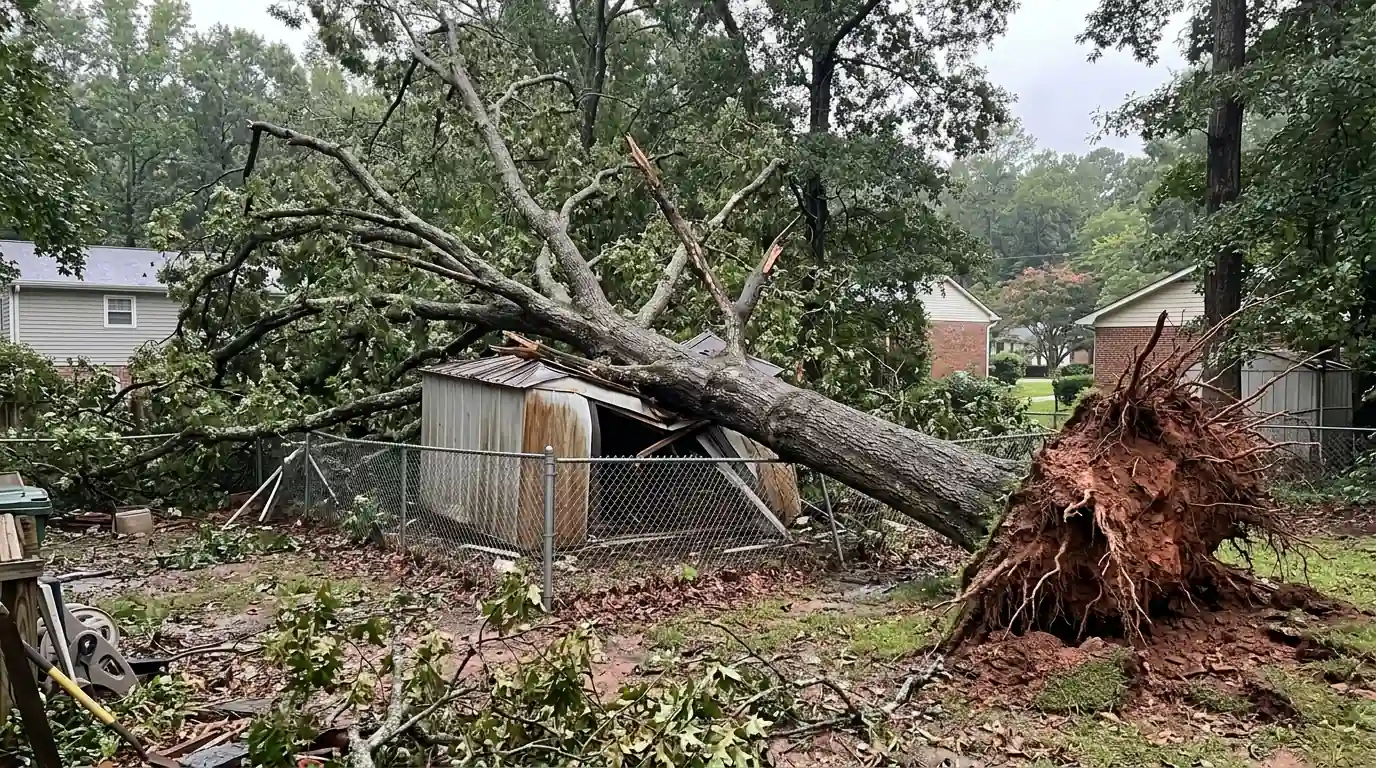
What happens after death matters just as much. Dead ash dries out fast and gets brittle, often within a year or two, and limbs snap off on calm days. That's why a dead ash near a house, a driveway or a street is a hazard tree, not just an eyesore.
How trunk injection works
Most of the ash we protect are treated by trunk injection. We drill small holes into the sapwood near the root flare, spaced evenly around the trunk, and meter the product in under low pressure. The tree's own water flow carries it into the crown. Nothing is sprayed into the air, so there's no drift onto vegetable beds, ponds or the yard next door.
Timing matters. We inject in spring, after the tree has leafed out and is moving water well, because a tree that is actively drinking takes the product up evenly. Depending on the product, treatment is repeated every one to three years for as long as you want to keep the tree. Our insect treatment program explains how we schedule ash work alongside pine beetles, scale and bagworms. We won't inject a tree too weak to respond.
Save or remove: how to decide
The decision usually comes down to four things about the tree and the yard around it.
Tree size and value
A large ash shading the house or the patio adds a lot to the property and would take decades to replace. A small ash crowded under oaks, or one that was never a feature, may not be worth years of treatment. Bigger trees also cost more to remove later, especially once they're dead and harder to work.
Current health
A tree that has lost less than about a third of its crown usually responds well. One with half or more of the crown thin or bare rarely comes back, and treating it tends to delay the removal rather than prevent it. A tree risk assessment gives you a clear read on the trunk, roots and crown before you commit either way.
Location and targets
An ash in the back woods with nothing under it can be left to decline if you accept that it will eventually come down on its own. An ash over the roof, the driveway, a play area or a power line can't. Once it starts dying, the clock is running on removing it while the wood still holds.
Cost over the years
Treatment is a recurring cost every one to three years for the life of the tree. Removal is a one-time cost, plus the stump and a replacement tree if you want one. Over ten or fifteen years, protecting a large, healthy ash in a prominent spot often makes sense. For a marginal tree, removing it and replanting with a different species usually makes more. We lay both paths side by side so you can see the trade.
Why a dead ash is dangerous to climb
Climbers judge wood by how it bends, and dead ash doesn't bend. It snaps. Limbs that look solid can break under a climber's weight or under the shock of a rope catching a lowered piece, and the trunk can fail at the tie-in point. That's why we don't put a climber in an ash that has been standing dead for more than a short time.
Instead, we work it from a bucket truck or take it apart with a crane, so no one's weight or rigging hangs on the dead wood. Our dead tree removal and hazard tree work are planned around exactly this kind of tree. For other species, our guide to the signs a tree is dying covers what to watch.
Inside Atlanta city limits, a dead, dying or hazardous ash still needs a permit from the Arborist Division, with no application fee, and the city inspects the tree to verify its condition. No replacement charge applies to a qualifying dead or hazardous tree. Our permit checker shows which rule covers your address.
Key takeaways
- Emerald ash borer has been in metro Atlanta since 2013 and is now confirmed across the core metro counties and Forsyth.
- An ash has opposite branching, compound leaves and, when mature, diamond-patterned bark.
- Thinning from the top, woodpecker flecking, D-shaped holes, S-shaped galleries and trunk sprouts are the main signs.
- A healthy or lightly hit ash can be protected with trunk injection every one to three years, while a badly thinned one rarely recovers.
- Dead ash turns brittle fast, so plan the removal early and keep climbers out of it once it has dried.