A screen that grows fast and fails young
Leyland cypress earned its place in Atlanta subdivisions for one reason: it grows several feet a year and closes a gap between houses faster than almost anything else. For the first ten or fifteen years a well-planted row looks great. Then the problems start, and they tend to arrive together.
The tree is a hybrid bred in the cool, damp climate of the British Isles. Long, hot Georgia summers, droughts that come between heavy rains, and dense red clay all put it under stress it wasn't built for. A stressed Leyland is an open door for the two canker fungi that kill most of the rows we see. The pattern is so common that a dead or dying screen is one of the main reasons we get called to a yard in Lawrenceville or Snellville.
The two cankers behind most dying rows
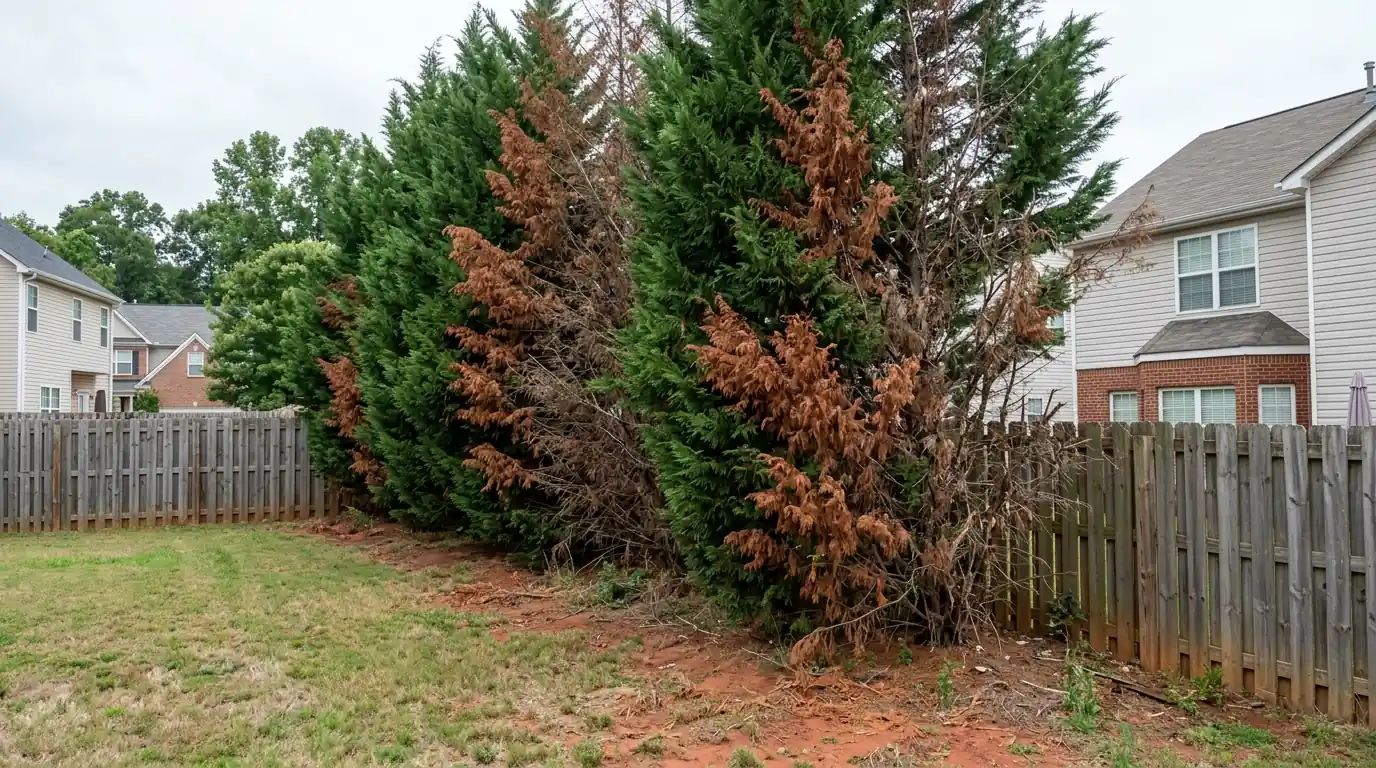
Both diseases are fungal, both enter through bark that is already stressed or wounded, and both kill limbs by girdling them. From the ground they can look alike: a branch or a whole section that turns from green to yellow to rust brown, often in late summer.
Seiridium canker
Seiridium shows up as sunken, dark or purplish patches on the bark of limbs and the main trunk, often weeping a lot of resin that dries into white or amber streaks. Limbs above a canker die back one at a time, which gives the tree a patchy, flagged look with brown branches scattered through green ones. When a canker girdles the main trunk, everything above it dies at once. Spores spread in rain splash, so a row planted shoulder to shoulder passes the disease from tree to tree.
Botryosphaeria canker
Botryosphaeria, which most people shorten to Bot canker, is the one most tied to drought. It attacks trees weakened by heat and dry soil, and limbs can brown out quickly once the fungus takes hold. The bark lesions are harder to see than with Seiridium, often a reddish discoloration with less resin, and the wood under the bark is stained brown. Bot canker shows up hardest in the summers after a dry spell, and it often kills the tree from the inside of the crown out.
Drought, heat and clay set the stage
Leyland cypress has a shallow, spreading root system, and in compacted Georgia clay those roots stay even shallower. In a wet spring the clay holds water and the roots sit in it. In a dry August the same clay bakes hard, sheds rain off the surface and leaves the roots with nothing. That swing between soaked and parched is what pushes a healthy-looking Leyland into canker.
Heat adds to it. A row along a south or west fence, backed by a wood fence or a driveway that reflects heat, dries out faster than one in light shade. We often see the same row healthy at one end and dying at the sunny end, which tells you the stress came first and the fungus followed.
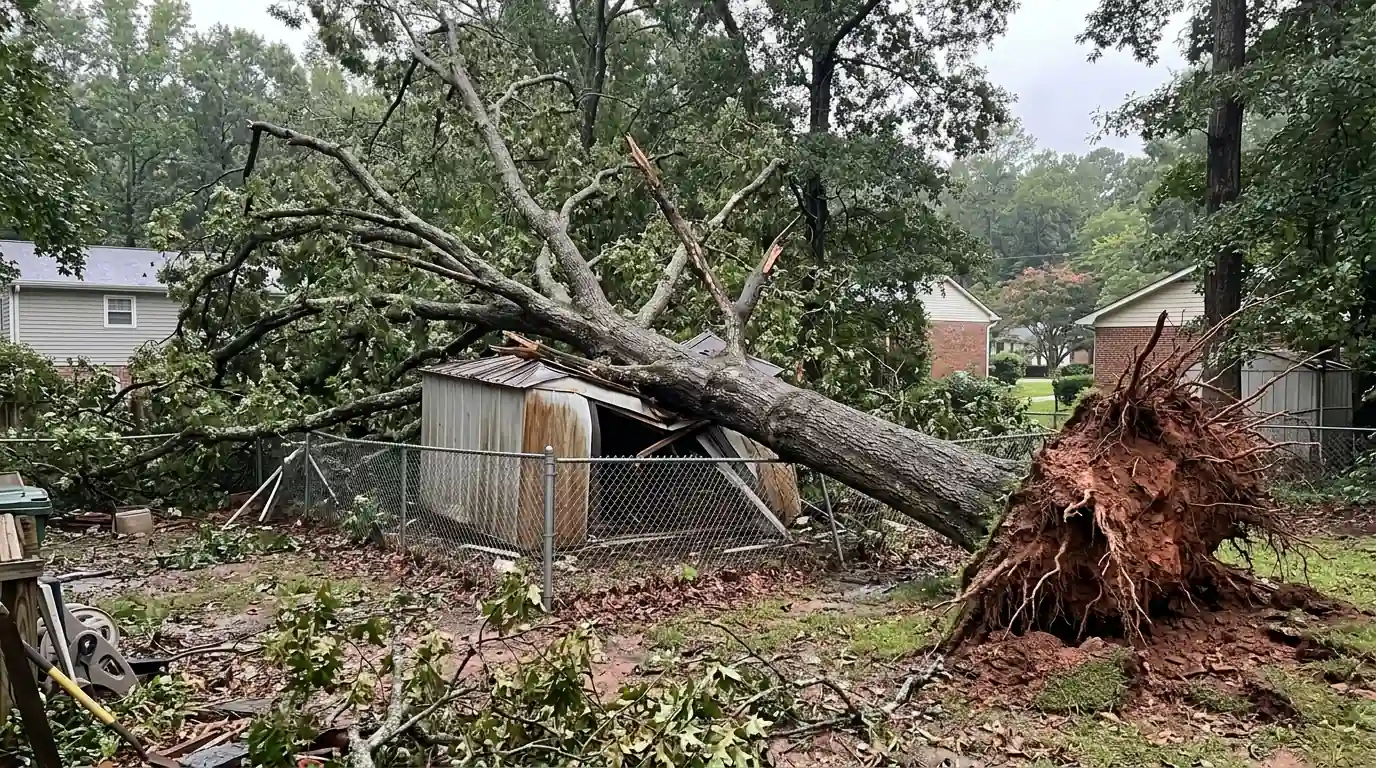
Shallow roots also mean poor anchorage. Older Leylands are top-heavy and dense, and in saturated clay after a long rain they can tip over at the root plate in a wind that leaves nearby hardwoods standing.
Planting mistakes that show up years later
Many of the rows we take out were doomed by decisions made the day they went in. The trees were small in the nursery pot and the goal was an instant screen, so they were set far too close together.
- Too close: a mature Leyland spreads 15 to 25 feet wide, but rows are often planted 4 to 6 feet apart, so the trees shade out each other's lower limbs and trade disease through constant contact.
- Too deep: a root flare buried under soil or a mound of mulch keeps the bark at the base wet, starves the roots of air and invites rot.
- Too near the fence: trees jammed against a property line have no room for air to move, and the side facing the fence browns and dies first.
- No water in year one: a Leyland that never got deep roots in its first summers stays drought sensitive for life.
- Shearing hard: cutting back into old brown wood leaves bare patches, because Leyland rarely sprouts new growth from wood without green foliage.
Bagworms: the insect side of the problem
Bagworms are caterpillars that build spindle-shaped bags out of silk and bits of foliage, and they hang from the branches like small brown ornaments. People often mistake them for cones. In early summer the young larvae feed hard on the needles, and a heavy population can strip a Leyland in a few weeks.
Unlike broadleaf trees, Leyland cypress can't push out a new set of leaves after being stripped. Branches that lose all their foliage stay bare. On a small tree you can pick the bags off by hand in fall or winter, before the eggs inside hatch. On a tall row, timed insect treatment in late spring, while the larvae are still small, is the practical answer.
What can be saved and what can't
A row with a few cankered limbs scattered through healthy trees can often be kept going for years. A row where the cankers have reached the main trunks, or where half the trees have already died, usually can't. The honest test is whether what's left will still screen the view once the dead wood is out.
Worth saving
Prune out cankered limbs well below the visible damage, back to healthy wood, and do it in dry weather so spores don't spread in rain. We disinfect our saws between trees on these jobs so we aren't carrying the fungus down the row. Water deeply in drought, about once a week, out at the edge of the branches rather than at the trunk, and keep mulch a hand's width off the bark. Disease management focuses on these steps, because no spray cures a canker that's already inside the wood.
Time to remove
A trunk canker means the whole tree above it is lost. A tree that is more than about half brown won't fill back in, because Leylands don't regrow from bare wood. And a dead tree left standing in a row keeps shedding spores onto its neighbors. Our Leyland removal crews take out the dead ones, and careful shaping of the survivors can help close the gaps for a while.
Better screen plants for Atlanta yards
The single biggest lesson from failed Leyland rows is not to plant a privacy screen of one species again. When every plant is the same, one disease or one insect can take the whole line. A mixed planting, staggered in two offset rows with room between plants, hides the view almost as well and survives a bad year far better.
Mixed hollies are a strong backbone: Nellie R. Stevens, Foster and other upright evergreen hollies handle clay and heat and take shearing well. Cryptomeria grows tall and narrow with soft foliage and has few serious pest problems here. Green Giant arborvitae grows nearly as fast as Leyland and has a much better disease record in the Southeast. Wax myrtle is a native that fills in quickly, likes heat and tolerates wet spots, though it can be short-lived in deep shade.
Plan for the mature width, not the pot size, and water every new plant through its first two summers. Grinding the old stumps first gives the new roots clean soil to grow into. Stump grinding and new tree planting are often booked as one visit so the row goes from dead to replanted in a single job.
Key takeaways
- Seiridium and Botryosphaeria cankers kill most Leyland cypress rows in Atlanta, and both attack trees that are already stressed.
- Swings between soaked and baked clay, summer heat and shallow roots set the stage for disease.
- Rows planted too close, too deep or against a fence are the ones that fail first.
- Cankered limbs can be pruned out in dry weather, but a trunk canker or a half-brown tree cannot be saved.
- Replace a failed row with a mixed screen of hollies, Cryptomeria, Green Giant arborvitae and wax myrtle so one disease cannot take it all.